Somewhere in your feed right now, a token is being called the next 1000x. Here is what the base rates say about that call before you spend a single dollar on it.
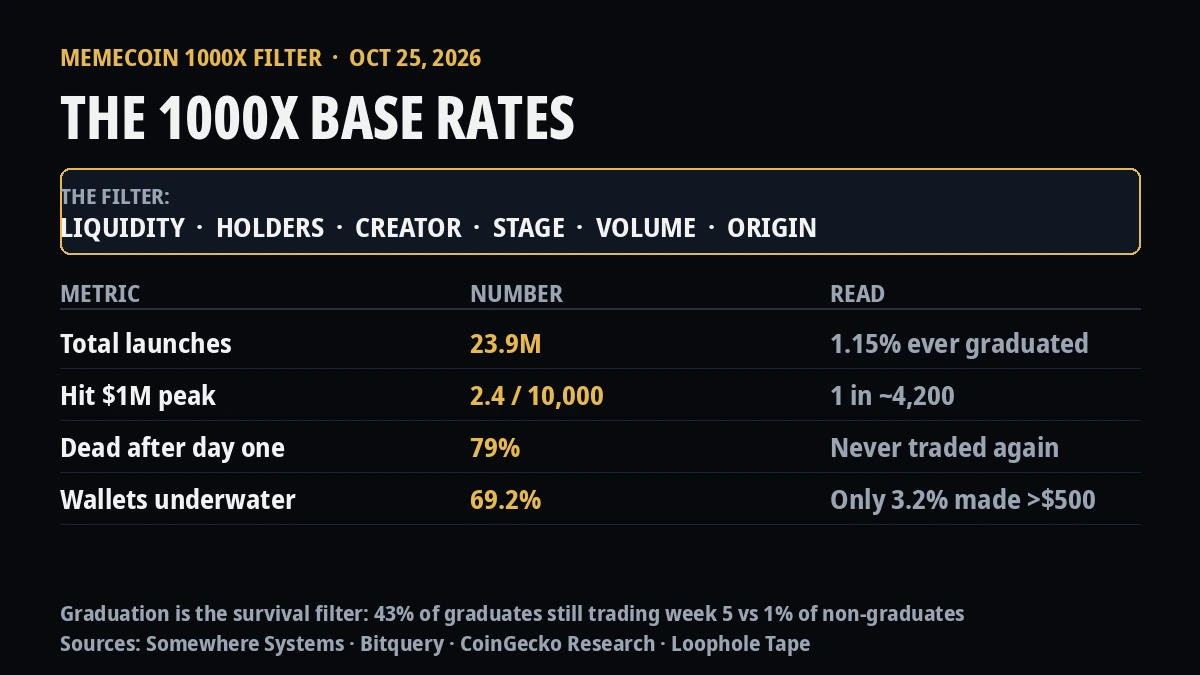
Pump.fun has hosted an estimated 23.9 million token launches. About 1.15 percent of them ever graduated to a real liquidity pool. Roughly 2.4 in every 10,000 — one in about 4,200 — ever touched a $1 million market cap, according to a Somewhere Systems study of launch data through October 2026. Bitquery’s separate count is blunter: 79 percent of Pump.fun tokens traded only on their launch day and never again. The median memecoin is not an investment that underperforms. It is a mayfly.
That does not mean nobody makes money. It means the game is filtering, not finding. The traders still standing after a year of this are not better at spotting winners — a study of winner traits found that none of the six characteristics shared by the largest tokens was even twice as common among them as among ordinary launches. They are better at rejecting losers, fast, with a checklist. Here is the checklist.
Question 1: Is the Liquidity Real — and Can It Leave?
The 1000x Base Rates: Graduation Probability and Survival Curves Across 23.9M Launches (CoinXSight Telemetry)
Liquidity is the exit door, and the first question is whether the door is locked open or can be slammed. On Pump.fun’s bonding curve, there is no pool to pull — but there is also no depth: your sell order moves the price against you on the same curve your buy pushed up. After graduation to PumpSwap, the launch LP tokens are burned, which is genuinely protective. On other launchpads and manual DEX listings, check whether LP tokens are burned or locked, for how long, and in whose wallet.
The walk-away signal: a token trading on a few thousand dollars of liquidity with a market cap quoted in the millions. That market cap is a multiplication, not a bank balance. If your position is more than 1–2 percent of the pool, you are the exit liquidity event.
Question 2: Who Holds It — Really?
Pull up the holder list before the chart. On Solscan or Birdeye, look at the top 10 wallets’ share of supply. Above roughly 20–30 percent in the top 10 (excluding the pool and burn addresses) means a small room of people can end the trade whenever they like.
Then look for the trick the raw list hides: bundling. Snipers and launch teams split holdings across dozens of fresh wallets so no single address looks large. A chain tracker rebuilding the week of October 12–18, 2026 counted 318,184 launches — and found 60.9 percent of that week’s graduations happened within two seconds of launch, a fingerprint of bundled buys rather than a crowd arriving. Fresh wallets funded from the same source, buying in the same block, are one holder wearing many masks. Tools that cluster related wallets are worth more than any influencer’s conviction.
Question 3: What Has the Creator Already Done?
The creator’s wallet is a public confession. Check three things: how many tokens this wallet has launched before, what happened to them, and whether the creator has already sold into this one.
The base rates here are ugly. In that same October week of launches, the tracker flagged 58.8 percent of classic launches as rug pulls within 300 seconds, and in 46.2 percent the creator had sold within the first minute. A creator who launches ten tokens a week is not building ten communities; they are running a mint. A creator who sold before graduation has told you exactly where they think the price is going. Believe them.
Question 4: Where Does It Trade — and Who Else Is in the Pool?
Stage matters. A token still on the bonding curve is a different animal from a graduated one: Bitquery found 43 percent of graduated tokens were still trading in their fifth week, versus 1 percent of those that never graduated. Graduation is the single strongest survival filter the data offers — roughly 1 in 58 launches in Bitquery’s window made it.
Also check who is providing the volume. Staged activity is cheap: DEXTools flagged about a quarter of new Pump.fun pools in one June snapshot as bot-like bursts of 20 or more trades in 15 minutes. Volume that arrives in identical sizes at metronome intervals is choreography, not demand.
The 5 Questions
Where to Check
Pass
Walk Away
1. Is liquidity real & locked?
DEXScreener, launchpad page
LP burned or long lock; pool deep vs your size
Thin pool, huge quoted mcap, unlocked LP
2. Who holds it?
Solscan, Birdeye holder tab
Top 10 under ~20–30%, no wallet clusters
Concentrated top 10; bundled fresh wallets
3. Creator’s record?
Creator wallet history on Solscan
First launches, still holding, no early dump
Serial launcher; sold within the first minutes
4. What stage & volume quality?
Bitquery/Dexscreener trade feed
Graduated; organic, varied trade sizes
Pre-graduation hype; bot-metronome volume
5. Where did it come from?
Launch timestamp, copycat count
Original ticker, verifiable origin
20 copycats of a viral moment; impersonator accounts
Question 5: Where Did This Token Actually Come From?
The final question is about origin. When a moment goes viral — a photo, a news clip, a celebrity post — copycats multiply instantly. Traders tracking one viral token this month counted 20 or more competing versions launched alongside the original, and the promotional account’s “best trade” ($200 into $34,000) belonged to whoever bought the real one at a $6,310 market cap, not to the thousands who bought the impostors. Verify the contract address against the source — the project’s official account, the launchpad’s verified page — never against a screenshot in a reply thread. Giveaway and impersonator accounts exist precisely to route you to the wrong contract in the 60 seconds when you are least careful.
The Filter Is the Strategy
Run the October numbers once more, because they reframe what “good at memecoins” means. In a recent 30-day wallet breakdown, about 69 percent of Pump.fun wallets lost money, most of them small amounts; only about 3.2 percent made more than $500. CoinGecko’s research found the share of profitable wallets bottomed at 30.1 percent in June 2025. The losses are rarely one catastrophic rug — they are death by a hundred unfiltered entries.
Five questions will not find you a 1000x. Nothing reliably does: launch-time features barely predicted even graduation in the data, let alone what a token did afterward. What the questions do is remove the categories that are structurally designed to take your money — the bundled launch, the serial creator, the unlocked pool, the copycat contract. In a market where 79 percent of products die on day one, survival is not a stock-picking skill. It is a refusal skill. The 1000x call can wait ninety seconds. The checklist cannot.
Disclaimer: This article is for informational and educational purposes only and does not constitute financial advice. Memecoins are extremely volatile, illiquid assets; most lose all value, and the statistics cited describe historical populations of tokens, not the prospects of any individual token. Never invest money you cannot afford to lose, and verify contract addresses through official sources before any transaction.