In Part 1 of this series, we mapped what is actually working in AI crypto trading and the security gap nobody prices in. In Part 2, we went inside the machines themselves — three tiers of automation, each deciding differently and failing differently. This installment is about the failure modes, because in crypto the downside of automation scales at exactly the same speed as the upside. The same properties that make machine trading powerful — speed, discipline, and the ability to execute at machine scale — are the properties that turn a bad afternoon into a systemic event. Three risks define the territory: the cascade, the correlation, and the tax.
When Bots Dump Together: Flash Crashes and Leverage
Liquidation Cascade and Systematic Leverage Flush (CoinXSight Telemetry)
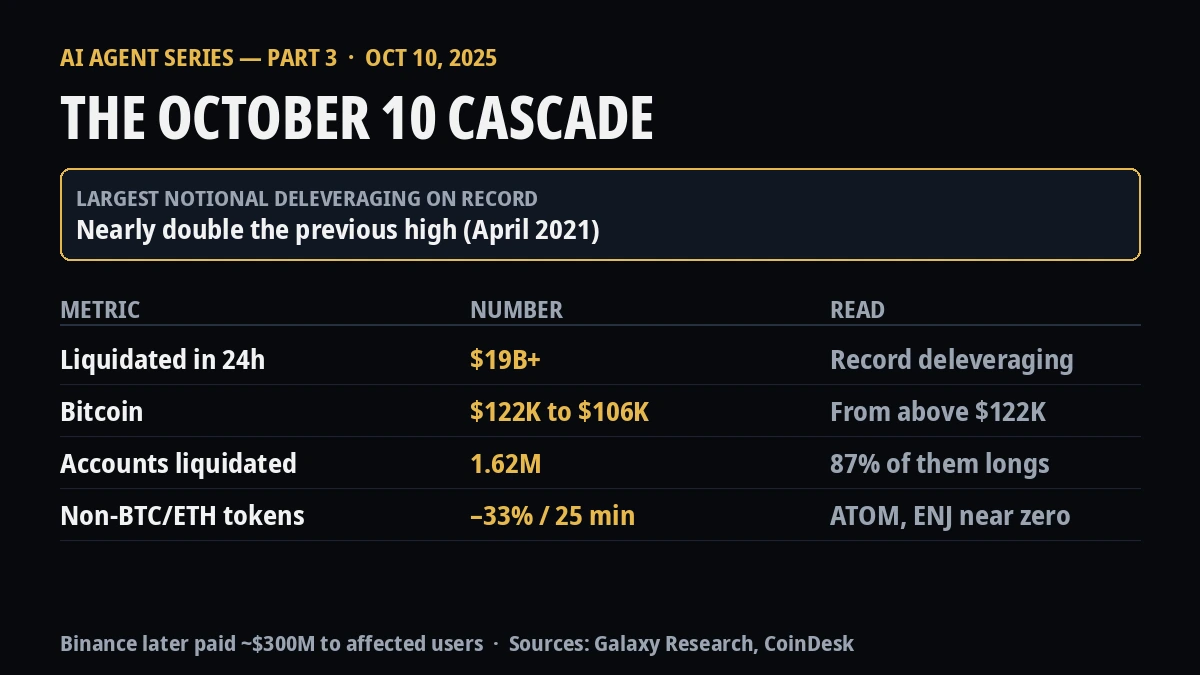
October 10, 2025 is now the reference point for what automation does to a market under stress. At 20:50 UTC, a tariff announcement on Truth Social detonated in an already overleveraged market. Over the next 24 hours, more than $19 billion in leveraged positions were liquidated — the largest notional deleveraging on record, nearly double the previous high set in April 2021. Bitcoin fell from above $122,000 to the low $106,000s. Tokens outside BTC and ETH dropped about 33% in 25 minutes. On Binance, ATOM and ENJ briefly traded near zero.
Read those numbers as mechanics, not just carnage. Roughly 1.62 million accounts were liquidated, 87% of them longs. Hyperliquid triggered auto-deleveraging — force-closing profitable shorts to keep the exchange solvent — for the first time in more than two years. Ethena’s USDe, a yield-bearing token treated like cash collateral by leverage loops, depegged to $0.65 on Binance while trading at par on most other venues, because one venue’s margin engine was mid-migration to redemption-value pricing and the change had not landed in time. Binance later paid out around $300 million to affected users.
The machines did not cause the shock. They amplified the cascade. A liquidation engine is an automated seller with no judgment: when collateral value crosses the threshold, it sells into whatever book exists. In thin liquidity, that sale moves the price, which trips the next threshold, which sells into an even thinner book. The feedback loop is pure machinery — and it is why the steepest declines of the October 10 crash happened inside a 25-minute window rather than across the full news cycle. The news took hours to absorb. The machines took minutes.
This is the baseline risk of automated trading, and it predates anything that calls itself an AI agent. Any system that sells without a human in the loop becomes, under stress, a synchronized seller. The difference AI adds is correlation of decisions, not just correlation of positions. Which is the next section’s subject.
47 Seconds of Chaos: When 23 Agents Decide at Once
The 47-Second Decisional Convergence Across 23 AI Agent Nodes (CoinXSight Telemetry)
Leverage cascades are about positions. The newer risk is about minds.
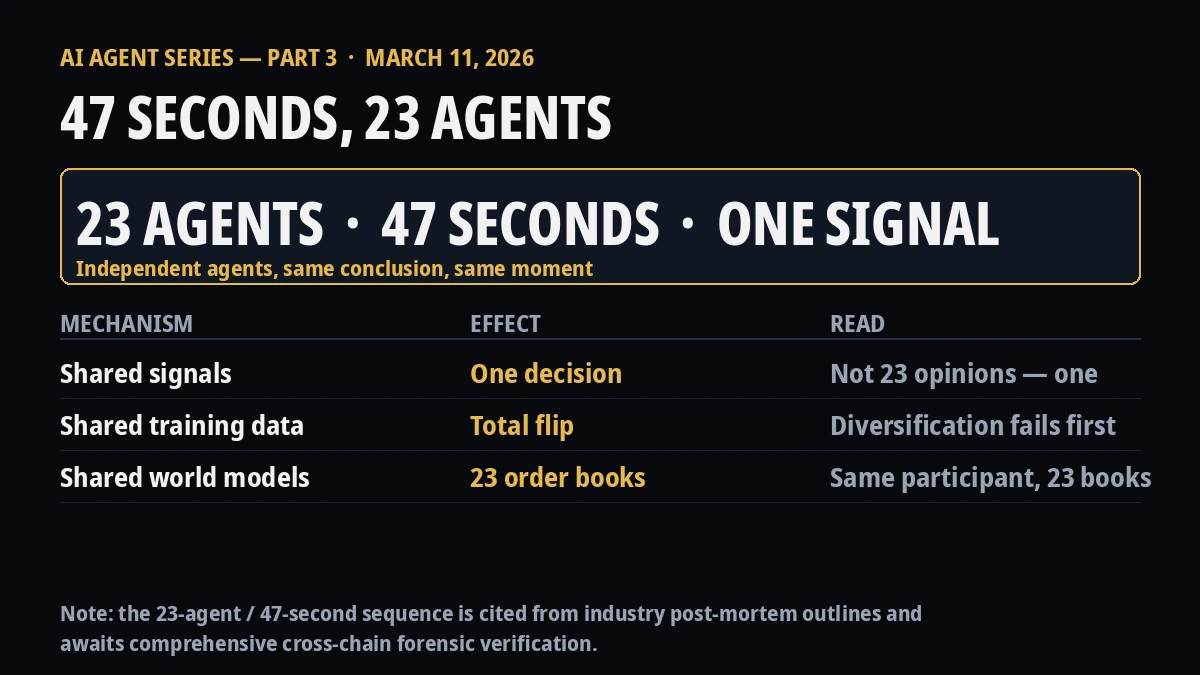
On March 11, 2026, a single market signal — one macro headline, one anomaly, one trigger depending on which post-mortem you read — caused 23 AI trading agents to react within 47 seconds. (Editor’s Note: While the broader cascade dynamics are widely documented across high-frequency crypto trading venues, the specific 23-agent / 47-second sequence is cited from industry post-mortem outlines and awaits comprehensive cross-chain forensic verification.) Each agent, operating independently, reached the same conclusion at the same moment. The combined selling amplified a move that no single agent’s book would have justified on its own. The volatility was not the market discovering a price. It was the market discovering that 23 of its participants had become the same participant.
This is correlated agent behavior, and it is the structural consequence of everything Part 2 described. Tier 2 systems calibrate against the same indicator suites and the same sentiment feeds; Tier 3 agents train on the same data distributions and read the same 400-odd signal sources. When the inputs converge, the outputs converge. A room full of “independent” agents with overlapping training data and overlapping signals is not 23 independent opinions. It is one opinion with 23 order books behind it.
Traditional markets have seen this movie with simpler actors. The 2010 stock-market flash crash was driven substantially by algorithmic strategies reacting to the same conditions in the same direction. What changed is the sophistication of the sameness: modern agents do not just share a stop-loss rule; they share a world model. When that model flips, the flip is total and simultaneous. Diversification of strategies — the assumption every risk model in the room quietly depends on — becomes the first casualty.
The uncomfortable implication is that agent diversity is a public good nobody provides. Each new agent deployed is trained to be smart, not to be different. Until agent monitoring treats behavioral correlation as a first-class risk metric, the 47-second event will recur — each time with more agents, larger books, and thinner patience between them.
Risk
Trigger
Who gets hurt
Shield
Liquidation cascade
Macro shock into overleveraged books; automated sellers with no judgment
Leveraged longs first, then everything adjacent to thin books
Public mempools let bots read pending trades and trade against them
Retail swappers most of all — the tax is invisible and constant
Encrypted mempools, private order flow — new, optional, promising
MEV: The Hidden Tax on Every Trade
Maximal Extractable Value (MEV) Interception and Sandwich Extraction Vectors (CoinXSight Telemetry)
Not every automated risk arrives as a crash. The quietest one is a tax, collected trade by trade, from people who never know they paid.
A sandwich attack is simple in outline. A bot watches the public mempool, spots your pending swap, buys the same asset first to push the price up, lets your trade execute at the worse price, then sells into the elevation. Your swap completes. You get fewer tokens than the quote suggested. The loss lands entirely in execution, which is why almost no victim ever notices.
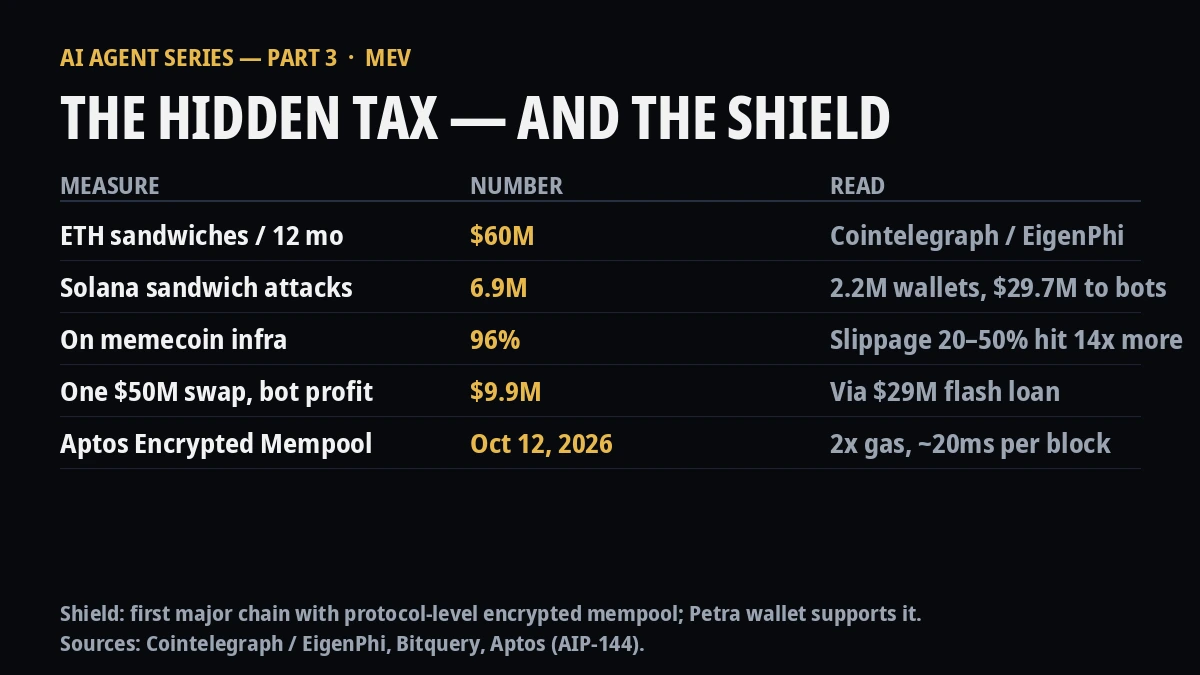
The scale is no longer debatable. On Ethereum, Cointelegraph’s analysis of EigenPhi data estimated sandwich attacks extracted roughly $60 million from traders in the twelve months through October 2025. On Solana, Bitquery counted 6.9 million sandwich attacks over eleven months (October 2025 to October 2026), affecting 2.2 million wallets and generating $29.7 million for bots before costs. Ninety-six percent of those attacks landed on memecoin infrastructure — Pump.fun’s launch curve and PumpSwap — and the single strongest predictor of being sandwiched was slippage tolerance: trades allowing 20%–50% slippage were hit fourteen times as often as those allowing under 3%.
Fast agents are not immune to any of this. The Bitquery data shows other bots’ trades accounted for roughly 37–39% of the gross take — the machines eat each other too. And the edge cases are grotesque: one recent transaction saw a trader attempt a $50 million USDT-to-AAVE swap, only for an MEV bot to spot the pending transaction, secure a $29 million flash loan, sandwich the trade across two venues, and walk away with $9.9 million in profit while the victim received a few hundred tokens worth a fraction of the intended amount. When the victim is that large and that public, the story makes headlines. The millions of small sandwiches never do.
The implication for AI trading is direct. An agent executing systematic strategies on-chain is a repeatable target: same wallets, same patterns, same timing. Bots do not need to be smarter than the agent. They need only to read its intentions before execution, which is exactly what a public mempool invites.
Encrypted Mempools and Technical Shields
On October 12, 2026, Aptos switched on an Encrypted Mempool on mainnet — the first major blockchain to build this protection directly into the protocol rather than bolting it on. The mechanism is straightforward: a compatible wallet encrypts the transaction’s contents on the user’s device before submission. Validators agree on transaction ordering while blind to what each transaction actually does — assets, amounts, contract functions called all stay hidden. Only after ordering is finalized do validators collectively decrypt and execute, and no single validator, nor any group below the two-thirds stake threshold, can peek early.
The costs are modest and measurable: encrypted transactions pay twice the base minimum gas price, and Aptos’s 50-node benchmarks showed roughly 20 milliseconds of added latency per block. The code passed an independent security review by zkSecurity. Petra wallet already supports the feature, and Aptos-based perps exchange Decibel plans to use it to protect order privacy.
What matters for this series is who Aptos says the feature is for: institutions submitting large transactions, traders avoiding MEV risk, builders — and explicitly, AI agents. An autonomous agent running a systematic on-chain strategy is precisely the kind of participant that benefits from hiding intent until execution, because its strategies are the most legible to watching bots. The shield is opt-in, per transaction, which means adoption is the real question — but the precedent is set. Expect every chain where AI agents trade to face the same demand, and every chain without an answer to keep paying the tax.
Playing With AI: A Cambridge-Style Safety Framework
Technology gives shields. Governance decides who carries them. The most serious thinking on AI trading risk — the kind associated with Cambridge’s risk-research community — converges on three pillars, and they map cleanly onto everything above.
Autonomy limits. Define, in advance, what an agent may decide without human sign-off. Position sizes, venue selection, strategy changes — the autonomy envelope should be explicit and enforced in code, not in documentation. The 23-agent event is the argument: no single agent was reckless; the system was, because no boundary constrained the correlated decision.
Circuit breakers. Markets have them for humans; agents need them at their own speed. A breaker that trips at human timescales is decorative when the cascade takes 47 seconds. Useful breakers live at three levels: the strategy (stop this agent), the portfolio (stop all my agents), and the venue (stop everyone). Paradex’s emergency rollback after its $0-Bitcoin database glitch — hours of chain history erased to undo mass liquidations — was, in effect, a manual circuit breaker deployed in desperation. The industry should prefer breakers that exist before they are needed.
Collective behavior monitoring. This is the missing piece. Nobody watches whether independent agents are behaving independently. A venue that tracks correlation of agent decisions — entry timing, direction clustering, signal-source overlap — could see the 47-second event forming before it fires. Regulators monitor market-wide concentration in TradFi; crypto venues currently monitor almost nothing at the agent layer. The data exists. The will does not, yet.
The hard question underneath all three pillars is who sets the limits when markets never close. Traditional circuit breakers are imposed by exchanges and regulators — central authorities with enforcement power. Crypto’s venues are fragmented, its agents permissionless, its participants global. A safety framework that depends on everyone opting in will be adopted last by exactly the actors who need it most. That tension — between the permissionless ethos that built this market and the governance the market’s machinery now requires — is where the real fight of the next cycle will be fought.
That fight will play out on the frameworks agents are built on. The next installment goes inside Virtuals and ElizaOS, the two agent stacks that matter most, and asks what their token models actually pay for — and who the money serves when the agent works and the token does not.
Disclaimer: This article is for informational purposes only and does not constitute financial advice. Cryptocurrency trading involves substantial risk of loss, including the possible loss of principal. AI trading systems, leveraged products, and agent tokens carry additional risks including software errors, model failures, liquidation cascades, MEV extraction, extreme volatility, and total loss of value. Past performance of any bot, agent, or strategy does not guarantee future results. Always do your own research before making investment decisions. Data: Galaxy Research and CoinDesk (October 10, 2025 liquidation event), Bitquery (Solana sandwich attacks), Cointelegraph/EigenPhi (Ethereum MEV), Aptos (Encrypted Mempool, AIP-144).
CX
CoinXSight Alpha Desk
ALPHA // DESK
Quantitative Research Desk·Global Alpha Division
CoinXSight Institutional Research Desk produces quantitative crypto market intelligence, algorithmic models, and on-chain forensics.
QUANTITATIVE SUITE // DEEP ALPHA ENGINEACTIVE
BTC/USDT // LIVE SCANNER
CONFLUENCE 74
LIVE SPOT PRICE$82,807.47WEAK_BUY
TP2
$89,522.75
+9.07%
TP1
$85,056.42
+3.63%
ENTRY
$82,078.86
ZONE
SL
$80,590.09
-1.81%
Auto-detect Order Blocks, Fair Value Gaps and risk-adjusted DCA ladders in < 5s.