Crypto Weekly: Bitcoin Lost $75,000 at the Weekly Close — Now CPI Decides
Bitcoin held $75,000 through a week of a divided Congress, a 5.5% Nasdaq rout, a $1.28 billion ETF exodus and a jobs report that beat every forecast — then lost it in the final hours of Sunday, closing the week at $74,738. Now Tuesday's CPI decides what the break was worth.
CX
CoinXSight Alpha DeskQuantitative Research Desk·Nov 9, 2026 · Updated Nov 10
The week that ends tonight was supposed to be about one thing: whether America still has a functioning Congress and what that means for crypto. By Friday it was about something else entirely — a jobs report that beat every forecast on Wall Street by a factor of three, a stock-market rout that wiped out months of gains in a single session, and a bitcoin price that held $75,000 through Friday, Saturday and most of Sunday — then lost it in the final three hours, while the largest ETF in the category was being used as an exit door five days in a row. This is the week, start to finish, and the one question it leaves behind: what Tuesday’s inflation print does with a market whose floor just gave way.
Start with the scoreboard — this week was too crowded for a single narrative. Bitcoin opened the week near $78,232 and closed it at $74,738 — down about 4.5% on the week, the fifth consecutive losing week and the worst of the five. Ethereum closed Sunday at $2,124, down about 5% on the day after touching $2,071. The Nasdaq fell 3.3% for the week, most of it in a single Thursday session. U.S. spot bitcoin ETFs lost $1.28 billion in five sessions. And through almost all of it, $75,000 held: pierced once on Friday to $74,888 and reclaimed within hours, defended again through Saturday and most of Sunday — until the 21:00 UTC hour, when it fell through $75,000, touched $73,444, and closed the week below the level it had spent six days defending. That break, not the hold, is the week’s clean fact. Everything else is argument.
The election settled, and nothing settled with it
The week opened with the midterm elections, and the result, as called by the Associated Press, was a divided Congress: Democrats took the House, 223 seats called to 138 for Republicans and 74 still uncalled, while the Democratic bloc held 54 seats in the Senate to 44 for Republicans. The new Congress does not sit until January 3, 2027, so no law changed hands this week — worth saying plainly, because the market spent Tuesday night trading as if one had.
Bitcoin’s reaction was a V-shape in miniature: it slid toward $75,736 overnight as results came in, then recovered to roughly $78,300 to $78,460 by Wednesday morning. The shape tells you what the market actually believed: a Democratic House means tighter scrutiny of AI and data centers — a story about equities — while crypto’s own legislation, the CLARITY Act’s path through the Senate, is a lame-duck question, not a Tuesday-night one. A divided Congress neither kills CLARITY nor passes it — its fate depends on a session that has not happened yet. Anyone who wrote this week as the week crypto regulation was decided was writing about a different election.
A week of data that refused to agree
If the election was noise, the data calendar was the week’s real spine, and it refused to tell a single story. October’s ISM Manufacturing index came in at 55.5, with prices paid at 75.2 — factories busy and paying more for everything. September’s JOLTS report showed 7.523 million job openings, up 333,000 and well above the 7.1 million forecast, with the quits rate back above 2% for the first time since June 2025. October’s ADP payrolls printed 86,000, a beat on the surface — except September was revised down to exactly 86,000, which means the labor market was standing still.
Then October’s ISM Services index landed at 54.5, a miss against a 54.7 to 54.8 consensus and down from 54.9 in September, but with employment rising to 51.4 and prices paid stuck at 73.0 — the seventh reading above 70 in eight months. Read together, the honest summary is that the economy is neither booming nor breaking: hiring is warm, services are cooling at the edges, and the prices businesses actually pay have not stopped rising. That is a mixed tape — the worst kind for a market that wants a clean excuse to move in one direction. It got one anyway, on Thursday night, from somewhere else entirely.
Thursday night: the rout
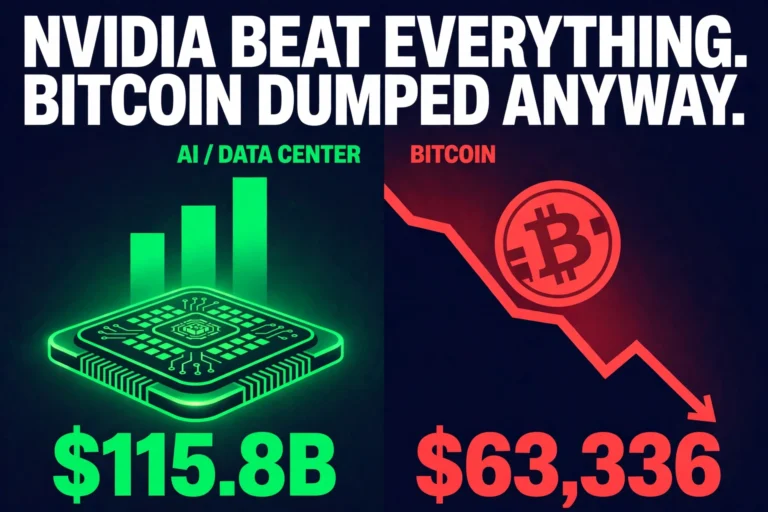
The sell-off that defined the week did not start with a data print. It started with a story traders told each other on Thursday: that a Democratic House would move faster to regulate artificial intelligence and the data centers that power it, that Qualcomm’s outlook was weak, and that the chip trade — the engine of the year’s rally — had run too far, too fast. The S&P 500 fell 4.35% in a single session, the Nasdaq 5.52%, the Philadelphia Semiconductor Index 12.25%, and the Nasdaq 100’s 6.36% drop was its worst since 2020.
Bitcoin went with it, and then some. From above $80,500 it fell to a low of $75,208, erasing almost the entire post-election recovery in hours. The derivatives market did the rest: roughly $1.03 billion to $1.27 billion in crypto positions were liquidated over 24 hours, about 88% to 90% of them longs, with bitcoin alone accounting for around $325 million by one count. That wave belongs to Thursday and Friday — the number will keep appearing in headlines all week attached to the wrong day. It was a forced unwind, the kind that happens when a crowded long trade meets a gap down and every stop in the book fires at once. It was not a verdict on bitcoin. It was a verdict on leverage.
Friday: a jobs report that beat everyone and saved no one
Friday morning brought the print the whole week had been building toward, and it beat every forecast on the street. October payrolls rose 165,000 — nearly three times the 55,000 to 65,000 consensus range, above even Goldman Sachs’s upside tail of 75,000 — with 84,000 jobs of upward revisions, September revised up to 60,000 from 29,000 and August to 186,000. Unemployment ticked down to 4.1%. Private payrolls rose 159,000. Wages rose 0.4% month-on-month and 3.1% year-on-year. The University of Michigan’s preliminary November sentiment read 51.0, up from 48.0, with one-year inflation expectations falling to 4.3% from 4.7% — though that survey ran October 20 to November 2, before Thursday’s rout, and should be read with that caveat attached.
A jobs report that strong should have been a relief. It was not, at least not for crypto: stocks bounced narrowly — S&P +0.31% to 7,376.86, Nasdaq +1.09% to 24,579.42, VIX down 9.23% to 25.58 — but bitcoin could not retake $76,000. It pierced $75,000 in the session, printed a low of $74,888, the weakest since August 21, and reclaimed the level by the close. The reclaim held through Saturday and most of Sunday. It did not hold the week. The relief rally, in other words, was a stock-market event that bitcoin watched from the sidelines. The reason is not complicated: a hot labor market is good news for the economy and bad news for anyone hoping the Fed is done raising rates. A December hike, priced at roughly 74% to 78% depending on the venue by the weekend, is the market’s best guess at what the Fed does with a jobs report like this one. Bitcoin spent Friday finding out that good economic news is not always good crypto news.
The paradox: record outflows, then the floor broke
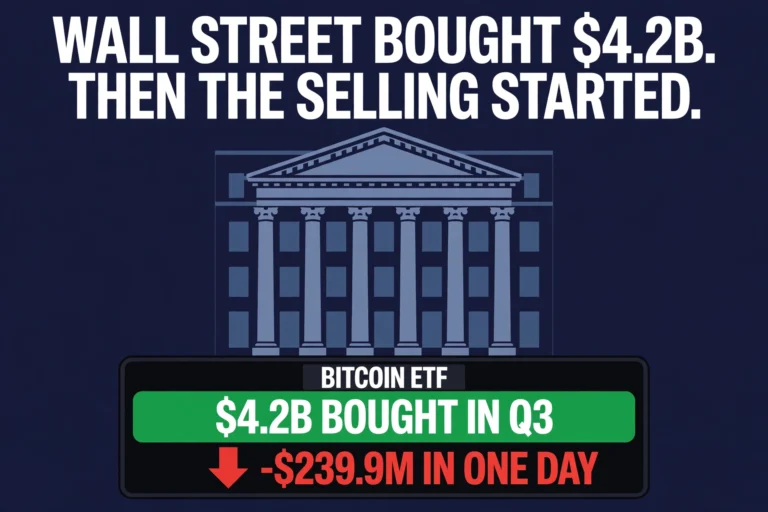
The strangest fact of the week is not a price. It is a contradiction — and the reason this weekly exists instead of a recap. U.S. spot bitcoin ETFs lost about $1.28 billion in the five sessions from November 2 to November 6, according to Farside Investors — the worst week since late June — and flows for 2026 as a whole have now turned negative. Friday alone took $411.9 million, almost all of it BlackRock’s IBIT, down $403 million in a single session; Fidelity’s FBTC went the other way, taking in $42.8 million. Thursday took $430.2 million. Ether funds lost about $93 million on Friday and $365.2 million for the week.
And yet, for five days, the price did not make a new low. Bitcoin held $75,000 through a Friday that included the largest single-session IBIT outflow of the stretch, and the hold survived Saturday and most of Sunday. That was the paradox in one frame: the largest fund in the category being used as the exit door five sessions in a row, and the market absorbing it at $75,000. The paradox lasted until the final three hours of the week. In the 21:00 UTC hour on Sunday, bitcoin broke through $75,000, fell to $73,444 — a new low for the week and the lowest since August 21 — and closed at $74,738. The headwind, it turns out, was not something the market could wait out indefinitely. It was something that won the week in the last hour.
Two caveats before anyone turns the paradox into a thesis. First, ETF flows measure fund subscriptions and redemptions, not direct selling on exchanges, and they do not identify who is redeeming or why. Second, the week’s outflows are less than 1% of total spot bitcoin ETF assets. But the direction is what matters, not the size: five straight sessions of redemptions from the category’s biggest fund is not noise. Something was buying — or, more precisely, something had stopped selling at these levels — until Sunday night, when whatever was absorbing the flow stepped back. The headwind is real, and it is not capitulation. But a headwind that breaks the floor in the final hour of the week is a different fact from a headwind the price absorbs, and Tuesday’s CPI now has to answer for it.
The week in numbers
What
Print
What it meant
House (AP called)
Dem 223 / Rep 138, 74 uncalled
Divided Congress; new session sits 03/01/2027
ISM Manufacturing Oct
55.5; prices paid 75.2
Factories busy, input costs still hot
JOLTS Sep
7.523M openings; quits 2.1%
Labor market warm, not booming
ISM Services Oct
54.5 (miss); employment 51.4, prices 73.0
Mixed tape — cooling edges, sticky prices
BoE, 05/11
+25bp to 4.00%, vote 8–1
Hawkish hike; Mann alone wanted +50bp
Jobless claims
189K — lowest since 1969
No layoff wave anywhere in the data
Payrolls Oct
+165K vs 55–65K consensus; 4.1% jobless
Beat every forecast; kept hike odds high
BTC spot ETF flows, week
−$1.28B; YTD 2026 now negative
Worst week since late June; price broke at the close
BTC weekly
$74,738 close (Kraken); −4.5%; low $73,444
Fifth straight losing week; closed below $75,000 and the 50-week MA
The quiet fix nobody traded
One real piece of crypto news happened this week and almost nobody traded it — probably the correct response. The XRPL’s fixCleanup amendment — fixCleanup3_4_0 — activated at 21:52 Vietnam time on Wednesday, November 4, at ledger 108,112,129. It is a technical patch to the ledger’s cleanup logic, not a product launch, and the two amendments that would enable native lending on the XRP Ledger, LendingProtocol and SingleAssetVault, remain below the support threshold. There is no native lending on XRPL this week, and there will not be until those votes clear. The activation matters the way infrastructure matters: quietly, for the people building on it.
The Bank of England’s decision on Thursday deserves a line of its own, because the vote was the story: rates up 25 basis points to 4.00%, its first hike since August 2023, on an 8–1 vote — the single dissenter, Catherine Mann, wanted 50 basis points, not a hold. Nobody voted to stand pat. That is a hawkish surprise dressed as a consensus decision, landing the same day as jobless claims of 189,000 — the lowest since 1969 — and third-quarter productivity growth of 3.6% with unit labor costs down 0.7%. The world’s central banks are not moving together anymore: the Bank of England is hiking into a strong labor market while the Fed must decide whether a hot jobs report is a reason to hike or to wait. and that divergence is the backdrop to everything bitcoin does next week.
The Treasury just cut MEXC off from the American banking system
The largest regulatory story of the week arrived on Friday, and it did not move the price — which is itself the point. On November 6, the US Treasury’s Financial Crimes Enforcement Network (FinCEN) issued an order designating MEXC Global a “primary money laundering concern in connection with Russian illicit finance” under Section 9714(a) of the Combating Russian Money Laundering Act. Once the order takes effect — 30 days after publication in the Federal Register — US financial institutions will be barred from sending or receiving funds, including crypto transfers, to or from MEXC.
The numbers FinCEN alleges are large enough to matter even discounted for the fact that they are allegations, not findings. Between May 2021 and May 2026, MEXC allegedly facilitated at least $16 billion in illicit transactions connected to sanctions evasion, cybercrime and other illegal activity. Of that, nearly $1.5 billion is tied to Russian sanctions evasion, including transactions with the sanctioned exchange Garantex and its successor Grinex as recently as June 2026. About $1 billion moved in direct transactions with more than 40 identified Iranian crypto exchanges, and about $22 million is linked to Iran’s central bank and the IRGC’s Qods Force. The action sits inside Operation Economic Outcast, the Treasury’s campaign to cut Iran off from global finance, and MEXC is the largest exchange ever hit under Section 9714.
Three things to get right about what this is not. It is not an OFAC sanctions designation, it does not freeze customer assets, and it is not effective yet — the 30-day clock has not started. MEXC says it is operating normally and reviewing the order. The practical read is slower and more structural than a headline: Washington is now willing to sever a major offshore venue’s dollar rails entirely, and every other exchange with a sanctions-exposed book just got a reason to audit its own flows before someone else does it for them.
Sources: CoinDesk and Bitcoin Magazine, both citing the US Treasury / FinCEN press release of November 6, 2026.
Russia opened the door — barely
The same week Washington closed one door, Moscow opened another, by a crack. On November 6, the Bank of Russia published a directive, signed by governor Elvira Nabiullina under Federal Law No. 282-FZ, naming the only three crypto assets ordinary investors may buy on regulated domestic exchanges: bitcoin, ether and Tether’s USDT. The rules take effect on November 17. Non-qualified (retail) investors may buy up to 300,000 rubles per intermediary per calendar year — roughly $3,650 at the central bank’s rate — and only after passing a mandatory knowledge test and reading a risk notice. Qualified investors face no cap and may buy any crypto asset. The Moscow Exchange plans pilot trading from December 1.
The cap is the story. A full year of permitted buying amounts to less than a twentieth of one bitcoin at current prices — about $304 a month. The directive caps purchases, not holdings, and it counts per intermediary, but no honest reading turns this into a retail on-ramp of any scale. What it is, is a direction change: a central bank that once treated crypto as a threat has now written the first formal, legal channel for ordinary citizens to own it, chosen on market capitalisation, daily volume and at least five years of price history. The rest of the framework underlines how controlled the opening is: crypto still cannot be used to pay for goods and services inside Russia, and direct peer-to-peer transactions between individuals will be banned from July 1, 2027.
Read the two stories together and the week looks less like a regulatory crackdown or a thaw than a sorting. The US is cutting off the venues it cannot see into; Russia is admitting the assets it can measure, in amounts too small to matter, through channels it controls. Neither move changes bitcoin’s price this week. Both change who gets to touch it, and on whose terms.
Sources: FinanceFeeds and VASP Tracker, both citing the Bank of Russia directive of November 6, 2026 (Indication No. 7441-U).
What the weekly close decides
The weekly candle is settled, and it answered the weekend’s question — in the bears’ favor. Bitcoin closed the week at $74,738 on Kraken, down about 4.5% from Monday’s open near $78,232: the fifth consecutive losing week, and the worst of the five — the previous four lost 2.0% to 3.3% each. The close sits below the $75,500 flip, the 50-week moving average near $75,500, and Strategy’s cost basis near $75,451. Every line the weekend was defending gave way in the same three hours.
The break came late and fast. Bitcoin spent Sunday between $75,545 and $76,096, quiet as the whole weekend had been, until the 21:00 UTC hour, when it fell through $75,000 to $73,444, the lowest since August 21. A bounce in the final hour reached $75,623 and faded. Ethereum fell with it, closing Sunday at $2,124, down about 5% on the day after touching $2,071. There was no headline to blame: no US data, no Fed speaker, no exchange news in the window. In thin weekend liquidity, the level simply gave way.
What the close cannot say is unchanged: it cannot tell you what Tuesday’s CPI will print, what Goolsbee will say on Monday night, or whether the ETF redemptions reverse. What it can say is narrower — the buyers who defended $75,000 all week were not there when the week was scored, and the CPI week starts with the bears holding the better hand. The next supports are $74,250, where the lower liquidation wall sits, and then $73,200, the 200-day moving average. Monday morning bitcoin was trading near $74,500 to $74,700, still below $75,000 with no recovery yet, and Fear & Greed read 29. A reclaim of $75,500 before Tuesday would change the read; until then, the break stands.
The week ahead: China, Goolsbee, and Tuesday
Monday started with data before most of Vietnam had breakfast: China’s October CPI came in at +0.7% year-on-year, below the +0.8% forecast and down from +0.9% in September, while PPI jumped to +5.7%, above the +5.3% forecast and up from +5.0%. The split widened — consumer demand still weak, industrial input prices still hot. Neither number will move bitcoin on its own. Then, at 22:00 Monday night, Chicago Fed President Austan Goolsbee speaks — the first Fed official to comment in public since Friday’s payrolls beat — with Barkin and Bowman also on the schedule.
Tuesday is the print the whole week is built around: October consumer prices arrive at 20:30 Vietnam time, the last inflation reading the Fed will see before it decides on December 9. Forecasts are +0.3% month-on-month for the headline index, after +0.6% in September, and +0.2% for the core, after +0.3%. One number is not to be watched — the trap this month is the year-on-year rate. The Bureau of Labor Statistics will not publish a 12-month CPI figure for October, because there is no October 2025 data to compare against after last year’s shutdown. The 3.7% annual rate in some headlines is a model estimate, roughly the Cleveland Fed’s nowcast, not a Bureau print. Anyone writing it as the official figure on Tuesday night will be wrong, in public.
Wednesday is Veterans Day: the New York Stock Exchange and Nasdaq open on normal hours, but the bond market is closed, so there is no yield move to read that day. Thursday brings jobless claims and existing home sales. Friday closes the data week with October PPI at 20:30 — headline forecast +0.4% month-on-month, after +1.3%, core +0.3% after +0.7% — the last scheduled print before the Fed goes quiet ahead of its December decision.
This week taught the market two things that do not sit comfortably together: the largest ETF in the category can bleed for five straight sessions while the price holds — and then the price can break anyway, in the last three hours, for no headline reason. A jobs report can beat every forecast and still leave bitcoin stuck under $76,000. The weekly close has given its verdict; now it is Tuesday’s print, and everyone in the market knows it. Know your levels before Tuesday — not after it.
This article is for informational purposes only and does not constitute financial advice. Figures are cited from official releases and market data as reported at the time of writing and are subject to revision. Cryptocurrency markets are volatile; always do your own research before making investment decisions.
Track real-time institutional orderflow, liquidity heatmaps, and whale positioning across global crypto venues with the CoinXSight Intelligence Terminal.
Disclaimer: This quantitative macroeconomic review and cryptocurrency market positioning analysis is published strictly for educational and informational purposes and does not constitute financial, investment, or trading advice. Digital asset markets carry significant capital risk and volatility. Always conduct independent due diligence (DYOR) before committing capital.
CX
CoinXSight Alpha Desk
ALPHA // DESK
Quantitative Research Desk·Global Alpha Division
CoinXSight Institutional Research Desk produces quantitative crypto market intelligence, algorithmic models, and on-chain forensics.
QUANTITATIVE SUITE // DEEP ALPHA ENGINEACTIVE
BTC/USDT // LIVE SCANNER
CONFLUENCE 74
LIVE SPOT PRICE$82,807.47WEAK_BUY
TP2
$89,522.75
+9.07%
TP1
$85,056.42
+3.63%
ENTRY
$82,078.86
ZONE
SL
$80,590.09
-1.81%
Auto-detect Order Blocks, Fair Value Gaps and risk-adjusted DCA ladders in < 5s.