Reinforcement Learning in Crypto Trading: How AI Learns to Trade by Doing
Discover how reinforcement learning trains AI to trade crypto through trial and reward. Q-learning, DQN, PPO explained for traders. Essential crypto technical analysis for smarter trading.
KZ
Dr. Kevin ZhangPrincipal AI & Quantitative Researcher·May 29, 2026 · 14 min read · Updated Oct 6
What Is Reinforcement Learning? The Video Game Analogy
Imagine sitting down to play a video game you have never seen before. Nobody hands you a manual. Nobody tells you which buttons to press. You simply start playing, make mistakes, collect some coins, fall into a few pits, and gradually figure out which moves lead to higher scores. After hundreds of attempts, you are navigating every level with confidence — not because someone taught you the rules, but because you learned them yourself through trial and error.
That is exactly how reinforcement learning works in crypto trading.
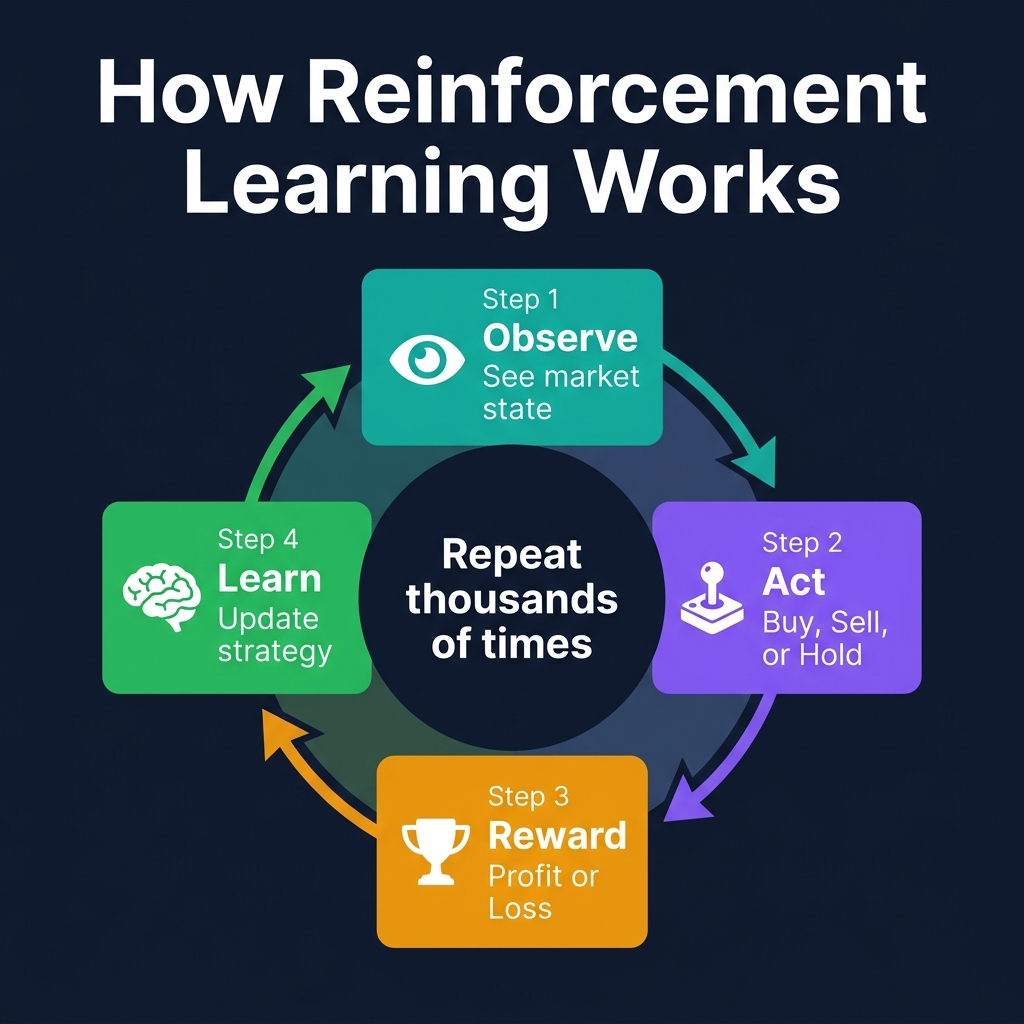
A reinforcement learning (RL) system is an AI "agent" that interacts with the market the same way a gamer interacts with a video game. It observes what is happening on screen (the market state), presses a button (executes a trade), and then sees whether the score goes up or down (profit or loss). Over thousands — sometimes millions — of these cycles, the agent discovers which actions tend to produce the best outcomes in different situations.
This stands in sharp contrast to the way most traders first encounter AI. Traditional machine learning price prediction follows what is called supervised learning: you show the model thousands of historical examples along with the "correct" answers, and it learns to mimic those patterns. Think of it as a student studying a textbook full of solved problems. The student can get very good at recognizing familiar problems, but may struggle when the exam throws a curveball.
Reinforcement learning takes a fundamentally different path. There is no textbook. There are no "correct" answers pre-loaded into the system. The agent must discover its own strategy through interaction, just like our video game player. This makes RL uniquely powerful for markets, where conditions shift constantly and yesterday's correct answer may be tomorrow's costly mistake.
In the crypto markets of 2026 — where Bitcoin trades near $108,000, Ethereum hovers around $2,650, and Solana pushes past $180 — conditions change rapidly. Flash crashes, regulatory announcements, and sudden sentiment shifts can invalidate static strategies overnight. An RL agent, in theory, can adapt to these changes because it never stops learning from its own experience.
Reinforcement Learning vs. Traditional AI Trading Approaches
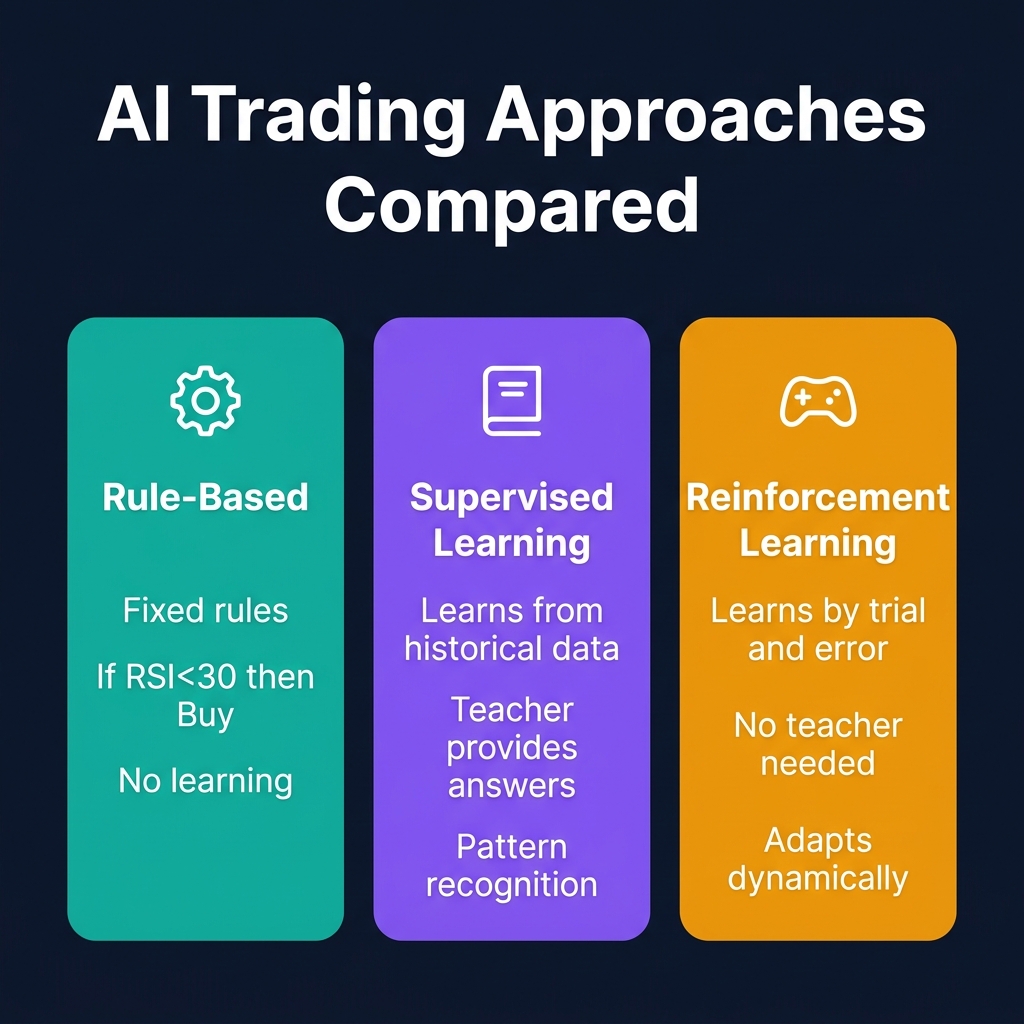
Before diving deeper into how RL works, it helps to understand where it sits alongside the other AI trading approaches you may already be familiar with. Each method has a different philosophy, and each excels in different scenarios.
Feature
Rule-Based Systems
Supervised Learning
Reinforcement Learning
How it learns
Human writes fixed rules
Studies historical examples with known outcomes
Learns by trial-and-error interaction
Analogy
Following a recipe
Studying for a test with answer keys
Playing a game with no manual
Adaptability
None — rules are static
Limited — retrain needed for new conditions
High — continuously learns from experience
Speed to deploy
Fast
Moderate
Slow (long training required)
Handles new situations
Poorly — breaks on unseen patterns
Moderately — generalizes from training data
Well — explores and adapts
Transparency
High — you wrote the rules
Moderate — feature importance is visible
Low — decisions can be opaque
Data requirements
Minimal
Large labeled datasets
Massive interaction data (real or simulated)
Best for
Simple, well-defined strategies
Price prediction, classification
Position sizing, dynamic strategy, execution
A rule-based trading bot is like a cook following a recipe to the letter. If the recipe says "add salt when the water boils," the cook does exactly that — no judgment, no improvisation. These systems work well in stable conditions but fall apart when the kitchen catches fire.
Supervised learning models, which power many neural network-based trading tools, are the diligent students. They study thousands of past market scenarios, learn the patterns, and can make solid predictions on data that looks similar to what they trained on. The limitation is that they predict outcomes but do not inherently decide what to do about those predictions.
Reinforcement learning bridges that gap. It does not just predict where the price might go — it decides whether to buy, sell, or hold, how much to risk, and when to exit. It is a complete decision-making system, not just a forecasting engine.
That said, RL is not strictly superior. In practice, the most effective AI trading systems in 2026 combine elements of all three approaches. A supervised model might generate a price forecast, a rule-based filter might screen out low-liquidity conditions, and an RL agent might decide the optimal position size and timing. Each layer plays to its strength.
How Reinforcement Learning Trading Actually Works
Understanding How Reinforcement Learning Trading Actually Works is a key part of crypto technical analysis. Most professional trading indicators on any crypto trading platform will help you apply these concepts in real time.
Let us strip away the jargon and walk through the mechanics of RL trading in plain language. The entire system revolves around four concepts: state, action, reward, and policy.
State: What the AI Sees
The "state" is everything the agent can observe about the market at a given moment. Think of it as the game screen in our video game analogy. This might include the current price of Bitcoin, the trading volume over the last hour, the spread between bid and ask, volatility metrics, how much capital the agent currently holds, and its existing open positions.
The richer the state information, the more nuanced the agent's decisions can be — but also the harder it becomes to learn effectively. Finding the right balance is one of the key challenges in RL system design.
Action: What the AI Does
Based on the current state, the agent chooses an action. In trading, actions typically include buying, selling, or holding. More sophisticated agents also decide position sizing (how much to trade), order type (limit vs. market), and even which asset to trade if operating across multiple pairs.
Reward: The Score
After taking an action, the agent receives a reward signal. This is the critical feedback mechanism. In trading, the reward is usually tied to profit or loss, but it can be designed to include other goals. For example, a well-designed reward might penalize excessive drawdowns, reward consistent returns over volatile ones, or include transaction costs so the agent does not churn positions needlessly.
The design of the reward function is arguably the most important decision in building an RL trading system. A poorly designed reward can lead an agent to discover strategies that look profitable on paper but are catastrophic in practice — like an agent that learns to take enormous leveraged positions because it gets rewarded for the rare big wins while ignoring the frequent devastating losses.
Policy: The Strategy
The "policy" is the agent's learned strategy — its internal playbook that maps every possible state to the best action. Early in training, the policy is essentially random: the agent buys and sells chaotically, like a beginner mashing buttons. Over time, as the agent accumulates experience and adjusts its policy based on rewards, the strategy becomes more refined and effective.
A useful analogy here is a chess player. A beginner might move pieces randomly, but a grandmaster has internalized millions of positions and knows intuitively which moves lead to winning positions many turns ahead. The RL agent undergoes a similar transformation — starting from chaos and gradually developing "intuition" about market dynamics.
The training process works something like this:
The agent observes the current market state
It selects an action based on its current policy (plus some random exploration)
The market moves, and the agent receives a reward
The agent updates its policy to make the rewarding action more likely in similar states
Repeat — thousands or millions of times
The "exploration" element in step two is crucial. If the agent only ever does what it thinks is best, it may never discover a better strategy. By occasionally trying random actions, it explores new possibilities. Over time, this exploration rate decreases as the agent becomes more confident in its policy. This balance between "exploit what you know" and "explore what you don't" is a fundamental challenge in reinforcement learning — and a relevant metaphor for human trading psychology as well.
Three Types of RL Approaches in Trading
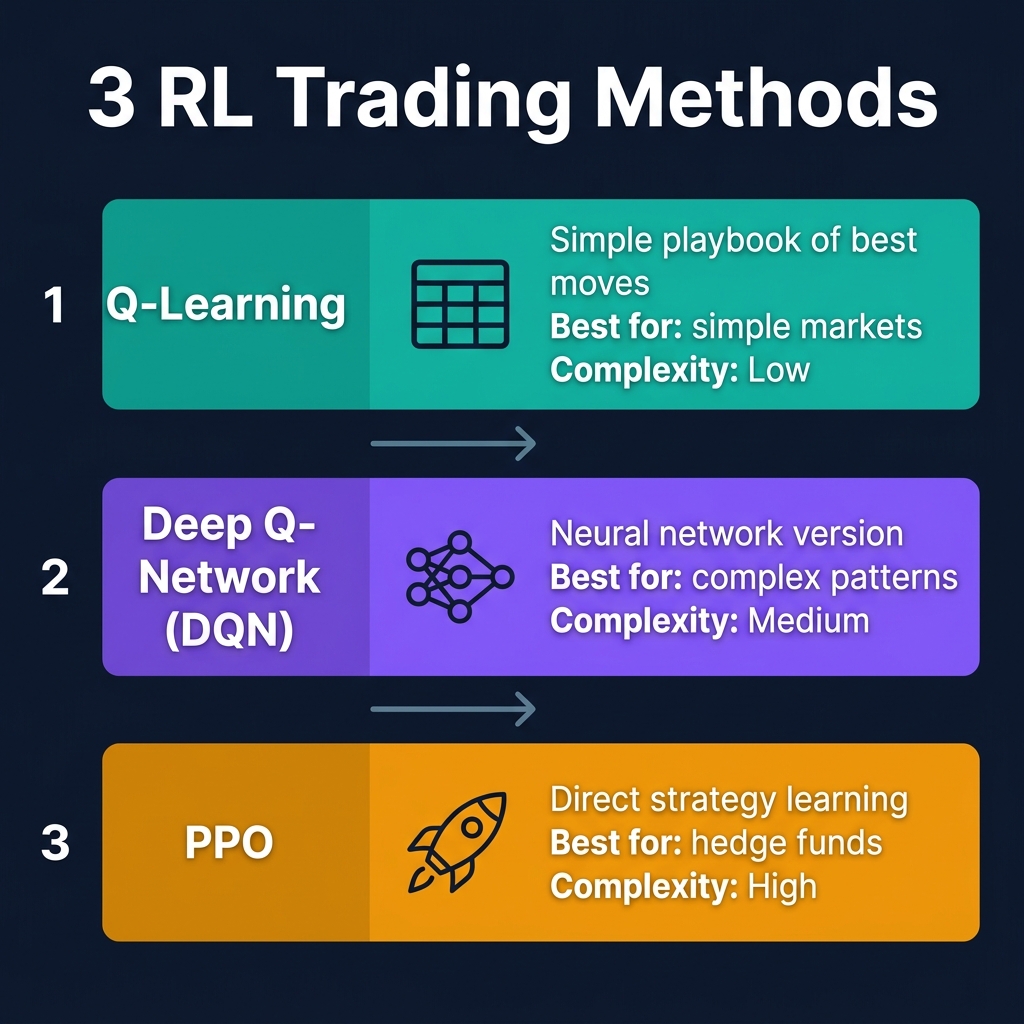
Not all reinforcement learning is created equal. Over the past decade, researchers and quantitative traders have developed several distinct RL approaches, each with different strengths. Here are the three most relevant for crypto trading.
Q-Learning: The Playbook Approach
Q-Learning is the simplest and most intuitive form of RL. Imagine creating a massive spreadsheet where every row represents a market condition and every column represents a possible action. Each cell contains a "Q-value" — a score that tells the agent how good that action is in that state. The agent simply looks up its current state, checks which action has the highest score, and does that.
The "learning" part happens after each trade. If the action produced a good reward, the Q-value for that state-action pair goes up. If it produced a loss, it goes down. Over thousands of iterations, the spreadsheet fills with increasingly accurate scores, and the agent's decisions improve.
The limitation of Q-Learning is that this "spreadsheet" approach only works when the number of possible states is manageable. In the real crypto market, where prices can take infinite values and dozens of indicators interact simultaneously, a simple lookup table cannot capture the full complexity.
Deep Q-Network (DQN): Adding Neural Network Power
Deep Q-Networks solve the scalability problem by replacing the spreadsheet with a neural network. Instead of looking up values in a table, the agent feeds the current state into a neural network that outputs Q-values for each possible action.
This is a game-changer because neural networks can generalize. Even if the agent has never seen this exact market state before, the network can estimate how valuable each action might be based on similar states it has encountered. DQN is what DeepMind used to teach AI to play Atari games at superhuman levels — the same principles apply to trading.
DQN handles complex, continuous market data far better than vanilla Q-Learning, but it comes with its own challenges. The neural network adds a layer of opacity (it is harder to understand why the agent made a particular decision), and training requires significantly more data and computational power.
PPO and Policy Gradient: Learning Strategy Directly
Proximal Policy Optimization (PPO) and other policy gradient methods take a fundamentally different approach. Instead of learning how valuable each action is and then picking the best one, they directly learn the best strategy (policy) itself.
If Q-Learning is about building a playbook ("in this situation, this move is worth X points"), policy gradient methods are about developing instinct ("in this situation, do this"). The distinction may seem subtle, but it has profound practical implications.
PPO is particularly popular in advanced trading systems because it handles continuous action spaces naturally. Rather than choosing from discrete options (buy, sell, hold), a PPO agent can output a precise position size — "allocate 23.7% of portfolio to ETH" — which is far more useful for real portfolio management.
This is the approach favored by sophisticated quantitative hedge funds and is considered state-of-the-art in RL trading research as of 2026.
Approach
Complexity
Data Needs
Strengths
Limitations
Best Use Case
Q-Learning
Low
Moderate
Simple, interpretable, fast to train
Cannot handle complex state spaces
Simple strategies, educational purposes
DQN
Medium
High
Handles complex markets, proven track record
Can be unstable during training
Single-asset trading, discrete decisions
PPO / Policy Gradient
High
Very High
Precise position sizing, continuous actions, stable training
Computationally expensive, harder to interpret
Portfolio management, institutional use
For most retail traders, the takeaway is not which algorithm to implement yourself, but rather understanding the spectrum of sophistication that exists. When evaluating AI trading bots or platforms, knowing whether a product uses simple Q-Learning versus advanced PPO methods can help you assess its potential — and its claims.
What Reinforcement Learning Is Good At (and What It Is Not)
RL has generated enormous excitement in the trading community, but setting realistic expectations is essential. Here is an honest assessment.
Where RL Excels
Dynamic position sizing. Perhaps the single greatest strength of RL in trading is its ability to adjust position sizes based on market conditions. While a static strategy might always risk 2% per trade, an RL agent can learn to increase exposure during low-volatility trending markets and reduce it during choppy, uncertain periods. In a market like May 2026, where BTC has swung between $103,000 and $112,000 within weeks, this adaptability is invaluable.
Execution optimization. Large trades move markets. Institutional traders use RL to break large orders into smaller pieces and time them to minimize market impact. An RL agent might learn to execute during specific liquidity windows, vary order sizes based on order book depth, and adjust strategy based on how the market reacts to each partial fill.
Adapting to regime changes. Markets cycle between trending, ranging, volatile, and calm phases. A traditional model trained on trending data will struggle during a range-bound period. An RL agent, if properly designed, can detect these shifts and adjust its strategy accordingly — although this capability is far harder to achieve than it sounds.
Multi-objective optimization. Real trading involves balancing competing goals: maximizing returns while minimizing drawdowns, maintaining portfolio diversification, keeping transaction costs low. RL naturally handles these multi-objective problems through careful reward design.
Where RL Struggles
Sample efficiency. RL agents are notoriously data-hungry. While a human trader might learn a lesson from a single painful loss, an RL agent may need thousands of similar experiences before the lesson sinks in. In crypto, where market regimes change every few months, the agent may never get enough samples from a single regime to learn it properly.
Explainability. When an RL agent decides to suddenly sell its entire ETH position, it cannot tell you why. The decision emerges from millions of learned weight parameters, making it nearly impossible to audit. This is a serious concern for risk management and regulatory compliance, and it stands in stark contrast to the transparency advantage of rule-based systems vs. AI trading.
Reward hacking. RL agents are master optimizers — they will find any shortcut to maximize their reward signal, even if that shortcut defeats the purpose. An agent rewarded for total returns might learn to take enormous concentrated bets. One rewarded for Sharpe ratio might learn to trade extremely infrequently. Designing a reward function that truly captures what you want is deceptively difficult.
Sim-to-real gap. Most RL agents are trained in simulated environments using historical data. The real market is fundamentally different: the agent's own trades affect prices, slippage varies unpredictably, and liquidity dries up precisely when you need it most. Strategies that work brilliantly in simulation often fail when deployed with real capital.
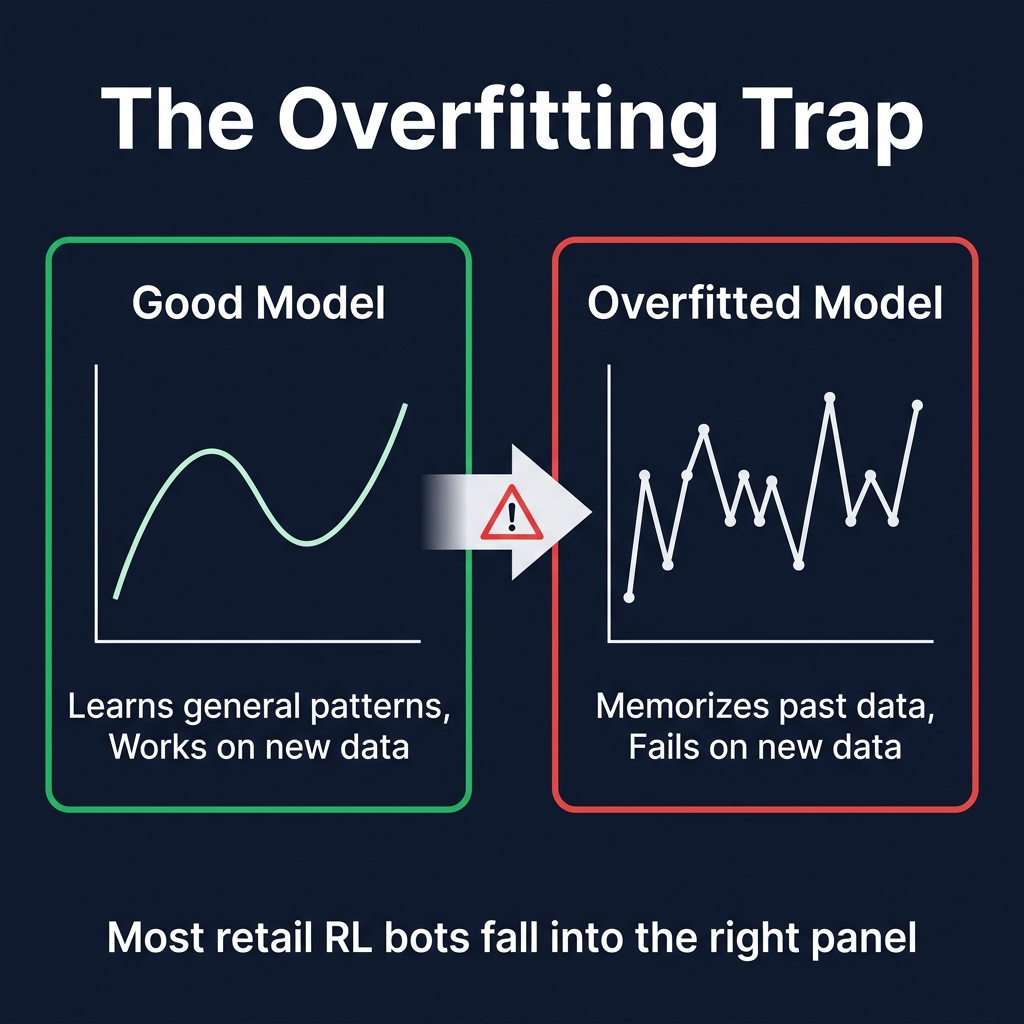
The Overfitting Trap: Why Most Retail RL Bots Fail
If you take one thing away from this article, let it be this section. Overfitting is the single biggest reason RL trading systems fail in practice, and retail traders are especially vulnerable.
Overfitting happens when an RL agent memorizes the specific sequence of past market events rather than learning general patterns. The distinction is critical:
Generalization: "When volatility is low and volume is increasing, going long tends to be profitable."
Overfitting: "On the 47th candle after a specific pattern, buy BTC because it went up last time."
An overfit agent will show spectacular backtest results. It will appear to nail every major move, avoid every crash, and generate returns that seem too good to be true — because they are. The agent has essentially memorized the answer key to a test it has already seen. When faced with new, unseen market data, performance collapses.
Warning Signs of an Overfit RL System
Warning Sign
What It Looks Like
Why It Matters
Perfect backtests
Win rate above 80%, Sharpe ratio above 3.0 on historical data
Real strategies rarely achieve this; near-perfect results almost always indicate memorization
Massive performance gap
Spectacular on training data, terrible on unseen data
The model learned the past instead of learning patterns
Excessive complexity
Agent uses hundreds of input features
More inputs give the agent more "room" to memorize noise
No out-of-sample testing
Only tested on the same data it trained on
Without validation on fresh data, overfitting goes undetected
Sensitivity to timing
Results change dramatically with small shifts in start date
The model relies on specific sequences rather than general patterns
How Professionals Guard Against Overfitting
Institutional teams employ several defenses that retail traders often skip. They train on one time period and rigorously test on a completely separate period the agent has never seen. They inject random noise into training data to force the agent to learn robust patterns. They simplify the state space, using fewer but more meaningful inputs. They train across multiple market regimes and asset pairs, forcing generalization. And they run extensive "paper trading" periods before risking real capital.
The uncomfortable truth is that building a genuinely effective RL trading system requires resources — computing power, data infrastructure, quantitative expertise, and rigorous testing frameworks — that are beyond most individual traders. This is not to discourage exploration, but to set realistic expectations.
Reinforcement Learning in Practice: Real-World Examples in 2026
While the academic literature is full of promising RL trading experiments, real-world deployment looks quite different from the idealized textbook version. Here is how RL is actually being used in the crypto markets today.
Institutional Applications
Execution algorithms. The most proven and widely deployed use of RL in trading is not picking which assets to buy — it is figuring out how to buy them efficiently. When a fund needs to acquire $50 million worth of Bitcoin, an RL-powered execution system learns the optimal way to slice that order across time and venues to minimize market impact. This is a narrower, more well-defined problem that plays to RL's strengths.
Market making. Automated market makers on both centralized and decentralized exchanges use RL to dynamically adjust bid-ask spreads based on volatility, inventory risk, and order flow. The agent learns to widen spreads during uncertain periods and tighten them during calm markets — continuously optimizing the tradeoff between capturing spread revenue and managing inventory risk.
Portfolio rebalancing. Some quantitative funds use RL agents to decide when and how to rebalance multi-asset portfolios. Rather than rebalancing on a fixed schedule (monthly, quarterly), the RL agent learns to rebalance when specific market conditions make it advantageous, factoring in transaction costs, tax implications, and current market liquidity.
Retail vs. Institutional Reality
Aspect
Institutional RL
Typical Retail RL
Training data
Proprietary tick-level data across years
Publicly available daily/hourly candles
Computing resources
GPU clusters, weeks of training
Single machine, hours of training
Testing rigor
Multi-phase validation, live paper trading
Often backtested on training data only
Problem scope
Narrow, well-defined tasks (execution, sizing)
Often tries to solve everything (predict + trade)
Team
PhDs in ML, finance, and statistics
Usually self-taught individual
Risk management
Multiple independent layers
Often minimal or absent
Realistic expectations
Incremental edge, small improvements
Often expects market-beating returns
The pattern is clear: institutional teams succeed with RL by applying it to narrow, well-defined problems where the feedback loop is tight and the data is abundant. Retail traders often struggle because they attempt to use RL for the much harder problem of generating alpha from price prediction alone.
This does not mean RL is useless for individual traders. It means the value is more likely to come from using platforms and tools built by teams with the resources to do RL properly, rather than building RL systems from scratch.
How CoinXSight Uses Adaptive Learning Models
You do not need to build your own reinforcement learning system to benefit from the principles behind it. CoinXSight integrates adaptive learning concepts throughout its platform, giving you access to intelligent, self-adjusting analytics without the complexity.
ASI Score: Market Regime Adaptation. The CoinXSight ASI (Aggregate Sentiment Index) score does not use a static formula. It dynamically adjusts the weighting of its component signals based on current market conditions. During high-volatility regimes — like the BTC surge past $108,000 in late May 2026 — sentiment and momentum indicators receive different weight than during quiet, range-bound periods. This adaptive weighting draws on the same principle that makes RL powerful: adjusting strategy based on what is working right now.
Alpha Hunter: Dynamic Signal Optimization. The Alpha Hunter signals system continuously evaluates which combination of technical and on-chain signals are producing the most reliable trading opportunities in current market conditions. When a signal source proves unreliable during a specific regime, its influence is reduced. When another gains predictive power, its weight increases. This is the practical benefit of adaptive learning delivered through a clean, actionable interface.
AI Analysis Dashboard. Rather than presenting raw model outputs, CoinXSight's AI analysis tools translate complex multi-model intelligence into clear scores, trend indicators, and risk assessments. You get the benefit of sophisticated adaptive models without needing to understand the mathematics behind them.
The philosophy is straightforward: the heavy lifting of model training, validation, and adaptation happens behind the scenes. What reaches you is a distilled, actionable signal that adapts to the market without requiring you to tune parameters, retrain models, or worry about overfitting.
Key Takeaways for Traders
Understanding reinforcement learning does not mean you need to build an RL bot. The real value for most traders lies in three areas:
Better evaluation of AI tools. When a platform claims to use "AI-powered trading," you now have the vocabulary to ask meaningful questions. Is it rule-based, supervised, or reinforcement learning? How is it validated? What safeguards exist against overfitting?
Realistic expectations. RL is powerful but not magical. It excels at position sizing, execution, and adaptation — not at predicting the future. Any system claiming to predict exact prices using RL should be viewed with extreme skepticism.
Appreciation for adaptive systems. Markets evolve. The most robust trading tools are those that evolve with them. Whether through formal RL or related adaptive techniques, systems that continuously learn and adjust have a structural advantage over static ones.
Reinforcement learning represents a paradigm shift in how AI approaches trading: instead of studying historical textbooks, the AI learns by doing — making decisions, receiving feedback, and refining its strategy through millions of interactions. While building production-grade RL trading systems remains the domain of well-resourced institutional teams, the principles of adaptive, experience-driven learning are already accessible to everyday traders through platforms like CoinXSight. From regime-adaptive ASI scores to dynamically weighted Alpha Hunter signals, you can benefit from the intelligence behind RL without the complexity. Explore how adaptive AI analytics can sharpen your trading edge at coinxsight.com.
KZ
Dr. Kevin Zhang
AI // QUANT LABS
Principal AI & Quantitative Researcher·Deep Alpha Engine Labs
Ph.D. in Computational Statistics. Leads machine learning architecture, regime-switching detection, and automated execution systems at CoinXSight Labs.
QUANTITATIVE SUITE // DEEP ALPHA ENGINEACTIVE
BTC/USDT // LIVE SCANNER
CONFLUENCE 100
LIVE SPOT PRICE$82,617.68STRONG_BUY
TP2
$90,817.78
+10.15%
TP1
$85,796.52
+4.06%
ENTRY
$82,449.02
ZONE
SL
$80,775.27
-2.03%
Auto-detect Order Blocks, Fair Value Gaps and risk-adjusted DCA ladders in < 5s.