AI Trading Tools Compared: Which Actually Use Real AI vs Marketing Hype?
We rate 10 crypto trading tools on AI authenticity only. Find out which use real ML models and which are rules with a label. Perfect for any crypto trading platform setup.
KZ
Dr. Kevin ZhangPrincipal AI & Quantitative Researcher·May 29, 2026 · 16 min read · Updated Oct 6
Walk through any crypto tool's landing page in 2026 and you will see the same word repeated like a mantra: AI. "AI-powered signals." "AI-driven analytics." "AI trading bot." The term has become so overused that it has lost nearly all meaning.
Here is the uncomfortable truth. The majority of tools that market themselves as "AI-powered" are running simple conditional logic: if RSI drops below 30, generate a buy alert. If price crosses above the 200-day moving average, flash a green arrow. That is not artificial intelligence. That is an IF/THEN statement from a first-year programming class wrapped in a $99-per-month subscription.
This is AI washing, and it is the crypto industry's version of greenwashing.
Think of it like the organic food label analogy. In the early days of organic food, any company could slap "natural" on a package of processed chips. The word had no regulatory definition, so it meant whatever the marketing team wanted it to mean. Consumers had to learn the difference between a certified organic label and a meaningless "natural" sticker. The same thing is happening with "AI" in trading tools right now.
Real AI in trading means machine learning models that train on historical data, adapt to changing market conditions, combine multiple data sources, and improve their predictions over time. It means models that can explain their reasoning, show confidence levels, and demonstrate a measurable track record. A static rule that fires the same way in a bull market, a bear market, and a sideways chop is not AI. It is automation. Automation is useful, but it is not intelligence, and you should not pay intelligence prices for it.
This article exists because no one else is making this distinction clearly enough. We reviewed 10 of the most popular crypto trading tools and rated each one exclusively on one question: how real is the AI? We did not review their charting, their UI, their portfolio features, or their general usability. Other articles cover that ground. For general feature comparisons, see our tools guide and our best crypto app breakdown. This article is about one thing only: AI authenticity.
And yes, we include CoinXSight in this review, and we are honest about where it falls short.
Key Terms You Should Know
Before we rate any tools, make sure you speak the language. These terms separate informed evaluation from marketing susceptibility.
Term
Definition
AI Washing
Marketing a product as "AI-powered" when it relies on simple rules, static thresholds, or basic automation rather than genuine machine learning. The crypto equivalent of "greenwashing."
Rule-Based System
Software that follows fixed IF/THEN logic defined by a human programmer. It does not learn, adapt, or improve from new data. Example: "Buy when RSI < 30."
Machine Learning (ML)
A subset of AI where models learn patterns from data rather than following explicit rules. The model improves as it processes more examples.
Deep Learning
A subset of ML using neural networks with multiple layers. Capable of finding complex, non-linear patterns in large datasets. Used in advanced sentiment analysis and price prediction models.
Hybrid System
Combines rule-based logic with ML components. For example, rules define the trading framework while ML optimizes parameters or scores confluence.
Model Accuracy
The percentage of correct predictions a model makes on unseen data. A model that is 60% accurate in live trading is genuinely strong for crypto markets. Claims above 80% should trigger immediate skepticism.
Backtested vs Live Performance
Backtested results show how a model would have performed on historical data. Live performance shows how it actually performs in real-time markets. Many models look great in backtests but fail live due to overfitting, slippage, and changing market conditions.
Explainability
Whether a model can tell you WHY it made a specific prediction. Black-box models give you an output with no reasoning. Explainable models show which factors contributed to the decision.
Signal Latency
The delay between when a pattern forms and when the tool alerts you. High latency means the opportunity may already be gone by the time you see it. Real AI should reduce latency, not add it.
Overfitting
When a model is so perfectly tuned to historical data that it fails on new data. A classic trap in backtesting — the model "memorized" the past instead of learning generalizable patterns.
Confidence Score
A numerical measure (usually 0-100 or a percentage) indicating how certain the model is about a prediction. Tools without confidence scores are asking you to trust every signal equally, which is irresponsible.
If you are new to how AI works in crypto trading more broadly, our AI in Crypto Trading guide covers the full landscape.
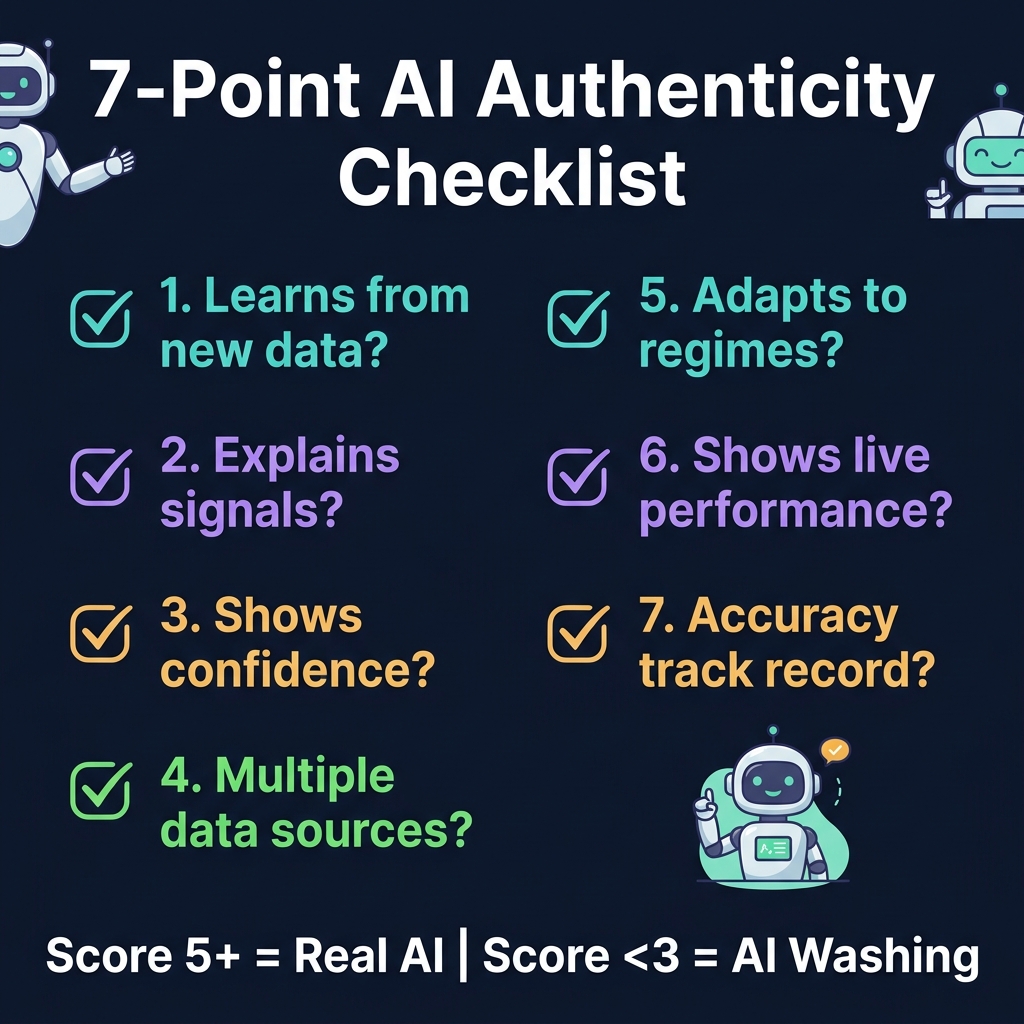
The AI Authenticity Checklist: 7 Questions That Expose Fakes
Understanding The AI Authenticity Checklist: 7 Questions That Expose Fakes is a key part of crypto technical analysis. Most professional trading indicators on any crypto trading platform will help you apply these concepts in real time.
Before you pay for any tool that claims to use AI, run it through these seven questions. Genuine AI tools will answer most of them positively. Rule-based tools dressed up as AI will fail the majority.
1. Does It Learn From New Data, or Use Fixed Rules?
This is the single most important question. A real AI model retrains periodically on new market data. It adjusts its weights, parameters, and decision boundaries as market dynamics shift. A rule-based system runs the same logic today that it ran six months ago, regardless of whether the market is in a bull run, a crash, or a sideways grind.
Ask the tool's documentation or support team: how often does your model retrain? If they cannot answer, or if the answer is "it doesn't," you are looking at a rule-based system.
2. Can It Explain WHY It Generated a Signal?
A genuine AI system with any level of explainability will tell you which factors contributed to its output. "BTC is bullish because momentum indicators align with rising on-chain accumulation and declining exchange reserves" is explainable. "BTC is bullish" with no further context is a black box, or worse, a random number generator.
Explainability is not just a nice-to-have. It is how you learn to trust (or distrust) a tool over time. Without it, you are following signals blindly.
3. Does It Show Confidence Scores?
Every legitimate prediction model produces probability distributions, not binary yes/no outputs. If a tool says "BUY" without telling you whether it is 52% confident or 94% confident, it is hiding information that should change your position sizing and risk management.
Confidence scoring is table stakes for real AI. Its absence is a red flag.
4. How Many Data Sources Does It Combine?
Rule-based systems typically operate on one or two data types: price and volume. Real AI systems ingest multiple data streams: price action across timeframes, on-chain metrics (exchange flows, whale activity, network health), social sentiment, derivatives data (funding rates, open interest), and sometimes macroeconomic inputs.
The power of AI is in synthesis. If a tool only looks at price candles, a human with TradingView can do the same thing. AI earns its value when it processes data layers that no human can combine mentally in real time.
5. Does It Adapt to Different Market Regimes?
Markets cycle through bull trends, bear trends, accumulation ranges, and distribution phases. A static strategy that works in a trending market will get destroyed in a range, and vice versa. Real AI detects regime changes and adjusts its behavior: different signal thresholds, different indicators weighted more heavily, different risk parameters.
If the tool fires signals with the same logic regardless of whether Bitcoin is at $111,000 in a parabolic uptrend or $65,000 in a capitulation phase, it is not adapting.
6. Does It Show Both Backtested AND Live Performance?
Backtests alone are meaningless. Any quant can build a model that returns 500% on historical data by overfitting to known outcomes. The real test is live performance on data the model has never seen.
Trustworthy AI tools publish both: here is how the model performed in backtesting, and here is how it has performed live since deployment. If a tool only shows backtested results, treat those numbers with extreme skepticism.
7. Does It Have a Verifiable Track Record of Accuracy?
Not self-reported accuracy. Not cherry-picked winning trades on social media. Verifiable track records mean timestamped signals that users can independently confirm, historical performance dashboards, or third-party audits.
A tool claiming "85% accuracy" without verifiable evidence is making a marketing claim, not a factual statement.
AI Feature Deep-Dive: 10 Tools Rated on AI Quality Only
This section is not a general product review. We are not scoring UI design, charting quality, customer support, or pricing value. We are answering one question per tool: how genuine and effective is the AI?
CoinXSight uses a hybrid approach combining machine learning models with rule-based confluence scoring. The ASI Score is generated by an ML pipeline that ingests technical indicators across multiple timeframes, on-chain data (exchange flows, whale activity, network metrics), and sentiment signals. The Alpha Hunter module applies a multi-layer confluence system where each layer (trend, smart money concepts, momentum, volume) is scored independently before an ML model weights their combination based on current market regime.
The AI Analysis module uses LLM technology to synthesize data into natural language explanations, including specific entry zones, stop levels, and risk assessments. This is genuine AI: it does not just regurgitate indicator values; it interprets their interaction in context.
Where CoinXSight is honest about limitations: The ML models retrain on defined cycles, not continuously in real time. During sudden black swan events or unprecedented market conditions, model performance degrades like any ML system. The on-chain data depth does not match dedicated blockchain analytics platforms. And while the ASI Score has demonstrated strong correlation with subsequent price action, published accuracy metrics are still building a longer track record. The platform is newer than many competitors, which means the live performance history is shorter.
AI Criterion
Rating
Notes
Learning from data
Yes
ML models retrain periodically on new market data
Explainability
Strong
AI Analysis explains reasoning in natural language; confluence factors visible
Confidence scores
Yes
Alpha Hunter signals include LOW/MEDIUM/HIGH confidence with numerical scores
Growing track record; backtested and live data available but history is shorter
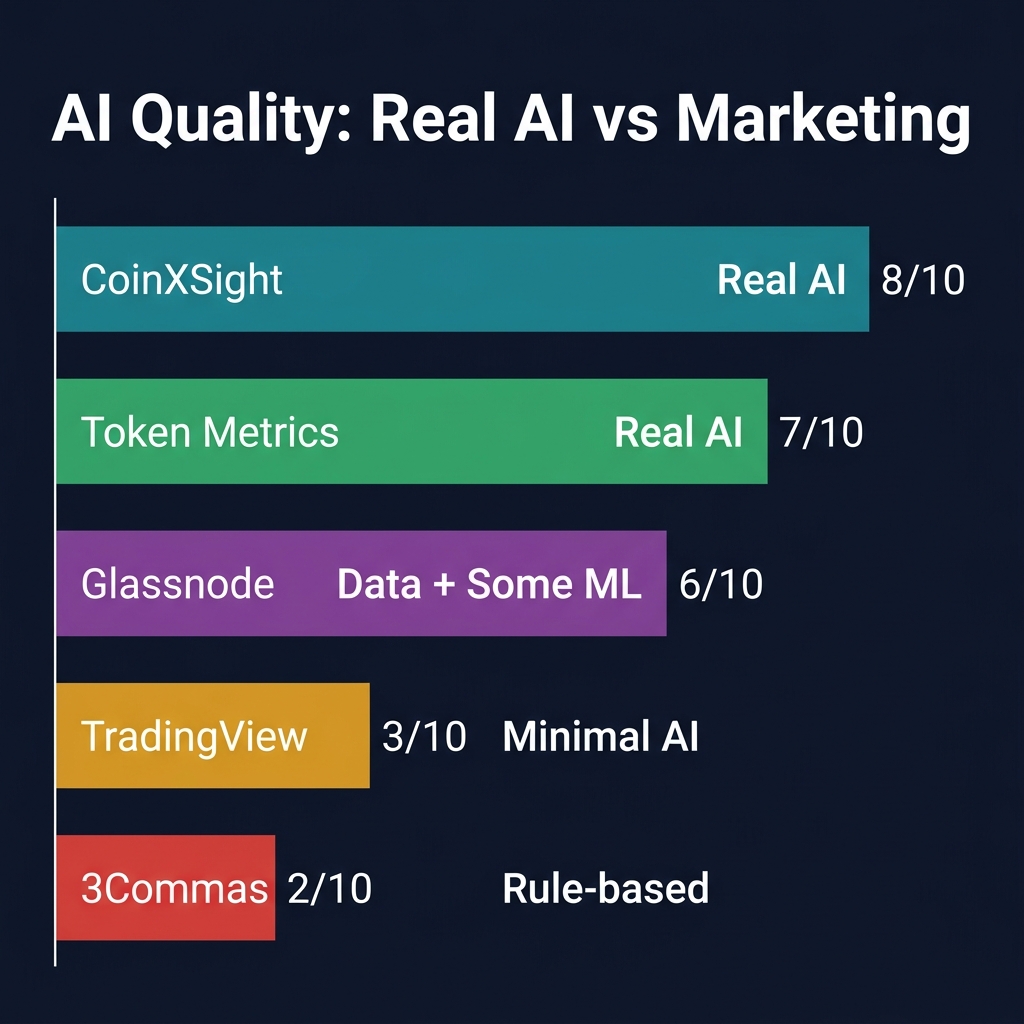
Bottom line: CoinXSight's AI is genuine but not perfect. The hybrid ML approach is more sophisticated than rule-based tools, the explainability is among the best in the space, and the multi-source data synthesis is a real differentiator. The main limitation is the relatively shorter live track record compared to tools that have been operating for five or more years. The 8/10 reflects real AI with room to build a longer proof of performance.
2. Token Metrics — AI Score: 7/10
Verdict: Real AI — ML-Driven Rating System
Token Metrics is one of the few platforms in crypto that genuinely uses machine learning for its core product. The platform employs neural networks and ensemble models to generate token ratings, price predictions, and portfolio allocation suggestions. The models process fundamental data, technical indicators, and market structure inputs to produce quantitative scores.
The AI is real. Token Metrics publishes information about its model methodology, offers backtesting frameworks, and provides quant-grade indicators that go beyond simple rule-based logic.
Where it falls short: Prediction accuracy is publicly debated, and historical performance transparency could be stronger. The interface overwhelms users with competing scores and metrics, making it hard to extract a clear trading decision. Signal latency can be an issue since the models generate periodic ratings rather than real-time alerts. And while the models are ML-driven, the explainability of individual predictions is limited. You get a rating, but the "why" behind it is often opaque.
AI Criterion
Rating
Notes
Learning from data
Yes
Neural networks and ensemble methods trained on market data
Explainability
Moderate
Ratings provided but detailed reasoning is limited
Confidence scores
Partial
Grades (bullish/neutral/bearish) rather than granular confidence percentages
Data sources
Multiple
Fundamental, technical, market structure
Regime adaptation
Partial
Models retrain but adaptation to regime shifts is not explicitly communicated
Live performance
Debated
Some published results; independent verification is inconsistent
Bottom line: Token Metrics does use real ML, and that puts it ahead of most competitors on AI authenticity. The 7/10 reflects genuine AI capability held back by limited explainability and an accuracy track record that needs stronger independent verification.
3. Glassnode — AI Score: 6/10
Verdict: Data-Rich With Some ML — Interpretation Is Mostly Manual
Glassnode has the deepest on-chain dataset in the industry for Bitcoin and Ethereum. Its metrics (SOPR, NUPL, HODL waves, realized cap, exchange net flows) are institutional-grade and used by hedge funds and research desks. Some of these metrics involve statistical models and machine learning for anomaly detection and pattern classification.
However, Glassnode is fundamentally a data platform, not a signal platform. It presents beautifully organized data and leaves interpretation to the user. The Workbench lets you build custom metrics, but you are the intelligence layer, not the platform. This is like having the best ingredients in the world but being expected to cook the meal yourself.
AI Criterion
Rating
Notes
Learning from data
Partial
Some metrics use statistical modeling; core platform is data presentation
Explainability
N/A
Not applicable — does not generate trade signals to explain
Confidence scores
No
Presents raw data without prediction confidence
Data sources
Deep but narrow
Best-in-class on-chain for BTC/ETH; limited technical/sentiment integration
Regime adaptation
Partial
Metrics reflect regime changes, but user must interpret them
Live performance
N/A
No predictive signals to measure accuracy on
Bottom line: Glassnode is a phenomenal data tool, and some ML runs under the hood for metric construction. But calling it an "AI trading tool" would be a stretch. It is a data platform that AI tools should integrate with. The 6/10 reflects the ML components that exist, tempered by the fact that the human user provides the intelligence.
4. Santiment — AI Score: 6/10
Verdict: Good Data With Some ML — More Research Platform Than AI Engine
Santiment combines on-chain analytics with social sentiment and a unique layer: developer activity tracking via GitHub commit analysis. Its proprietary metrics (token age consumed, daily active deposits, crowd sentiment divergence) use statistical models and some machine learning for anomaly detection.
The platform's real strength is identifying divergences between social narrative and on-chain reality. When the crowd is euphoric but on-chain data shows distribution, Santiment surfaces that contradiction. Some of this is ML-assisted, particularly the sentiment scoring and anomaly flagging.
But like Glassnode, Santiment is primarily a research platform. It provides the data and some ML-enhanced metrics, but it does not generate actionable trade signals with entries, stops, and targets. The user must bridge the gap from data to decision.
AI Criterion
Rating
Notes
Learning from data
Partial
Sentiment models and anomaly detection use ML; many metrics are statistical
Explainability
Moderate
Metrics are transparent; divergence signals explain the underlying conflict
Confidence scores
No
No numerical confidence on predictions
Data sources
Broad
On-chain, social, developer activity — a unique combination
Regime adaptation
Partial
Data reflects regime changes; interpretation is user-driven
Live performance
N/A
Research metrics, not predictive signals with track records
Bottom line: Santiment earns its 6/10 by combining multiple data layers with some genuine ML components, especially in sentiment analysis. It is not an AI signal generator, but its ML-enhanced data is a legitimate input for traders building their own AI-augmented strategies.
5. CryptoQuant — AI Score: 5/10
Verdict: Strong Data Platform With Minimal AI Layer
CryptoQuant specializes in exchange flow analytics: BTC and stablecoin movements in and out of exchanges, whale deposit patterns, miner flows, and derivatives data. The data is excellent, particularly for tracking exchange reserves and large-scale capital flows.
The platform includes some automated alert logic and community-contributed analysis, but the core product is data visualization rather than AI-driven prediction. Alerts are threshold-based (rule-based) rather than ML-driven. The platform's value comes from the quality and timeliness of its data, not from artificial intelligence applied to that data.
CryptoQuant has introduced some ML-enhanced features and indicator calculations, but these are supplementary rather than core to the product experience. When you open CryptoQuant, you are looking at dashboards and charts, not AI-generated signals.
AI Criterion
Rating
Notes
Learning from data
Minimal
Some ML-enhanced metrics; core alerts are threshold-based
Explainability
N/A
Data presentation rather than signal generation
Confidence scores
No
No prediction confidence scoring
Data sources
Strong but narrow
Exchange flows, on-chain, derivatives — no sentiment or technical AI
Regime adaptation
No
Same data presentation regardless of market phase
Live performance
N/A
Data tool, not a predictive AI tool
Bottom line: CryptoQuant is a solid data platform. Rating it 5/10 on AI is generous — it reflects the quality of data that could feed an AI system rather than AI capabilities within the platform itself. If you use CryptoQuant, you are the AI.
6. LunarCrush — AI Score: 4/10
Verdict: Social Scoring With Limited ML — Not the AI It Appears
LunarCrush aggregates social data from X, Reddit, YouTube, TikTok, and news platforms to calculate social volume, engagement, and sentiment scores. The Galaxy Score and AltRank metrics provide quick reads on social momentum. It is the market leader in social sentiment tracking for crypto, and it catches narrative-driven moves early.
But here is the critical question: is the Galaxy Score real AI? The scoring methodology combines weighted social metrics (post volume, engagement rate, sentiment classification) into a composite number. Some sentiment classification uses natural language processing, which qualifies as ML. However, much of the scoring is weighted aggregation: mathematical formulas applied to social data, not learned models that adapt and improve.
Social sentiment scoring is also inherently vulnerable. Bots, coordinated campaigns, and paid promoters can inflate social metrics artificially. A genuine AI system would detect and discount manipulation. It is unclear how much of LunarCrush's pipeline includes manipulation detection versus raw aggregation.
AI Criterion
Rating
Notes
Learning from data
Partial
Some NLP for sentiment classification; scoring is mostly weighted aggregation
Explainability
Low
Galaxy Score components visible but weighting logic is opaque
Confidence scores
No
No confidence levels on social predictions
Data sources
Narrow
Social media only — no price, on-chain, or technical inputs
Regime adaptation
No
Social scoring method remains constant across market conditions
Live performance
Unverified
No published track record for social-to-price prediction accuracy
Bottom line: LunarCrush provides genuinely useful social data, and the NLP component qualifies as some AI. But the Galaxy Score is closer to a weighted social index than a machine learning prediction. The 4/10 reflects real NLP wrapped in a scoring system that overstates its AI sophistication.
7. TradingView — AI Score: 3/10
Verdict: Great Platform, Minimal AI
TradingView is the best charting platform in existence. Its chart engine, Pine Script ecosystem, and social community are unmatched. But TradingView is not an AI tool. It is a visualization and analysis platform that relies almost entirely on human intelligence.
The AI features that exist are minor: basic pattern recognition overlays, some automated detection of chart patterns (head and shoulders, triangles), and smart alert suggestions. These are largely template-matching algorithms, not machine learning models that learn from data and adapt.
Pine Script lets users build custom indicators and strategies, but Pine Script is programming, not AI. A user-built RSI crossover strategy in Pine Script is a rule-based system written by a human.
TradingView excels at what it was built for: visual analysis. But scoring it on AI quality means acknowledging that AI is not its purpose.
AI Criterion
Rating
Notes
Learning from data
No
Pattern recognition uses templates, not learned models
Explainability
N/A
No AI signals to explain
Confidence scores
No
No ML-based confidence outputs
Data sources
Moderate
Price, volume, community scripts — no on-chain, limited sentiment
Regime adaptation
No
Same tools regardless of market condition
Live performance
N/A
No AI predictions to track
Bottom line: TradingView's 3/10 is not an insult to a fantastic platform. It simply reflects that AI is not what TradingView does. You should absolutely use TradingView for charting. You should not choose it because you expect AI capabilities.
8. Coinalyze — AI Score: 3/10
Verdict: Focused Data Tool, No AI
Coinalyze provides real-time derivatives data: aggregated open interest, funding rates, liquidation levels, and long/short ratios across exchanges. For futures traders, this data is invaluable. But Coinalyze is purely a data display tool.
There is no signal generation, no ML model, no predictive scoring, and no automated analysis. The platform presents numbers and charts; the user provides all interpretation and decision-making. It is excellent at what it does, but what it does is not AI.
AI Criterion
Rating
Notes
Learning from data
No
Data aggregation and display only
Explainability
N/A
No predictions to explain
Confidence scores
No
No predictive outputs
Data sources
Narrow
Derivatives data only
Regime adaptation
No
Static data presentation
Live performance
N/A
No AI predictions to evaluate
Bottom line: Coinalyze earns 3/10 rather than lower because the quality of its data feed could serve as a strong input to an AI system. But the platform itself has no AI layer.
9. 3Commas — AI Score: 2/10
Verdict: Rule-Based Bots Marketed as AI — Classic AI Washing
3Commas is one of the most popular trading bot platforms, offering DCA bots, grid bots, and signal-following bots across major exchanges. The platform frequently uses "AI" and "smart" in its marketing. But when you examine what the bots actually do, you find rule-based automation.
A DCA bot buys at fixed intervals or on fixed percentage drops. A grid bot places buy and sell orders at predefined price levels. A signal-following bot executes a preset action when it receives an external trigger. None of these learn from data. None adapt their parameters based on market conditions. None generate predictions with confidence scores. They are deterministic scripts executing human-defined rules.
This is the textbook definition of AI washing: taking standard automation and labeling it "smart" or "AI-powered" to justify premium pricing.
3Commas is a useful automation tool. Use it to execute strategies you have already validated. But do not choose it because you think AI is generating your trades.
AI Criterion
Rating
Notes
Learning from data
No
Fixed-rule bots with human-defined parameters
Explainability
N/A
No AI decisions to explain — all rules are user-set
Confidence scores
No
Bots execute without probability assessment
Data sources
Minimal
Price triggers only
Regime adaptation
No
Same bot behavior in bull, bear, and sideways markets
Live performance
User-dependent
Bot performance depends entirely on user configuration
Bottom line: 3Commas gets 2/10 on AI because there is essentially none. It is an automation platform, not an intelligence platform. The "smart" in its marketing is a label, not a description.
10. Pionex — AI Score: 2/10
Verdict: Free Grid Bots, Zero AI
Pionex is an exchange with built-in trading bots at no extra cost. Grid bots, DCA bots, arbitrage bots, and rebalancing bots are available out of the box. The platform recently added "AI-assisted" grid parameter suggestions, which calculate optimal grid ranges based on historical volatility.
Those parameter suggestions are the closest Pionex gets to AI, and they are basic statistical calculations (standard deviation of recent price ranges), not machine learning. The bots themselves are identical in function to 3Commas: deterministic, rule-based, non-adaptive.
Pionex has a genuine advantage in being free. But free automation is still automation, not AI.
AI Criterion
Rating
Notes
Learning from data
No
Statistical parameter suggestions at best; bots are rule-based
Explainability
N/A
No AI decisions exist
Confidence scores
No
No predictive capabilities
Data sources
Minimal
Price data only
Regime adaptation
No
Grid bots underperform in trending markets regardless
Live performance
N/A
No AI predictions to evaluate
Bottom line: Pionex is a fine free bot platform. Its AI score of 2/10 reflects the near-complete absence of AI. The "AI-assisted" parameter suggestion is a statistical shortcut, not machine learning.
The Honest AI Comparison Table
This table rates tools exclusively on their AI capabilities. For general feature comparisons, UI reviews, and pricing breakdowns, see our crypto tools guide.
Tool
AI Type
Data Sources
Explainability
Confidence Scores
Regime Adaptation
Retrains on New Data
AI Score /10
CoinXSight
Hybrid ML
12+ (tech, on-chain, sentiment, derivatives)
Strong (natural language)
Yes (numerical)
Yes
Yes (periodic)
8
Token Metrics
ML (neural nets)
Multiple (fundamental, technical)
Moderate
Partial (grades)
Partial
Yes
7
Glassnode
Data + some ML
Deep on-chain (BTC/ETH focused)
N/A (data tool)
No
Partial (data reflects)
N/A
6
Santiment
Data + some ML
On-chain, social, developer
Moderate
No
Partial
Partial
6
CryptoQuant
Data + minimal ML
Exchange flows, on-chain
N/A
No
No
N/A
5
LunarCrush
NLP + weighted scoring
Social media only
Low
No
No
Partial (NLP)
4
TradingView
Template matching
Price, volume
N/A
No
No
No
3
Coinalyze
None (data display)
Derivatives only
N/A
No
No
No
3
3Commas
None (rule-based bots)
Price triggers
N/A
No
No
No
2
Pionex
None (rule-based bots)
Price data
N/A
No
No
No
2
Three patterns emerge from this table.
First, there is a clear tier break between tools that use genuine ML (CoinXSight, Token Metrics) and tools that provide data for humans to interpret (Glassnode, Santiment, CryptoQuant). Both categories are valuable, but they serve fundamentally different roles. Confusing "excellent data" with "AI" is how the industry misleads traders.
Second, social scoring (LunarCrush) and charting platforms (TradingView) sit in a middle ground where some ML components exist but are not the core value proposition. Their AI scores reflect that nuance.
Third, trading bot platforms (3Commas, Pionex) are the clearest examples of AI washing in the industry. They automate. They do not think.
Combining AI Tools for Maximum Edge
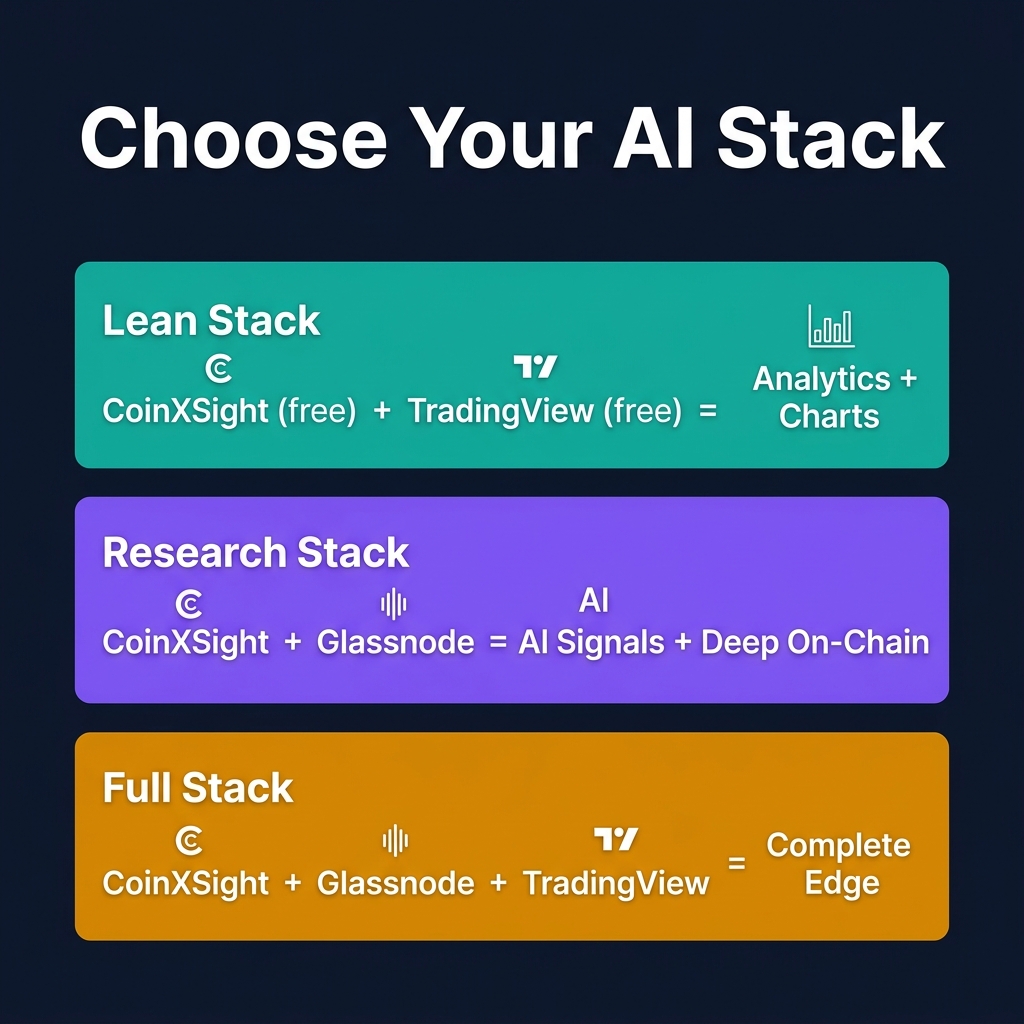
No single tool covers every dimension of AI-assisted trading. The most effective approach is building a stack where each tool contributes a different AI capability. Here are three proven combinations.
The AI-First Stack
CoinXSight + TradingView + Your Exchange
CoinXSight provides the AI layer: ML-powered scoring, multi-source signal generation, and explainable analysis. TradingView provides the visualization layer: best-in-class charting for manual confirmation of AI-generated setups. Your exchange provides execution.
This stack gives you genuine AI for signal discovery, human visual verification, and clean execution. It is the simplest combination that covers the full decision loop from AI insight to trade placement. CoinXSight's Alpha Hunter identifies opportunities across 500+ tokens. You verify the setup on TradingView's chart. You execute on your exchange. Total monthly cost ranges from $0 (free tiers of both) to approximately $100 (paid tiers of both).
The Data-Augmented AI Stack
CoinXSight + Glassnode or Santiment + TradingView
This stack adds a dedicated data layer to the AI-first stack. CoinXSight already ingests on-chain data, but if your edge depends on deep blockchain research for BTC and ETH specifically, Glassnode or Santiment provide granular metrics that go beyond what any integrated platform offers. Use Glassnode for SOPR, NUPL, and HODL wave analysis. Use Santiment for developer activity and crowd sentiment divergence. Then check whether CoinXSight's AI signals align with what the deep data is telling you.
When the ML-driven signal and the deep on-chain data agree, you have a high-conviction setup built on two independent analytical layers.
The Quantitative Validation Stack
CoinXSight + Token Metrics
Both tools use genuine ML, but their models are built differently and trained on different data combinations. CoinXSight focuses on confluence-based scoring across technical, on-chain, and sentiment layers. Token Metrics focuses on fundamental-weighted quantitative ratings. When both tools independently rate a token as bullish with high scores, you are seeing agreement between two separate ML systems, which is a stronger signal than either alone.
This stack is best for traders who want to cross-reference AI outputs rather than combining AI with manual data research.
The Future of AI Trading Tools: 2026-2027
The AI trading tool landscape is evolving fast. Here is where the technology is heading over the next twelve to eighteen months.
Multimodal AI Models
Current tools mostly process structured data: numbers, prices, percentages. The next generation will process unstructured data natively: reading charts visually like a human trader does, interpreting regulatory documents, analyzing video content from crypto conferences, and synthesizing all of it into a single output. Multimodal models that combine text, image, and numerical data processing will outperform single-modality tools significantly.
Autonomous Trading Agents
The line between "analysis tool" and "execution tool" is dissolving. AI agents that can research, decide, size positions, execute, and manage trades end-to-end are emerging. These are not the same as rule-based bots. These are agents that use LLMs and reinforcement learning to make contextual decisions. The risk is obvious: fully autonomous AI trading without human oversight is dangerous, especially in a volatile market like crypto. But semi-autonomous agents that suggest trades and execute upon human approval are likely to become standard by 2027.
Real-Time Continuous Learning
Most current ML models retrain on scheduled cycles (daily, weekly). Future models will learn continuously from incoming data streams, adapting to intraday market shifts rather than waiting for the next retraining window. This reduces the gap between a model's training data and the live market, which is where most prediction errors originate.
Transparency as a Competitive Advantage
As more traders learn to distinguish real AI from AI washing, transparency will become a market differentiator rather than a nice-to-have. Tools that publish model methodology, live accuracy metrics, and timestamped prediction histories will win user trust. Tools that hide behind "proprietary" claims while delivering opaque outputs will lose ground.
The AI washing problem will not disappear. But informed traders who ask the right questions will route around it.
Closing: Ask Better Questions, Get Better Tools
The most important AI trading tool in 2026 is not any specific platform. It is the set of questions you ask before you trust one. Does the tool learn from data? Can it explain its reasoning? Does it show confidence levels? Does it combine multiple data sources? Can it prove its accuracy in live markets? These seven questions separate genuine AI from expensive automation with a marketing upgrade. Among the tools we reviewed, only a handful pass the majority of these tests. CoinXSight scores well on AI authenticity, but it is not perfect, and we have been transparent about where it falls short. Token Metrics brings real ML models to the table. Glassnode and Santiment provide the deep data that AI systems need as inputs. The bot platforms are useful for what they are — automation — but they are not what they claim to be. Build your stack based on verified AI quality, not landing page promises. Start by running any tool through the seven-question checklist, and let the answers guide your investment in technology rather than marketing.
Principal AI & Quantitative Researcher·Deep Alpha Engine Labs
Ph.D. in Computational Statistics. Leads machine learning architecture, regime-switching detection, and automated execution systems at CoinXSight Labs.
QUANTITATIVE SUITE // DEEP ALPHA ENGINEACTIVE
BTC/USDT // LIVE SCANNER
CONFLUENCE 99
LIVE SPOT PRICE$82,640.73STRONG_BUY
TP2
$92,155.12
+11.77%
TP1
$86,331.46
+4.71%
ENTRY
$82,449.02
ZONE
SL
$80,507.80
-2.35%
Auto-detect Order Blocks, Fair Value Gaps and risk-adjusted DCA ladders in < 5s.
Crypto tools that professional traders actually use. Screeners, AI signals, charting, portfolio trackers, and on-chain analytics explained with real examples.