Ask any struggling trader about their watchlist and you'll hear one of two answers: "I watch everything" or "I just trade whatever's pumping on Twitter." Both approaches lose money.
Watching too many tokens means you can't analyze any of them properly. You glance at 50 charts, recognize nothing, and either make impulsive decisions or freeze from analysis paralysis. Watching too few means you miss sector rotations and breakouts in tokens you never considered.
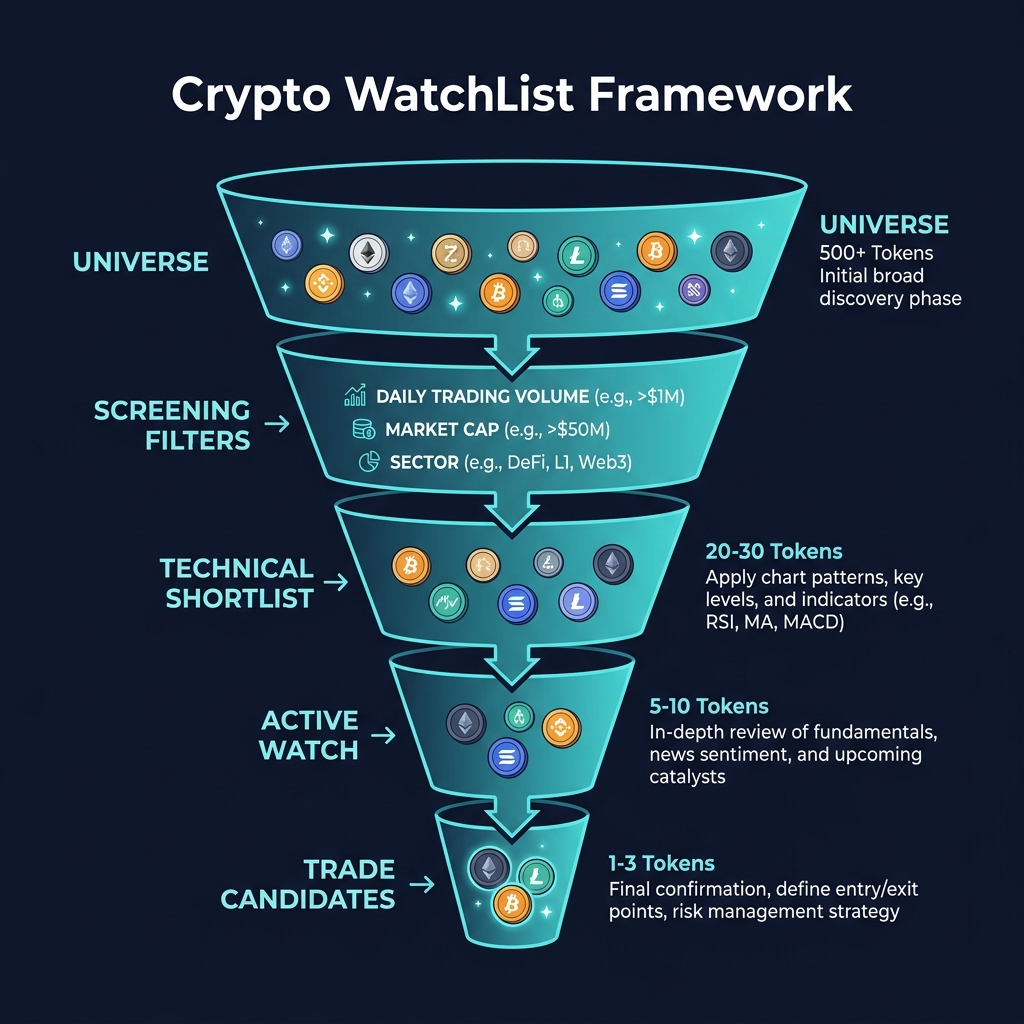
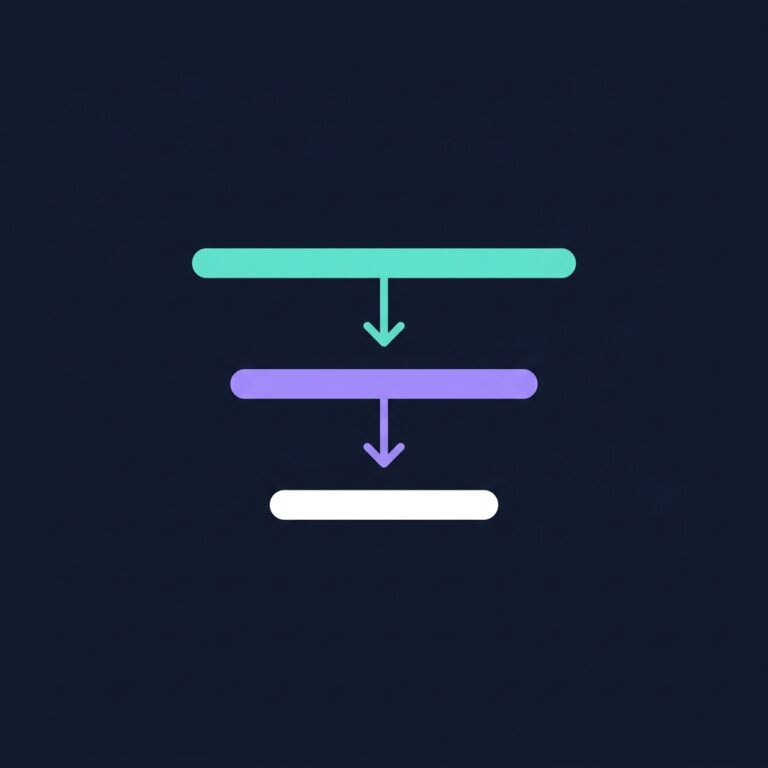
Professional traders solve this with a structured, tiered watchlist system that balances focus with coverage. This guide shows you exactly how to build one.
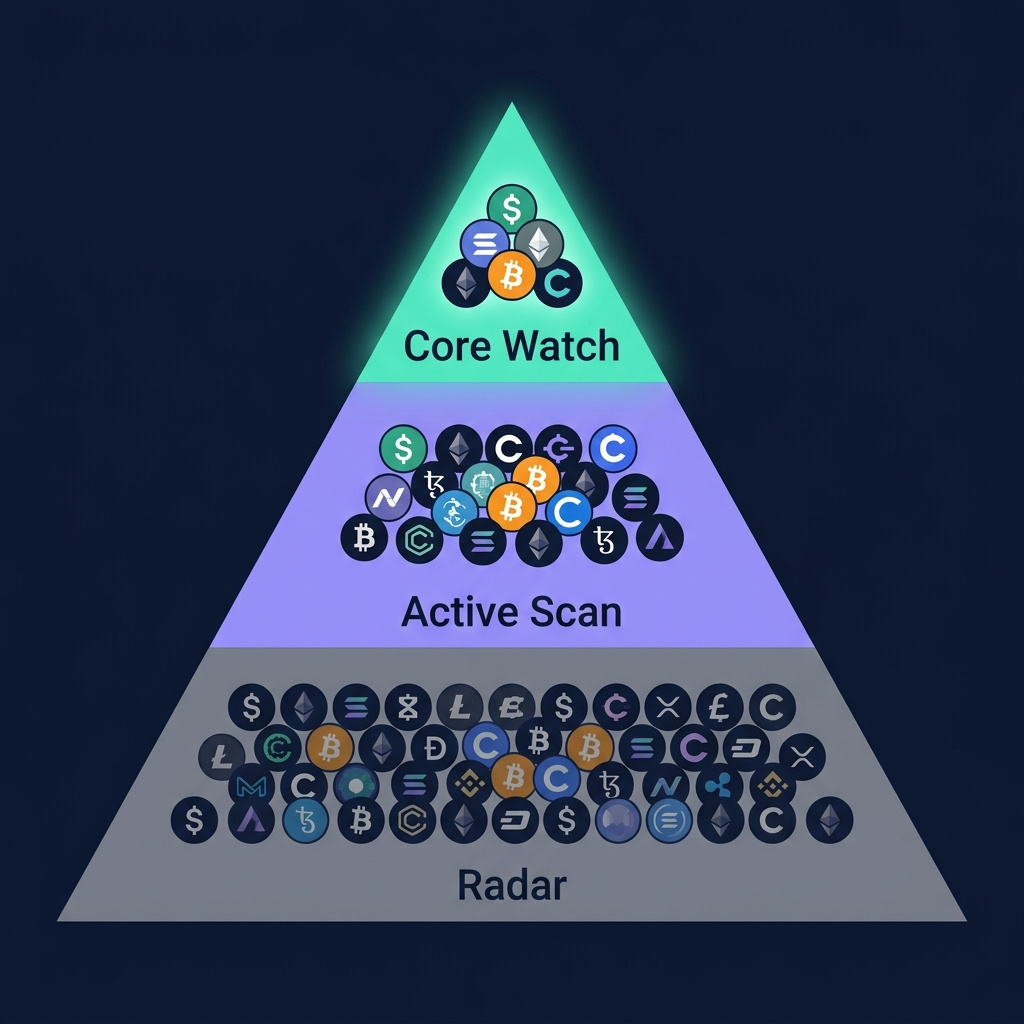
The 3-Tier Watchlist Model
Tier 1: Core Watch (3-5 Tokens)
These are tokens you know deeply. You understand their narratives, key levels, typical volatility, correlation with BTC, and fundamental catalysts. You check these every single day.
Criteria for Tier 1:
You can name the current support and resistance levels from memory
You know the project's roadmap and upcoming catalysts
You've traded this token before and have a feel for its behavior
Daily volume consistently above $50M (enough liquidity for your position sizes)
Example Tier 1 watchlist: BTC, ETH, SOL + 1-2 mid-cap tokens you specialize in (e.g., LINK if you trade oracle narratives, or AVAX if you focus on DeFi ecosystems).
Management rule: Tier 1 rarely changes. Review monthly, not weekly.
Tier 2: Active Scan (8-15 Tokens)
These are tokens showing emerging technical or fundamental signals. You don't know them as deeply as Tier 1, but they've passed your initial screening filters. Tier 2 is where most of your trades will come from.
How tokens enter Tier 2:
CoinXSight Discovery module flags them (volume spike, ASI score rising)
Alpha Hunter generates a signal
Sector rotation is moving capital toward their category
💡 CoinXSight Tip: Use the Dashboard macro view to identify which phase the market is in. BTC dominance rising = Phase 1. BTC dominance falling + altcoin volume surging = Phase 3.
Timeframe-Based Watchlist Filtering
Different trading styles need different watchlist criteria:
For Swing Traders (1-14 Day Holds)
Chart focus: Daily chart primary, 4H for entries
Tier 2 size: 8-12 tokens
Key filter: EMA 21/50 alignment on daily, approaching key support/resistance
Holding time in Tier 2: 1-3 weeks per token
For Day Traders (Intraday)
Chart focus: 1H and 15M
Tier 2 size: 3-5 tokens only (need deep focus)
Key filter: Top movers today, highest volume, widest ranges
Holding time in Tier 2: 1-2 days per token
For Position Traders (1-3 Month Holds)
Chart focus: Weekly chart primary, Daily for timing
Tier 2 size: 10-15 tokens
Key filter: Macro trend intact, fundamental catalysts, accumulation patterns
Holding time in Tier 2: 4-8 weeks per token
Red Flags: When to Remove a Token Immediately
Remove a token from ALL tiers if:
Volume collapse: 24H volume drops below 20% of its 30-day average. This token is dying or being manipulated.
Fundamental deterioration: Team leaves, major exploit, regulatory action against the project.
Persistent ASI decline: ASI score drops below 40 and stays there for 5+ days.
You don't remember why you added it. If you can't articulate the thesis, you're gambling.
Correlation breakdown: Token stops correlating with its sector. If all DeFi tokens pump and yours doesn't, something is wrong.
The Sunday Maintenance Ritual (15 Minutes)
Every Sunday, before markets get active on Monday, do this:
Minutes 1-5: Portfolio Health Check
Review open positions from last week
Close any trades that no longer have a valid thesis
Minutes 5-10: Tier 2 Audit
Open Discovery module → re-run your screening
Remove tokens that dropped below your ASI threshold
Add new tokens that emerged during the week
Minutes 10-15: Next Week Planning
For each Tier 2 token, write ONE sentence: "I'll trade [TOKEN] if [CONDITION]"
Example: "I'll buy SOL if it pulls back to $155 support with ASI above 65"
Set alerts for each condition
Done. 15 minutes. The entire week's trading plan is set.
Common Mistakes
1. Watchlist FOMO
You see a token pump 50% that wasn't on your watchlist. You chase it. It dumps. Solution: Accept that you'll miss moves. A focused watchlist catches enough opportunities — you don't need all of them.
2. Emotional Attachment
You keep a token on your Tier 2 because you "believe in the project" despite the chart looking terrible. Remove it. You can always re-add it when the chart improves.
3. Too Many Alerts
Setting 30 alerts means you get alert fatigue and start ignoring them. Set 5-8 maximum. If a token isn't worth one of your alert slots, it shouldn't be on Tier 2.
4. Never Rotating
Your Tier 2 shouldn't have the same tokens for months. Markets rotate. Your watchlist should rotate with them. If you haven't changed Tier 2 in 3 weeks, you're probably not adapting.
Frequently Asked Questions
How many tokens should be on my total watchlist?
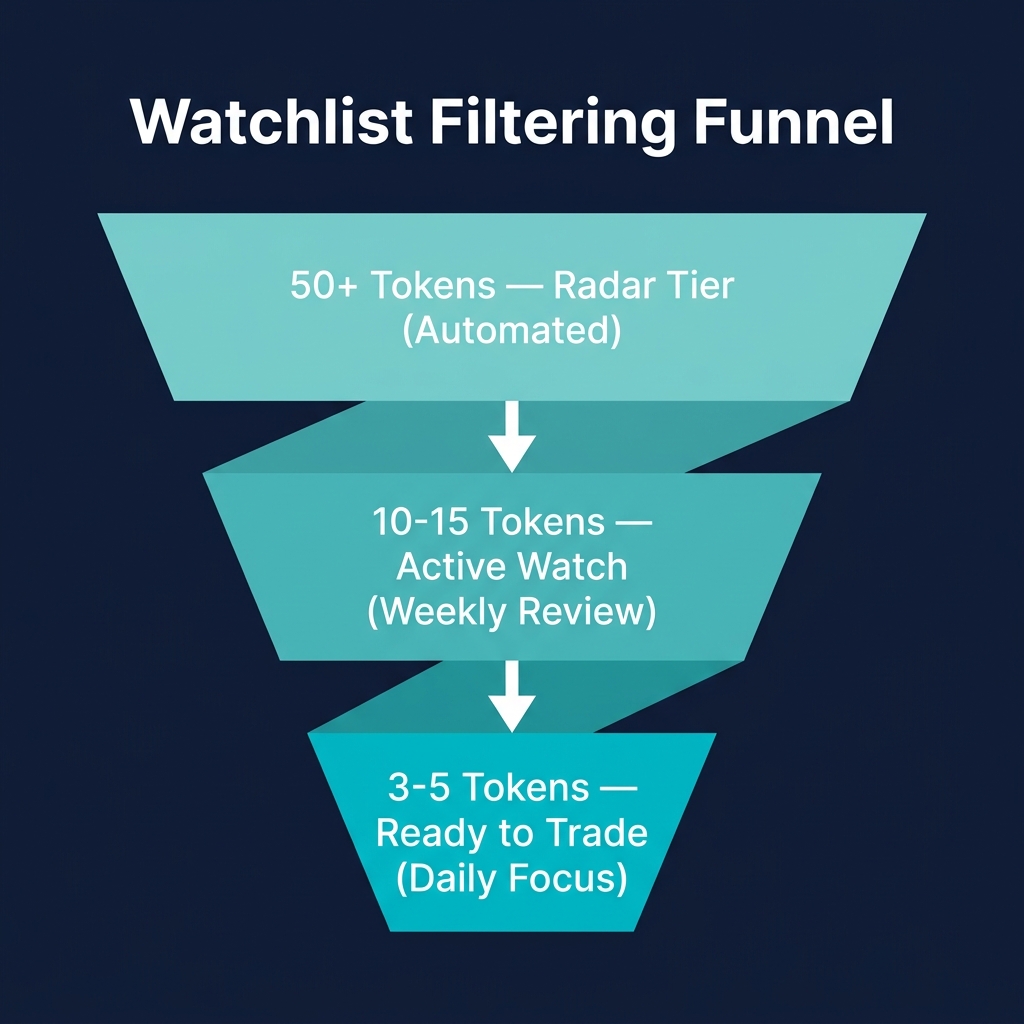
For most traders: Tier 1 (3-5) + Tier 2 (8-15) + Tier 3 (30-50 automated). Total active monitoring: roughly 15-20 tokens. This is enough coverage without information overload.
Should I include tokens I'm currently holding?
Yes. Current positions should be in Tier 1 or high Tier 2. You need to monitor them closely. If a holding drops to Tier 3 territory (no active signal, declining metrics), that's a strong sell signal.
How often should I change my Tier 1?
Rarely. Monthly review is sufficient. Tier 1 tokens should be assets you understand deeply. Frequent Tier 1 changes mean you're not going deep enough on any single asset.
What if Discovery shows 50 tokens above ASI 70?
In a strong bull market, this happens. Apply additional filters: focus on your strongest sectors, pick only tokens near identifiable support levels, and cap Tier 2 at 15. Quality over quantity.
Can I use this system for meme coins?
For established meme coins (DOGE, SHIB, PEPE) with sufficient liquidity, yes. For newly launched micro-cap meme coins, the standard ASI scoring may not have enough data. Use the Meme Hunter module's Rug Shield for those.
Summary
Tier 1 (3-5 tokens): Your specialties. Know deeply. Rarely change.
Tier 2 (8-15 tokens): Active opportunities. Data-driven entries. Weekly maintenance.
Tier 3 (30-50 tokens): Automated scanning. Only interact on alerts.
Sunday ritual: 15 minutes weekly to audit and plan the week
Remove tokens ruthlessly when they no longer meet criteria
Adapt to sector rotation — your watchlist should change with market phases
The difference between professional and amateur traders isn't talent or luck. It's preparation. A structured watchlist ensures you're always looking at the right tokens at the right time.
Master multi-timeframe analysis for crypto trading. Learn the 3-timeframe rule, top-down analysis flow, timeframe alignment signals, and how to combine…