The Bridge from Quantitative Theory to Live Execution
In Parts 1 through 3 of this mastery series, we explored the mathematical foundations of institutional trading: Dollar Bars, Level 2 Microstructure, Triple-Barrier Machine Learning, and Half-Kelly position sizing.
Yet, for the individual trader, running real-time WebSocket feeds, calculating L2 order book imbalances across multiple exchanges, and updating rolling covariance matrices in Python requires dedicated server infrastructure.
The CoinXSight Quant Terminal (app.coinxsight.com/quant-terminal) solves this bottleneck. It packages institutional-grade quantitative algorithms into a unified, low-latency web terminal powered by the 4-Step Actionable Decision Pipeline.
This guide walks through every module of the terminal, demonstrating how to execute trades with mathematical rigor.
Terminal Architecture & The Tape Bar
At the very top of the Quant Terminal sits the Tape Bar — an omnipresent command strip providing instant synchronization with global crypto macro state:
Average Funding (FUND): Volume-weighted perpetual futures funding rate across major exchanges. When FUND turns deep green ($>+0.03%$), long leverage is congested; when deep red ($<-0.02%$), short squeeze conditions emerge.
Aggregate Open Interest (OI): Total active capital locked in perpetual futures contracts.
WebSocket Status (LIVE): Direct real-time streaming link ensuring sub-second execution fidelity.
The 4-Step Quant Decision Pipeline
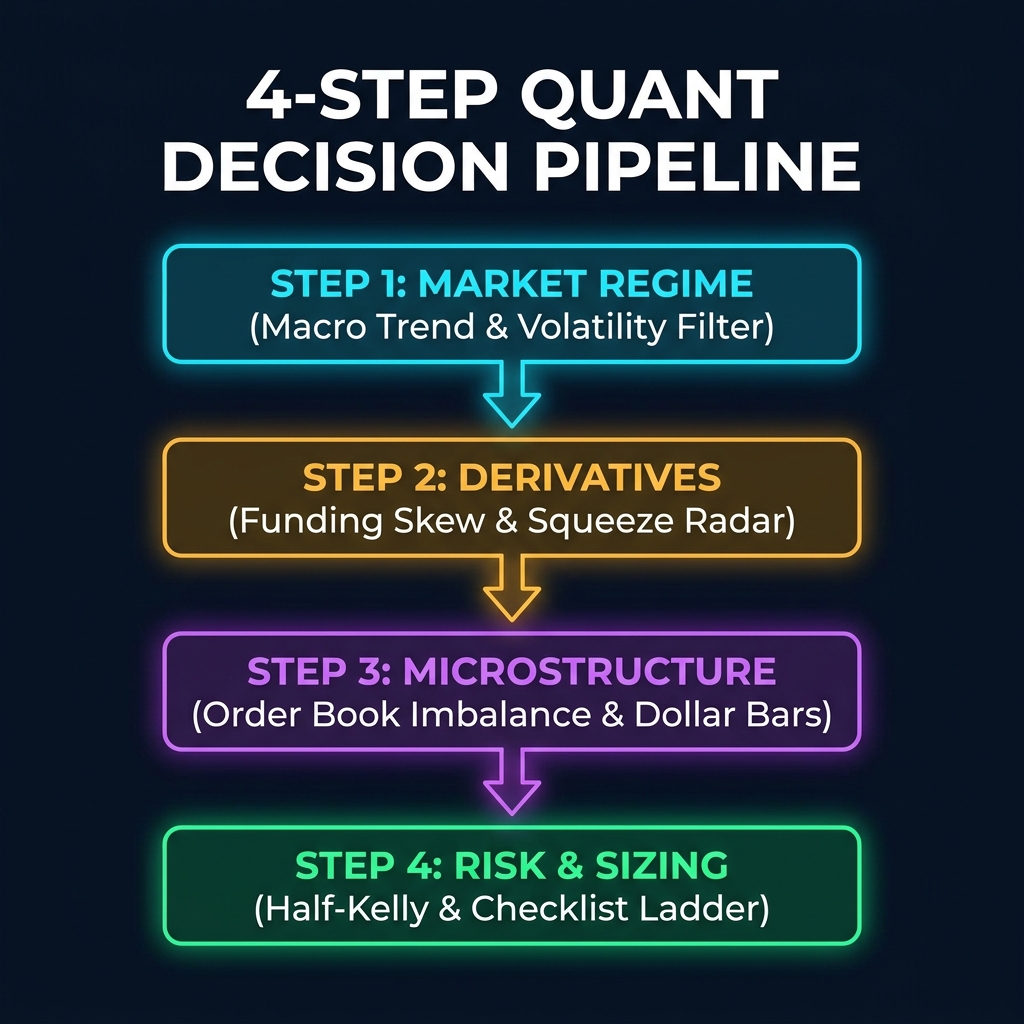
The core operational breakthrough of the Quant Terminal is the 4-Step Workflow Bar. Instead of staring at dozens of conflicting indicators, traders follow a sequential quantitative gate:
Alpha Signal Hero: Synthesizes multi-timeframe trend strength and order flow momentum into an actionable posture: STRONG LONG, LEAN LONG, FLAT, LEAN SHORT, or STRONG SHORT.
Regime Classifier: An unsupervised Hidden Markov / clustering model that labels current market structure as BULL, BEAR, or SIDEWAYS.
Kronos Neural Forecaster: A specialized predictive model estimating the most probable close price (K_target) over the active holding horizon.
Rule of Thumb: Never initiate a long position when the Regime is BEAR and Confidence is $< 60%$. Wait for alignment.
Step 2: Pre-Trade Risk Filter (5-Factor Go / No-Go Checklist)
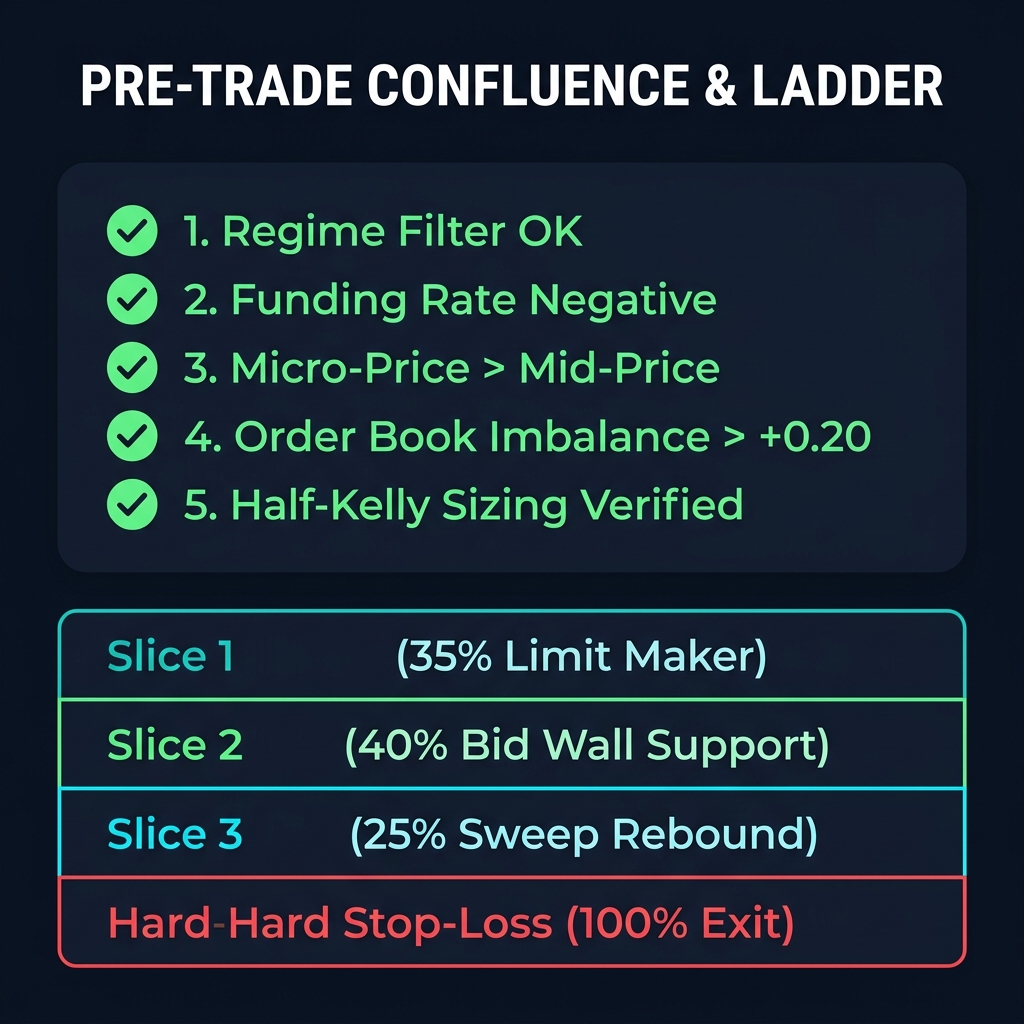
A strong directional signal is worthless if executing into illiquid spreads or adverse market conditions. Step 2 subjects the proposed trade to a rigorous 5-factor checklist:
+───────────────────────────────────────────────────────────+
| [STEP 2] PRE-TRADE CHECK                                  |
| VERDICT: GO (84/100)                                      |
|                                                           |
|  ✓ Trend Alignment   : 4H & 1D EMAs stacked bullishly     |
|  ✓ Momentum Velocity : RSI(14) = 54.2 with positive MACD  |
|  ✓ Risk/Reward Ratio : 2.45:1 to Key Resistance           |
|  ✓ Liquidity Depth   : Top 20 L2 depth > $4.2M            |
|  ✓ Regime Consensus  : AI Mood and Kronos synchronized    |
+───────────────────────────────────────────────────────────+
The Suggested Trade Ladder
When the overall verdict is GO, the engine computes a mathematically derived entry ladder based on local support/resistance and expected volatility:
Level
Price Target
Offset (%)
Rationale
Take-Profit 1 (TP1)
$66,450
+3.42%
Upper Volatility Barrier (Upper Barrier π+)
Entry Zone
$64,250
—
Volume-Weighted Fair Value
Stop-Loss (SL)
$63,280
-1.51%
Invalidation below Microstructure Support
Step 3: Institutional Flow (CVD & $1M Dollar Bars)
Even with a confirmed signal and passed risk check, retail market orders can suffer severe slippage if entered against large iceberg orders. Step 3 inspects real-time order book mechanics:
Cross-Venue OBI Gauge: Checks whether the bid/ask order book skew is shared across Binance, Bybit, and OKX.
$1M Dollar Bars: Validates whether the price is trading above or below institutional VWAP.
Institutional vs. Retail Tag: Bars filling in under 180 trades confirm aggressive whale accumulation.
Step 4: Capital & Kelly Sizing (Risk Engine)
The final step translates the trade opportunity into an exact capital allocation using Half-Kelly positioning:
+───────────────────────────────────────────────────────────+
| [STEP 4] CAPITAL & KELLY SIZING                           |
|                                                           |
| Engine Status  : RUNNING ●                                |
| Kill-Switch    : CLEAR (Normal Mode)                      |
| Sizing Factor  : HALF-KELLY (0.5x)                        |
| Allocated Pos  : 18.5% of Equity                          |
| Max Drawdown   : [████░░░░░░░░░░░░░░░] 3.42% / 15.0% Max  |
+───────────────────────────────────────────────────────────+
Drawdown Meter: Constantly monitors rolling peak-to-trough account drawdown against the 15% hard stop threshold.
Dynamic Leverage: Caps position leverage between 1x and 3x based on asset volatility and covariance with other open trades.
Fail-Safe Kill Switch: If sudden exchange API instability or abnormal market slippage is detected, the terminal flags KILL-SWITCH ACTIVE, freezing new order generation.
Daily Operational Routine on Quant Terminal
Follow this structured protocol during every market session:
Scan the Tape Bar: Verify macro climate. Check whether average funding is balanced and WebSocket stream is active (LIVE).
Review Step 1 (Directional Bias): Identify coins showing clear regime agreement (BULL or BEAR) with confidence $>70%$.
Inspect Step 2 (Pre-Trade Verdict): Only proceed if the score is GO ($>75/100$). Discard setups showing NO_GO or WAIT.
Confirm Step 3 (Institutional Flow): Check that the CVD is trending in your trade direction and $1M Dollar Bars show Close > VWAP for longs.
Execute according to Step 4 (Kelly Sizing): Never override the suggested position size. Respect the Half-Kelly allocation to preserve account longevity.
🔎 Deep Dive into Dollar Bars: How do you read the specific nuances of the $1M Dollar Bars table and tick count signals?
Learn Marcos López de Prado's Triple-Barrier Method, Meta-Labeling, and Purged Cross-Validation to eliminate overfitting in crypto algorithmic trading.