Liquid Staking Explained: Earn Yield Without Locking Your Crypto
Complete guide to liquid staking protocols in 2026. Learn how Lido, Rocket Pool, and Jito work, compare yields across ETH and SOL, and understand the risks of LST tokens like stETH and jitoSOL.
DK
Daniel KimHead of Curriculum & Trader Development·May 20, 2026 · 12 min read · Updated Oct 6
Traditional staking forces an uncomfortable trade-off: earn 3-5% yield on your ETH or SOL, but lose the ability to trade, use as collateral, or deploy in DeFi. In a volatile market like May 2026 — with BTC at $77,200 and the Fear & Greed Index at 27 — locking assets for weeks feels reckless.
Liquid staking solves this. You stake your tokens, earn yield, and receive a liquid derivative token (LST) that you can use elsewhere. It's staking without the lockup.
How Liquid Staking Works
The Basic Mechanism
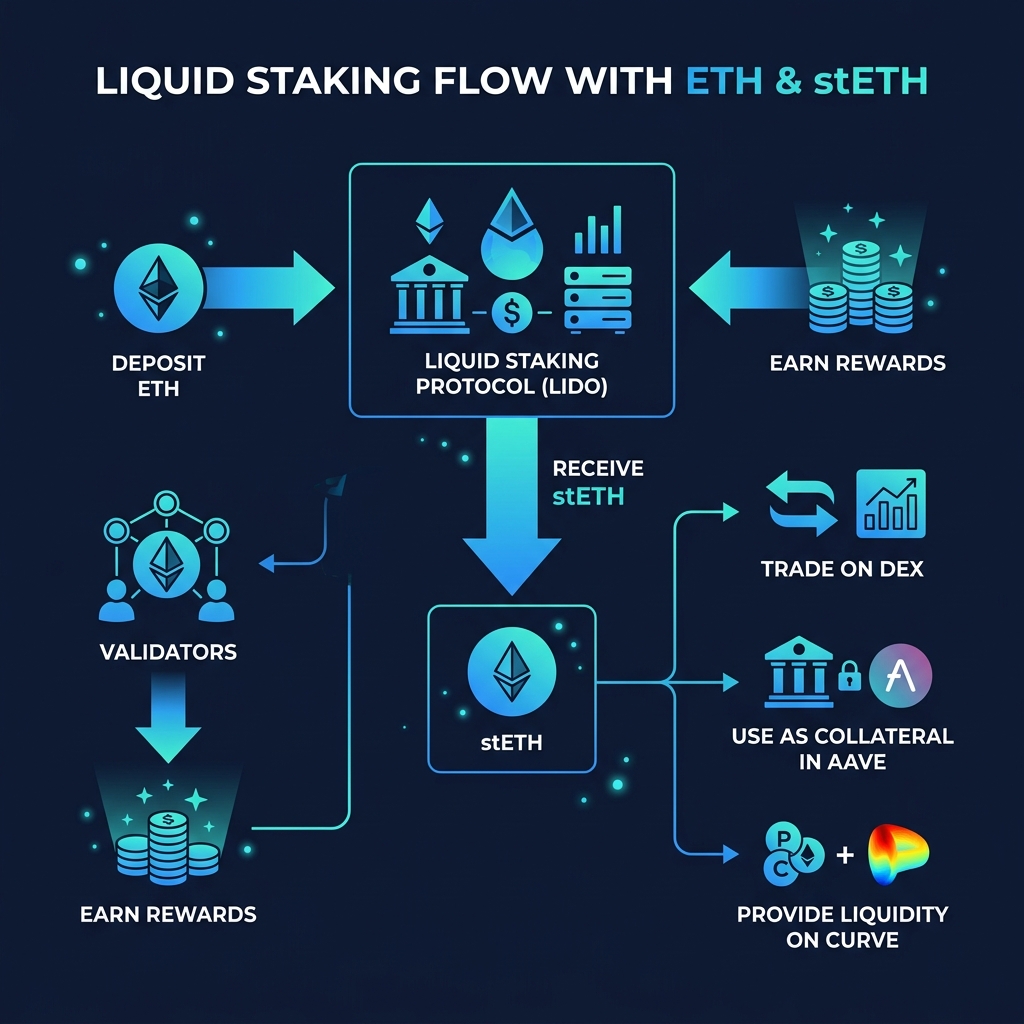
You deposit ETH (or SOL) into a liquid staking protocol
The protocol stakes your tokens with validators
You receive an LST token (e.g., stETH, rETH, jitoSOL) representing your staked position
The LST token accrues value as staking rewards accumulate
You can trade, lend, or use the LST in DeFi — while still earning staking yield
Two LST Models
Rebasing Model (Lido's stETH):
Your stETH balance increases daily. If you hold 10 stETH, tomorrow you hold 10.0008 stETH (approximately). The token count grows, but each token maintains ~1:1 peg with ETH.
Value-Accruing Model (Rocket Pool's rETH):
Your rETH balance stays the same, but each token becomes worth more ETH over time. 1 rETH might equal 1.08 ETH today and 1.12 ETH in six months. The exchange rate increases.
Model
Example
Balance Changes?
Price vs. ETH
Rebasing
stETH
✅ Daily increase
~1:1
Value-accruing
rETH
❌ Fixed
Gradually increases
The Major Liquid Staking Protocols (2026)
Ethereum Liquid Staking
Lido (stETH)
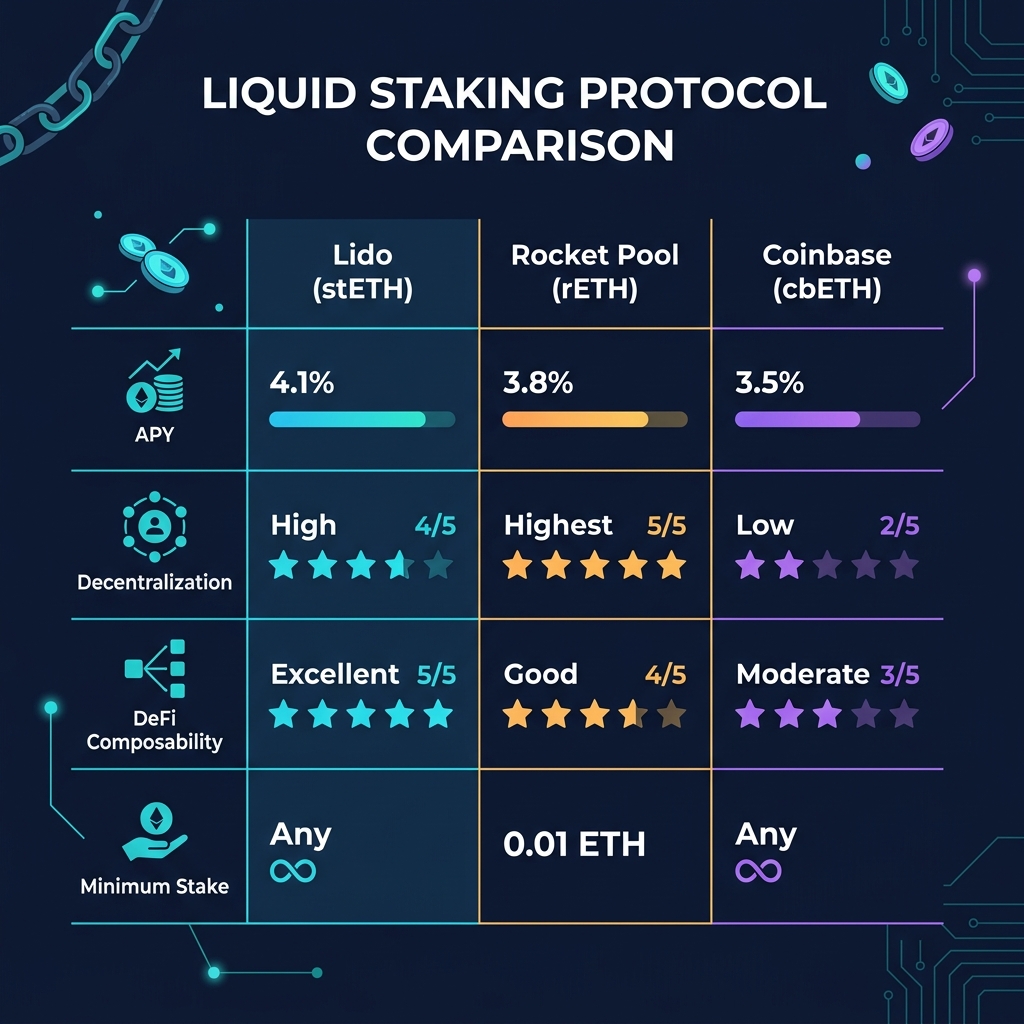
The dominant force. Lido controls ~29% of all staked ETH, making it the single largest staking entity on Ethereum.
Metric
Value
TVL
~$14.5B
APY
3.2-3.5%
Fee
10% of staking rewards
LST Token
stETH (rebasing)
Validators
Professional operator set
Unstaking
Instant via DEX or ~1-5 days native
Strengths:
Deepest liquidity of any LST — you can swap millions without slippage
Centralization concern (too much ETH in one protocol)
Smart contract dependency
Validator operator set is permissioned
Rocket Pool (rETH)
The decentralized alternative. Rocket Pool allows anyone to run a validator with just 8 ETH (vs. 32 ETH for solo staking).
Metric
Value
TVL
~$3.2B
APY
3.0-3.3%
Fee
14% of staking rewards
LST Token
rETH (value-accruing)
Validators
Permissionless (anyone can join)
Unstaking
DEX swap or ~7 days native
Strengths:
Most decentralized major LST protocol
rETH value-accruing model is simpler for tax accounting
No single operator controls more than a small % of validators
Risks:
Lower liquidity than stETH
Higher effective fee (14% vs. 10%)
Slightly lower APY due to fee structure
EigenLayer Restaking
The yield amplifier. EigenLayer allows you to "restake" your stETH or rETH to secure additional protocols (AVSs), earning extra yield on top of Ethereum staking rewards.
Metric
Value
TVL
~$11B
Additional APY
1-4% on top of base staking
Risk
Higher — exposure to AVS slashing
Complexity
High — requires understanding restaking dynamics
The yield stack:
ETH base staking (3.3%) + EigenLayer restaking (1-3%) + DeFi usage of LST (2-5%) = 6-11% total yield on a blue-chip asset.
Solana Liquid Staking
Jito (jitoSOL)
Solana's leading liquid staking protocol, enhanced with MEV (Maximum Extractable Value) rewards.
Metric
Value
TVL
~$2.1B
APY
7.2-7.8%
Fee
4% of rewards
LST Token
jitoSOL (value-accruing)
MEV Rewards
Yes — additional yield from block tips
Unstaking
~2-3 epochs (~4-6 days)
Why Solana staking yields are higher:
Solana's inflation rate (~5.5%) is higher than Ethereum's
MEV rewards on Solana are substantial due to high transaction volume
Lower staking ratio (~67%) means each staker gets a larger share
Marinade (mSOL)
Solana's most decentralized staking option, distributing stake across 400+ validators.
Metric
Value
TVL
~$1.3B
APY
6.8-7.3%
Fee
6% of rewards
LST Token
mSOL (value-accruing)
Validators
400+ (automated delegation)
Unique Feature
Directed stake (choose your validators)
Yield Comparison: Where to Stake in 2026
Asset
Protocol
Base APY
With Restaking
With DeFi
Total Potential
ETH
Lido (stETH)
3.3%
5.5%
8-12%
Up to 12%
ETH
Rocket Pool (rETH)
3.1%
5.0%
7-10%
Up to 10%
SOL
Jito (jitoSOL)
7.5%
N/A
10-15%
Up to 15%
SOL
Marinade (mSOL)
7.0%
N/A
9-13%
Up to 13%
Note: "With DeFi" yields include using LSTs as collateral for borrowing or in liquidity pools. These carry additional smart contract and impermanent loss risks.
Risks You Must Understand
1. Smart Contract Risk
Every liquid staking protocol is a smart contract. If there's a bug, your staked ETH could be at risk. Mitigation:
Only use protocols with multiple audits from reputable firms
Check the protocol's bug bounty program — larger bounties = more security confidence
Diversify across protocols if your position is significant
2. Depeg Risk
LST tokens should trade near 1:1 with their underlying asset, but this peg can break:
Historical example: stETH traded at a 5% discount during the 2022 Terra/3AC crisis. If you needed to sell stETH during the panic, you'd lose 5% on top of ETH's price decline.
Current state (May 2026): stETH/ETH peg is stable at 0.9997 — healthy conditions.
When depegs happen:
Market-wide panic → forced selling of LSTs
Protocol-specific fear → bank run dynamics
Large single-entity unstaking → temporary liquidity imbalance
3. Slashing Risk
Validators can be slashed (penalized) for misbehavior:
Double signing (signing two different blocks at the same height)
Extended downtime (failing to validate for long periods)
The protocol absorbs slashing losses, which reduces everyone's yield. Well-run protocols (Lido, Rocket Pool) have insurance funds to cover minor slashing events.
4. Regulatory Risk
Liquid staking exists in a regulatory gray zone:
The SEC has shown interest in whether LSTs qualify as securities
Some jurisdictions may treat staking rewards differently for tax purposes
Protocol governance tokens (LDO, RPL) face their own regulatory scrutiny
5. Yield Compression
As more ETH gets staked, individual yields decrease:
2023: ~4.5% APY on ETH staking
2024: ~3.8% APY
2026: ~3.3% APY
This trend will continue. Don't enter liquid staking expecting today's rates forever.
DeFi Strategies with LSTs
Strategy 1: Recursive Leverage (Advanced)
Deposit stETH into Aave as collateral
Borrow ETH against your stETH (at ~70% LTV)
Stake the borrowed ETH for more stETH
Repeat
Effective yield: 8-12% on ETH exposure
Risk: Liquidation if stETH depegs or ETH drops sharply
Suitable for: Risk-tolerant traders in stable markets only
Strategy 2: Liquidity Provision
Provide stETH/ETH liquidity on Curve
Earn trading fees + CRV rewards + base staking yield
Effective yield: 5-8%
Risk: Minimal impermanent loss (both assets track ETH closely)
Suitable for: Passive income seekers
Strategy 3: Pendle Yield Trading
Split your stETH into Principal Token (PT) and Yield Token (YT) on Pendle
Track liquid staking tokens and their performance alongside your entire crypto portfolio on CoinXSight. Use Discovery to find the best yield opportunities and Deep Alpha to time your entries.
The DeFi yield farming landscape has fundamentally shifted from inflationary token rewards to sustainable, real-yield models. Learn which strategies generate…
Master risk management for crypto trading. Learn position sizing formulas, stop-loss strategies, and how CoinXSight's Portfolio module tracks your risk…