Understand Real-World Asset (RWA) tokenization — how traditional assets like US Treasuries, real estate, and commodities are moving on-chain. Learn why this is the biggest crypto narrative of 2026 and how it affects traders.
DK
Daniel KimHead of Curriculum & Trader Development·May 19, 2026 · 11 min read · Updated Oct 6
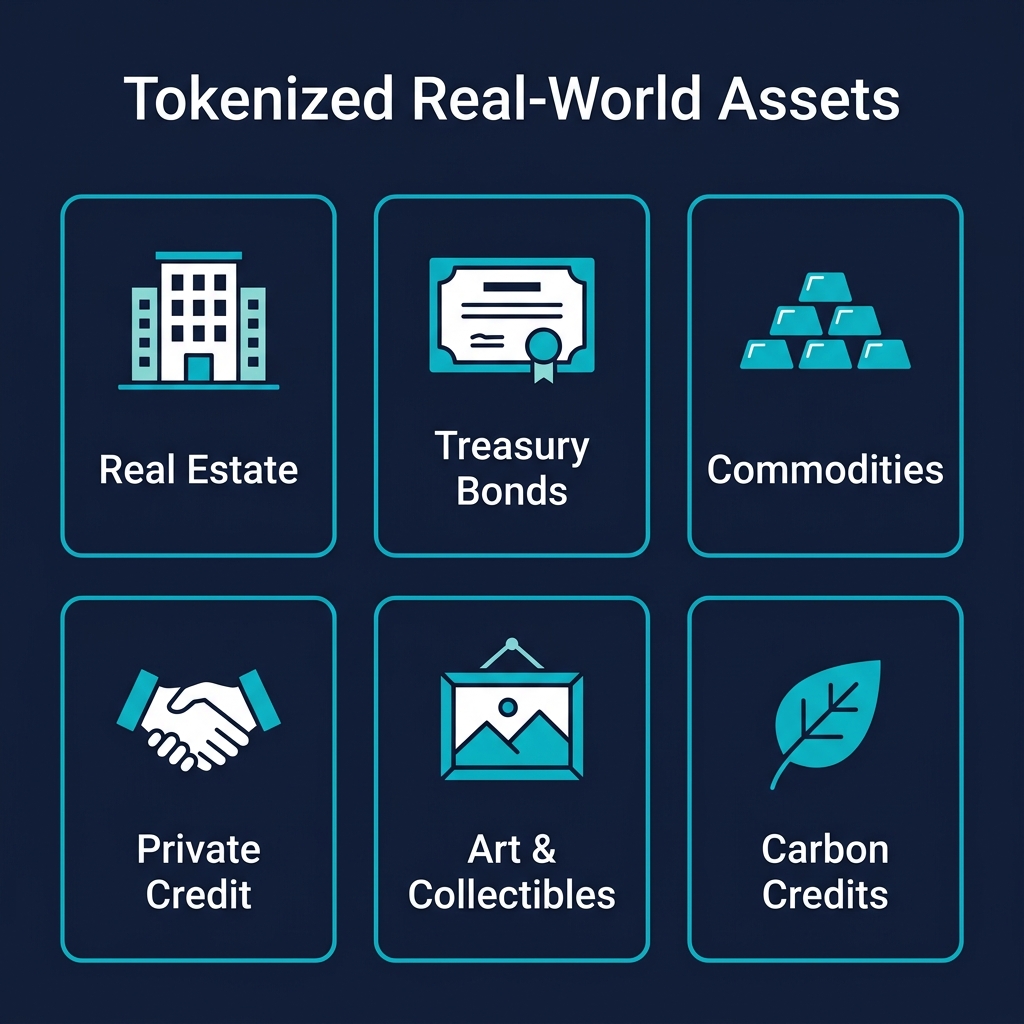
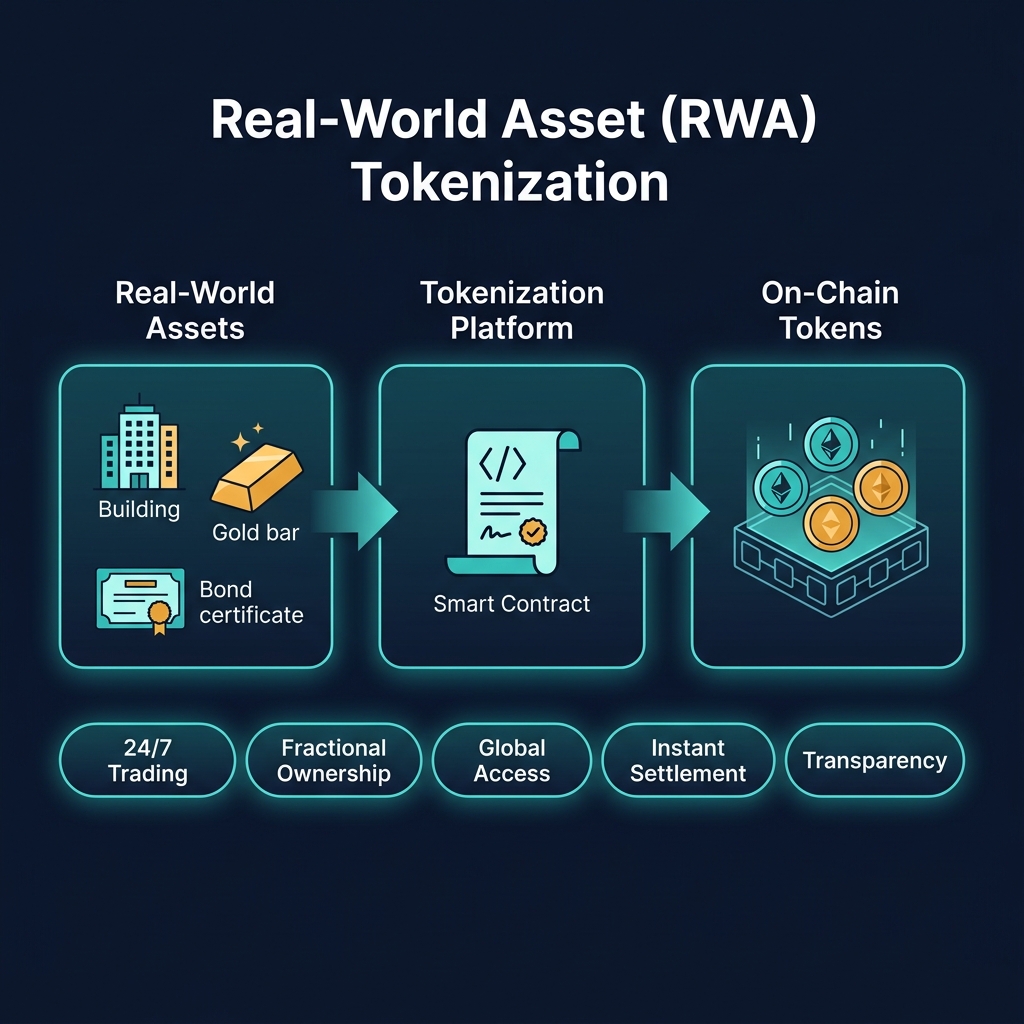
Real-World Asset (RWA) tokenization is the process of creating a digital token on a blockchain that represents ownership of a traditional financial asset — US Treasury bonds, real estate, corporate debt, commodities, or private equity.
Think of it as a digital receipt. When you buy a tokenized US Treasury bond, you're not buying a crypto token that "tracks" the bond's price — you're buying an on-chain representation of an actual Treasury bond held in custody by a regulated institution. The token carries the same economic rights (interest payments, maturity value) as the underlying asset.
This isn't theoretical. By mid-2026, over $15 billion in real-world assets have been tokenized, with BlackRock's BUIDL fund alone managing billions in tokenized Treasury products. Major financial institutions — Fidelity, Franklin Templeton, JPMorgan — are actively issuing tokenized assets.
Why Should Crypto Traders Care?
If you trade crypto, RWA tokenization affects you in four direct ways:
1. New Yield Sources
Traditional DeFi yield comes from token emissions (inflationary) or trading fees (variable). RWA-backed yield comes from real-world interest payments — US Treasury rates, corporate loan interest, real estate rental income.
This means you can now earn 4-5% APY on stablecoin deposits backed by actual US Treasuries, not algorithmic promises. For risk-adjusted returns, this is a massive improvement over pre-2026 DeFi yield options.
2. Better Collateral for DeFi
Tokenized Treasuries are becoming the "pristine collateral" of DeFi. Lending protocols that accept tokenized T-bills as collateral offer better terms because the collateral itself earns yield and has minimal default risk.
Before RWA: You deposit ETH as collateral → borrow stablecoins → your collateral earns nothing while locked
After RWA: You deposit tokenized T-bills as collateral → borrow stablecoins → your collateral earns 4-5% while locked → effectively reducing your borrowing cost to near zero
3. Sector Trading Opportunities
RWA tokens have become a major crypto sector, similar to DeFi, AI, or meme coins. Tokens of RWA infrastructure protocols (Ondo, Centrifuge, Maple, Goldfinch) move based on institutional adoption metrics, TVL growth, and regulatory developments.
CoinXSight's Discovery module tracks RWA as a distinct sector, showing capital flow patterns and momentum data.
4. Institutional Capital Inflow
RWA tokenization is the primary mechanism through which institutional capital (pension funds, endowments, sovereign wealth funds) enters the crypto ecosystem. More institutional capital = more liquidity = more sophisticated markets = better opportunities for data-driven traders.
The RWA Landscape in 2026
Modern crypto analytics platforms integrate these signals with additional data layers — combining trading indicators, on-chain metrics, and AI analysis for higher-probability entries.
Tokenized Treasuries (Largest Category)
What: US Treasury bonds (T-bills, T-notes) represented as ERC-20 tokens on Ethereum, Solana, or other chains.
Key products:
BlackRock BUIDL — The largest tokenized fund
Franklin Templeton FOBXX — Tokenized money market fund
Ondo USDY — Yield-bearing stablecoin backed by T-bills
Yield: 4-5% APY, paid in stablecoins or compounded into the token's NAV
Why they matter: They provide a risk-free rate benchmark for all of DeFi. Any yield source now competes against "I could just hold tokenized T-bills and earn 4.5% with zero crypto risk."
Tokenized Private Credit
What: Corporate loans, invoice financing, and trade receivables represented on-chain.
Key protocols: Maple Finance, Centrifuge, Goldfinch
Yield: 8-15% APY, but with credit risk (borrower default)
Risk factors: Unlike Treasuries, private credit carries real default risk. Due diligence on the underlying borrowers is essential.
Tokenized Real Estate
What: Fractional ownership of real estate properties via blockchain tokens.
How it works: A property worth $1M is tokenized into 1,000 tokens of $1,000 each. Token holders receive proportional rental income and appreciation.
Current state: Still early compared to Treasuries. Regulatory complexity around property rights and jurisdiction makes scaling slower.
Tokenized Commodities
What: Digital tokens representing ownership of physical gold, silver, oil, or agricultural products.
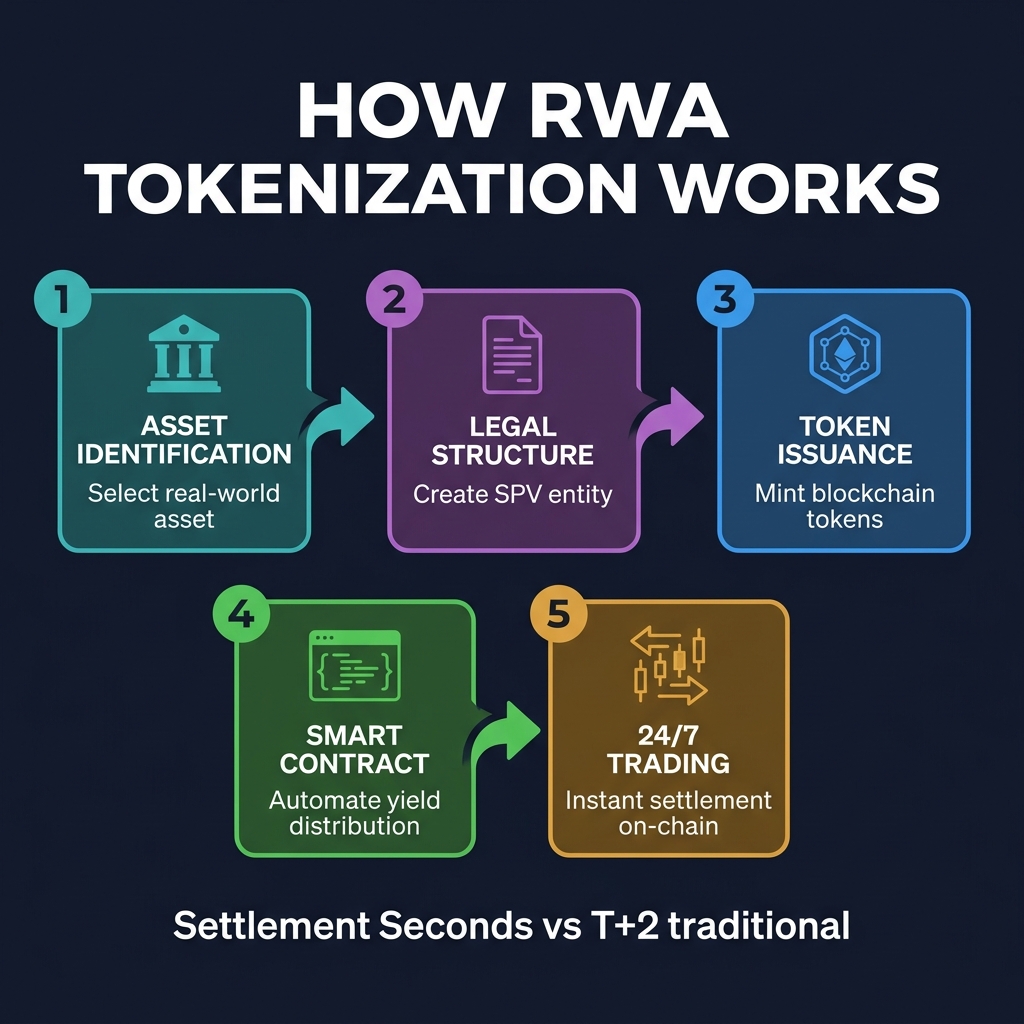
Step 1: An institution (BlackRock, Ondo, etc.) purchases traditional assets and holds them with a qualified custodian.
Step 2: A smart contract is deployed that can mint tokens proportional to the custodied assets and burn tokens when they're redeemed.
Step 3: Investors purchase tokens, which represent claims on the underlying assets. The smart contract enforces supply constraints — new tokens can only be minted when new assets are deposited.
Step 4: Yield (interest, dividends, rent) is distributed to token holders, either as periodic stablecoin payments or by increasing the token's net asset value (NAV).
Step 5: Redemption — token holders can burn their tokens to receive the underlying asset value, subject to the protocol's redemption terms.
Key Trust Assumptions
RWA tokens require trust in:
The custodian — that they actually hold the assets they claim
The issuer — that they correctly mint/burn tokens proportional to custody
The legal framework — that token holders have genuine legal claims on underlying assets
The oracle — that off-chain data (asset prices, interest rates) is accurately reported on-chain
This trust requirement is the fundamental difference between RWA tokens and native crypto assets like ETH or BTC, which are trustless.
Trading the RWA Sector
Strategy 1: Hold Yield-Bearing Stablecoins
The simplest approach: convert some stablecoin holdings to yield-bearing RWA tokens (USDY, BUIDL, FOBXX). You earn 4-5% APY on capital that would otherwise earn nothing, while maintaining liquidity for trading.
Best for: Capital that sits idle between trades.
Strategy 2: Trade RWA Infrastructure Tokens
Tokens of protocols that build RWA infrastructure (Ondo, Centrifuge, Maple) trade like sector-specific equities. They correlate with:
Interest rates drop (lower yield = less compelling vs native crypto)
Regulatory uncertainty increases
Smart contract exploits hit any RWA protocol (sector-wide fear)
Risks Specific to RWA Tokens
Custodial Risk
If the custodian holding the underlying assets becomes insolvent, token holders may not recover their full value. This is the same risk as holding assets at a bank or brokerage — it's not unique to crypto, but it's important to understand.
Mitigation: Choose RWA products from established institutions with segregated custody arrangements.
Regulatory Risk
RWA tokens sit at the intersection of securities law and crypto regulation. Different jurisdictions classify them differently. A regulatory crackdown in one jurisdiction could affect token accessibility and liquidity.
Mitigation: Diversify across RWA products from multiple jurisdictions.
Smart Contract Risk
The smart contracts governing token minting, burning, and yield distribution can have bugs or vulnerabilities. An exploit could allow unauthorized minting or theft of custodied assets.
Mitigation: Prefer protocols with multiple independent audits and substantial time-in-market without incidents.
Liquidity Risk
Some RWA tokens have lower trading volume than native crypto assets. Large positions may be difficult to exit quickly without price impact.
Mitigation: Check daily trading volume before entering. Stick to the most liquid RWA products for trading-sized positions.
RWA Metrics to Track
Metric
What it tells you
Where to find
Total RWA TVL
Overall sector growth
DeFi dashboards
Treasury token market cap
Institutional adoption rate
Token analytics
New product launches
Acceleration of tokenization trend
Crypto news, CoinXSight Discovery
Regulatory developments
Legal clarity trajectory
Regulatory trackers
DeFi integration count
How many protocols accept RWA collateral
Protocol documentation
Yield spread
RWA yield vs DeFi native yield
Compare protocol dashboards
Summary
RWA tokenization is the most significant structural development in crypto since DeFi. It bridges traditional finance and blockchain, bringing trillions in real-world assets on-chain and fundamentally changing how yield, collateral, and institutional participation work in the crypto ecosystem.
Key takeaways for traders:
RWA provides real yield (4-15% APY) backed by actual economic activity, not token emissions
Tokenized Treasuries are becoming the risk-free rate benchmark for all of DeFi
RWA infrastructure tokens (Ondo, Centrifuge, Maple) are a tradeable sector with clear catalysts
RWA-DeFi composability creates new carry trade and yield optimization strategies
Custodial, regulatory, and smart contract risks require due diligence
This is a 2026-defining narrative that will likely accelerate through the decade. Understanding it now positions you ahead of the broader market.
Learn to identify altcoin season using BTC dominance charts, capital rotation patterns, sector analysis, and on-chain metrics. A data-driven framework…
The DeFi yield farming landscape has fundamentally shifted from inflationary token rewards to sustainable, real-yield models. Learn which strategies generate…