London Hiked, Washington’s Jobs Held Firm — and the Nasdaq Erased Bitcoin’s $80,000 Recovery Anyway
The Bank of England hiked to 4.00% on an 8u20131 vote, jobless claims hit their lowest since 1969, and productivity surged u2014 then the Nasdaq posted its worst day since April and Bitcoin fell back to $76,000, leaving Friday's payrolls to decide whether Thursday was a correction or a rout.
CX
CoinXSight Alpha DeskQuantitative Research Desk·Nov 6, 2026 · Updated Nov 6
Thursday was supposed to be the week finally settling down. The Bank of England did what markets expected and raised rates. American jobless claims came in at their lowest since 1969. Productivity surged. And Bitcoin still lost more than five percent overnight, because none of that was the story Wall Street was trading. By Friday morning in Vietnam, Bitcoin was back near $76,000, the $80,000 recovery of Wednesday erased in a single session, and the only thing left standing between this week and a much worse one is tonight’s payrolls report.
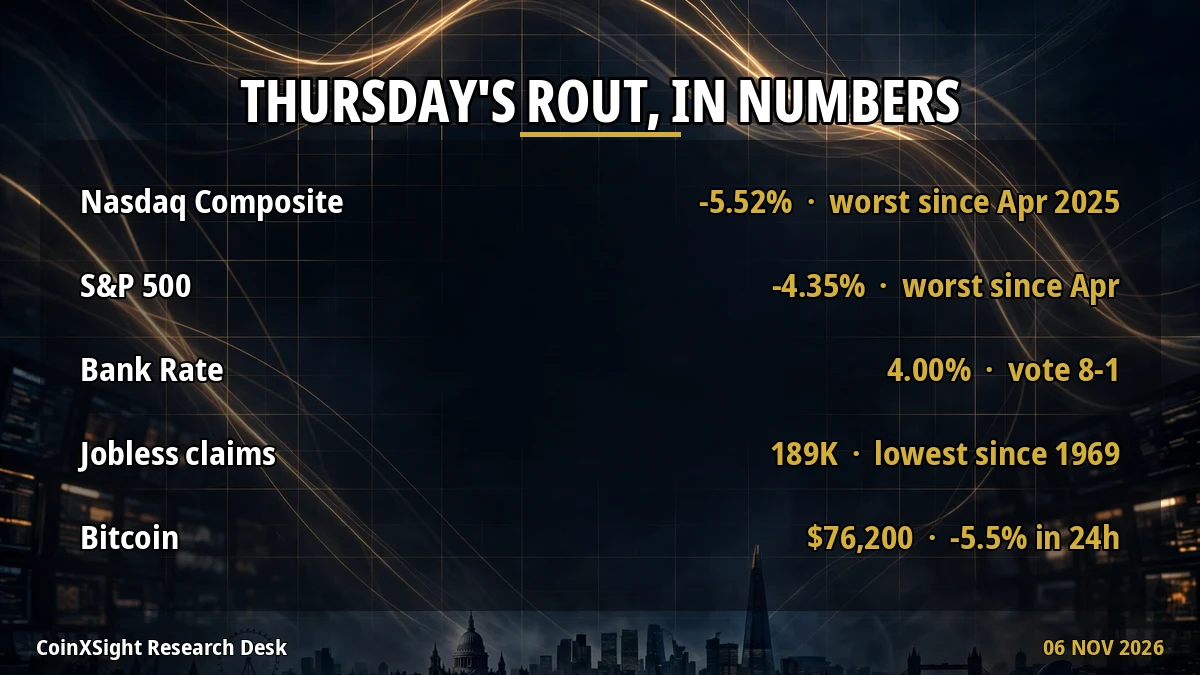
Start with the damage, because it reframes everything else in this article. The Nasdaq Composite fell 5.52 percent on Thursday to 24,315.00, its worst day since April 2025, and closed in correction territory, 11.9 percent below its October record. The S&P 500 fell 4.35 percent, also its worst day since April. The Dow lost 1,833 points, or 3.44 percent. The Nasdaq 100 dropped 6.36 percent, its worst day since 2020. The Philadelphia Semiconductor Index fell 12.25 percent, its worst day since March 2020, with Nvidia down 9.3 percent, Micron down 17.5 percent, and SanDisk down more than 22 percent. The Russell 2000 fell 4.45 percent. This was not a wobble. It was the market’s worst session in seven months, and it arrived the day after the post-election rally, not during it.
What set it off is a matter of attribution, and the honest way to write it is as traders read it, not as settled fact. The selling concentrated in chips and data-center names, and the explanation most desks gave was the Democratic sweep: a Congress and a set of state governments now seen as likely to slow the data-center buildout, with the governor-elect of Texas campaigning on a temporary moratorium and voters in 41 communities approving restrictions on new data centers. Qualcomm gave the move a company-specific spark, reporting handset revenue down 26 percent year on year and falling more than 10 percent. Underneath both sits the older doubt — whether the sums being spent on AI infrastructure will ever earn their keep. Crypto stocks fell with the sector rather than on crypto news: Coinbase, Circle, Robinhood, and MARA all dropped at least 10 percent. Bitcoin traded as risk, not as refuge. Liquidations ran to roughly $838 million in 24 hours across more than 166,000 traders, according to CoinGlass, with some tallies putting the crypto-wide figure above $1 billion.
London hiked — and more hawkishly than anyone polled
Against that backdrop, the Bank of England’s decision almost looks like the calm part of the day. It was not. The Bank raised Bank Rate by 25 basis points to 4.00 percent, its first increase since August 2023, on an 8–1 vote. The lone dissenter was Catherine Mann, who wanted a 50-point rise to 4.25 percent. Nobody voted to hold. Every member of the committee backed tightening; the argument was only about how much. That is more hawkish than the 7–2 split the Reuters poll had expected, and it is a sharp turn from September, when the committee held 6–3 with three members already wanting a rise. Swati Dhingra and Alan Taylor voted for a hike for the first time since joining the committee.
The hike itself was priced. The news was the direction of travel. Governor Andrew Bailey said at his press conference: “Today’s increase should not be seen as the first in an inevitable long sequence of hikes. That is not inevitable. But unless the conflict in the Middle East is resolved, neither does it seem likely to be the last increase.” He refused to sign up to a “two and done” path, said there was a case for another 25-point rise if the war does not end, and left the door open where the market had expected him to close it. Clare Lombardelli said another hike in the near future may be needed; Huw Pill and Megan Greene argued further tightening will likely be required. The Bank’s new forecasts explain the urgency: inflation is now expected to reach about 4.5 percent in the first quarter of 2027 and peak near 4.9 percent in the second quarter, up from 3.5 percent in September, while growth for 2027 was revised up to 1.3 percent. Markets now price roughly three more quarter-point rises in 2027. The next decision comes on December 17. For a central bank that spent the year holding, the message is that the holding is over, and the committee is not yet sure where the stopping point is.
The American labor market still will not break
Washington’s own numbers, released at 20:30 Vietnam time, told the same story the Bank of England was acting on: a labor market that is cooling by hiring less, not by firing more. Initial jobless claims fell to 189,000 in the week ending October 31, against a 197,000 consensus, and the prior week was revised up to 195,000. It is the lowest reading since 1969, matching the mid-July low, and claims have now stayed below 200,000 since mid-September. Continuing claims edged up 23,000 to 1.718 million in the week ending October 24, from a downwardly revised 1.695 million — a nudge, not a turn. The four-week moving average fell to 194,750.
The productivity report released at the same hour was the stronger surprise. Nonfarm productivity rose 3.6 percent annualized in the third quarter, against a 2.9 percent consensus, with output up 3.7 percent and hours worked up just 0.1 percent. The second quarter was revised up to 2.1 percent from 1.4 percent. Unit labor costs fell 0.7 percent, their first decline in more than a year — the number that matters most for the Fed’s inflation argument, because it says firms are producing more per worker while paying less per unit of output. Over the past year, productivity is up 2.1 percent.
One guardrail belongs here, because it is easy to get wrong. The claims week that just printed does not fall inside the survey period for Friday’s payrolls report, so 189,000 is not a forecast for tonight. It is evidence about layoffs, and the evidence says layoffs are not the problem. Read with Tuesday’s JOLTS report — 7.523 million openings — and Wednesday’s ADP count of 86,000 private jobs, the labor picture is consistent to the point of monotony: firms are not firing people, they are hiring slowly, and the December debate turns on whether Friday finally shows the hiring side cracking.
The week in one view
Print
What landed
What it means tonight
Bank of England, November 5
Hiked 25bp to 4.00%, vote 8–1; Mann wanted 50bp to 4.25%; nobody voted to hold
Hawkish surprise: the next move is open, inflation forecast peaks near 4.9% in Q2 2027
US jobless claims, week ending October 31
189,000 vs 197,000 consensus; lowest since 1969; continuing claims 1.718 million
Layoffs are not the problem; the claims week is outside the payrolls survey period
US productivity, Q3 prelim
+3.6% vs +2.9% expected; Q2 revised to +2.1%; unit labor costs −0.7%
Output per worker surging while labor costs fall — dovish for inflation, hawkish for the hike case
Worst day since April 2025; Nasdaq in correction; AI and data-center repricing, not a macro print
Bitcoin tape, Friday morning Vietnam time
Near $76,200, down about 5.5% in 24 hours; low near $75,208; ETH near $2,241, XRP near $1.21
$80,000 is resistance again; $76,500 broken; short-term holder cost basis near $75,950 is being tested
Payrolls, Friday 20:30 Vietnam time
Consensus split 55,000 to 65,000 depending on the survey; unemployment 4.2% expected
The week’s deciding print for December hike pricing near 79–81.5%
Tonight decides whether Thursday was a correction or a rout
Everything now funnels into 20:30 Vietnam time, when the Bureau of Labor Statistics reports October payrolls. The consensus is split, and the honest way to write it is as a range with sources attached: FactSet and CNBC put it at 55,000, in a 45,000 to 65,000 range, while several other previews cluster near 65,000, in a 50,000 to 65,000 range. Unemployment is expected to hold at 4.2 percent, and average hourly earnings to rise 0.3 percent on the month. September managed only 29,000 jobs, July was revised down to minus 10,000, and the revisions inside tonight’s release matter as much as the headline — a weak print with upward revisions tells a different story than a weak print with more cuts behind it. The breakeven pace of hiring is now near zero, by KPMG’s estimate, as retirements and tighter immigration shrink the labor force, so a print anywhere in the 45,000 to 65,000 range is enough to keep unemployment steady. Do not read 45,000 as a collapsing labor market, and do not read 65,000 as a boom. The survey’s own margin of error is roughly 100,000 jobs.
The two branches are straightforward. A strong beat with firm wages and unemployment flat hardens the December hike case — CME FedWatch put a 25-point December rise at roughly 79 to 81.5 percent on Thursday, with prediction markets lower at about 65 percent on Kalshi — and leaves Bitcoin fighting a tightening cycle with a broken chart. A soft print, especially with unemployment ticking up and negative revisions, gives the hold camp its first real ammunition of the week and takes pressure off risk. But one thin month does not reverse a tightening cycle, and the Fed does not meet again until December 8–9, with November payrolls on December 4 and October consumer prices on November 10 still to come before it. Tonight is the week’s deciding print, not the cycle’s.
Two smaller items belong on the watchlist, neither of them a reason to look away from payrolls. The University of Michigan’s preliminary consumer sentiment reading lands at 22:00 Vietnam time, with the forecast near 48 against October’s final 48.0, and a long-run inflation expectation above 3.5 percent would hand the hawks one more argument. And at 15:00 Vietnam time, about $2.65 billion of Bitcoin options expire on Deribit — 33,504 contracts, with max pain at $79,000. With Bitcoin trading below that level, the expiry is not a floor; it is one more piece of Friday plumbing that cuts against the bulls.
The levels from here are unsentimental. Eighty thousand dollars, reclaimed on Wednesday with such ceremony, is resistance again after one session. The $76,500 line that held all last week is broken, and the short-term holder cost basis near $75,950 is the ground being fought over this morning. The election-night low of $75,736 sits just below it, and a daily close under that level opens the $72,956 zone the market has not tested since the autumn. Above, the first job is simply getting back through $78,000, then $79,000, the options max-pain line. Ether near $2,241 and XRP near $1.21 fell harder than Bitcoin in percentage terms, which is what happens when the selling is about risk appetite rather than anything specific to crypto.
One thread from the week is worth closing honestly rather than leaving implied. Binance’s new proof-of-reserves snapshot, taken on November 4, has not yet had its zero-knowledge proof verified as live as of Friday morning — the 40 to 50 hours Binance said the computation would take lands around today, and until it appears, the only completed proof is the October 31 snapshot, finished on November 2, covering ten tokens at 1:1 or better. Withdrawals remain phased rather than fully restored, with about 95 percent of the affected value replenished. A snapshot is not an audit, and a proof that is due is not a proof that is done.
Thursday answered the central-bank question and the layoffs question, and the market answered back that neither was the question it was asking. The week began with an election, a services miss, and a ledger patch, and it ends with a stock-market rout and a jobs report carrying more weight than it did on Wednesday morning. If payrolls land firm, the story writes itself: a tightening world, a correcting Nasdaq, and a Bitcoin that has to prove $76,000 is a floor rather than a stop on the way down. If they land soft, the relief is real but narrow — one print does not undo a hawkish Bank of England, a 1969-low claims reading, and a market that has just decided AI might be worth less than it thought. Either way, Friday night is where this week gets its verdict, and the morning’s job was only to record how much Thursday changed the question.
This article is for informational purposes only and does not constitute financial advice. Figures are cited from official releases and market data as reported at the time of writing and are subject to revision. Cryptocurrency markets are volatile; always do your own research before making investment decisions.
Disclaimer: This quantitative macroeconomic analysis, central bank rate telemetry, and technical breakdown is published strictly for educational and informational purposes and does not constitute financial, investment, or trading advice. Digital asset markets involve significant capital risk and high volatility. Always conduct independent research and exercise disciplined risk management before making financial decisions.
CX
CoinXSight Alpha Desk
ALPHA // DESK
Quantitative Research Desk·Global Alpha Division
CoinXSight Institutional Research Desk produces quantitative crypto market intelligence, algorithmic models, and on-chain forensics.
QUANTITATIVE SUITE // DEEP ALPHA ENGINEACTIVE
BTC/USDT // LIVE SCANNER
CONFLUENCE 74
LIVE SPOT PRICE$82,807.47WEAK_BUY
TP2
$89,522.75
+9.07%
TP1
$85,056.42
+3.63%
ENTRY
$82,078.86
ZONE
SL
$80,590.09
-1.81%
Auto-detect Order Blocks, Fair Value Gaps and risk-adjusted DCA ladders in < 5s.