BoE Hikes Tonight, Claims Follow at 20:30 — and Friday’s Payrolls Decide What Bitcoin’s $80,000 Recovery Is Worth
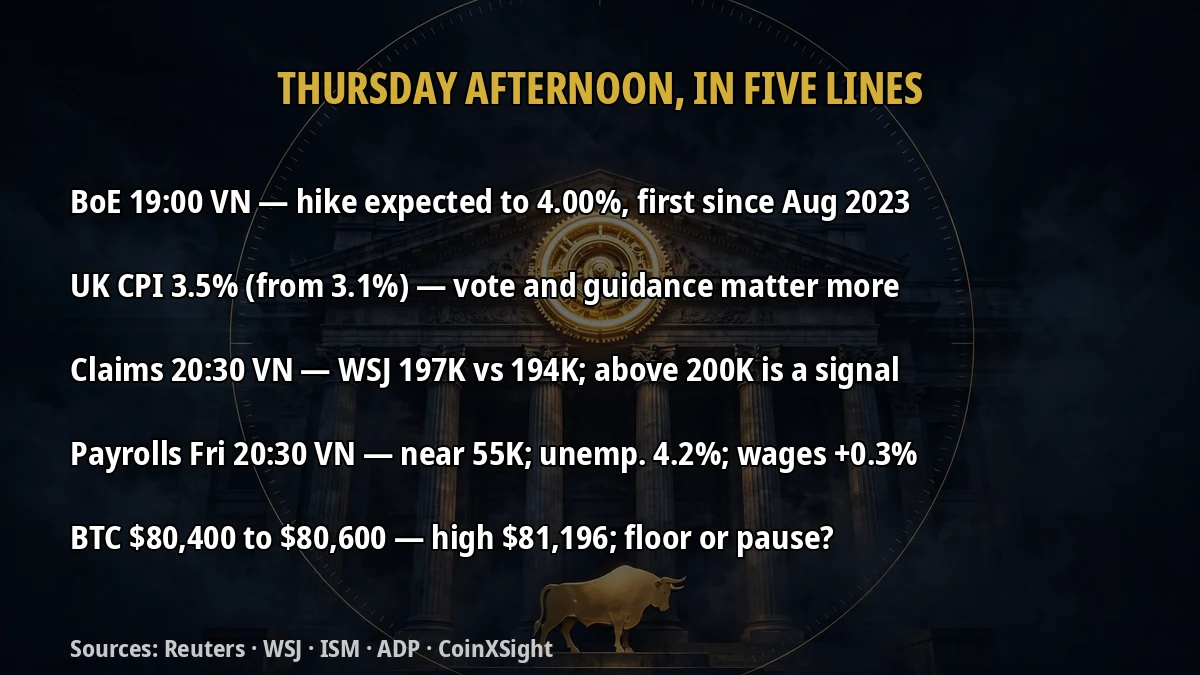
Two verdicts land tonight after the deadline: the Bank of England is expected to hike to 4.00% at 19:00 VN, its first rise since August 2023, and US jobless claims follow at 20:30 VN against 197,000 u2014 with Friday's payrolls still the week's deciding print for Bitcoin holding $80,000.
CX
CoinXSight Alpha DeskQuantitative Research Desk·Nov 5, 2026 · Updated Nov 5
By Thursday afternoon in Vietnam, the week has stopped handing out answers and gone back to asking questions. The count is called, services have cooled, the ledger is patched — that was the morning’s news. What happens next will not be known until after this article’s deadline: at 19:00 Vietnam time the Bank of England is expected to raise rates for the first time since August 2023, and ninety minutes later the United States reports weekly jobless claims. Neither number is in yet, and that is the point. This is a preview, not a recap, and the honest way to write it is as two branches: what each outcome would mean, and what Friday still has to decide.
Bitcoin is holding the ground it took back overnight. It trades near $80,400 to $80,600 at midday in Vietnam, up roughly 3 to 5 percent in 24 hours depending on the feed, after dipping to $75,736 on election night and touching $81,196 on the way back. Ethereum sits near $2,425, XRP near $1.307. The recovery is real but thin: it was built on a decided election and a mixed services print, not on a labour market verdict. Tonight’s two prints are the next test of whether $80,000 is a floor or a pause.
The Bank of England’s first hike in three years
The decision lands at 19:00 Vietnam time, which is noon in London, and the expectation is about as close to unanimous as central banking gets. In a Reuters poll published in mid-October, 54 of 63 economists forecast a 25-basis-point rise, taking Bank Rate from 3.75 percent to 4.00 percent. Market pricing puts the odds near 90 percent. The last time the Bank raised rates was August 2023; it has held at 3.75 percent since the final cut of the last cycle in December 2025.
The case for hiking is written in the inflation data. UK consumer prices rose 3.5 percent in the year to September, up from 3.1 percent in August and far above the Bank’s 2 percent target, driven by fuel and energy costs. Brent crude near $108 a barrel has pushed expected inflation above 4 percent early next year as the Ofgem price cap rises. The September meeting already showed where the committee was heading: it held 6 to 3, with three members voting for an immediate rise to 4.00 percent. Goldman Sachs expects a 7 to 2 vote this time, with the two likely dissenters preferring to hold.
But the 25 basis points are not the event. They are priced, and sterling already knows: the pound traded at $1.3434 against the dollar on Wednesday, and the Bank’s own sterling index touched 86.4, its joint highest since the Brexit referendum. What moves markets tonight is everything around the decision. Governor Andrew Bailey holds a press conference at 19:30 Vietnam time, and the Bank publishes its Monetary Policy Report with updated inflation and growth projections at the same moment as the decision. Three things are genuinely unresolved: the vote split, the new forecasts, and the guidance on what comes next.
The split matters because the committee has been divided 6 to 3 for two meetings. A 9 to 0 hike reads as intent to keep going; a 5 to 4 hike with four dissenters reads as a reluctant, one-off move. The guidance matters because the market has already priced in four more quarter-point rises by next September, a path ING economists have called extreme. The more common base case among economists is one further rise, to 4.25 percent, early next year — Goldman Sachs and Oxford Economics both land there, possibly in February, when inflation is projected to peak. If Bailey leans against the market’s four-hike path, sterling gives back some of this week’s gains and the dollar softens. If he validates it, the dollar firms and risk assets, crypto included, feel the drag.
For Bitcoin holders the transmission is indirect but real. A hawkish Bank of England that pushes the dollar higher tightens global liquidity at the margin, and Bitcoin’s recovery this week has been a risk-on move, not a safe-haven one. A dovish surprise does the opposite: a softer dollar and a gilt market that stops pricing endless tightening is the kind of backdrop in which $80,000 starts to look like a base rather than a ceiling.
Claims at 20:30: the quietest number that can still move the week
Ninety minutes after the Bank, the US Labor Department reports initial jobless claims for the week ending October 31. The Wall Street Journal’s survey puts the consensus at 197,000, against 194,000 the week before. That prior reading fell 1,000 from an upwardly revised 195,000 and came in below the 199,000 economists had forecast. Claims have now stayed mostly below 200,000 since mid-September, near 57-year lows, and the four-week moving average sits at 196,750. Continuing claims, a rough count of people still collecting benefits, dropped to 1.701 million in the week ended October 17.
It is a small number, and it rarely leads the news. But its message this week is the same one every other labour print has carried: layoffs are not the problem. Hiring is. The JOLTS report showed 7.523 million openings, ADP added 86,000 private jobs in October, and the ISM Services employment index rose to 51.4, its strongest since February. Firms are not firing people; they are hiring slowly and cautiously, with professional and business services shedding 27,000 jobs for a third straight month inside the ADP numbers.
That is why the branch that matters tonight is a break above 200,000. A print at or below the 197,000 consensus keeps the story intact: a labour market that is cooling by hiring less, not by firing more. A print above 200,000, the first in weeks, would be the first sign that the layoff side of the ledger is finally moving — and it would land less than 24 hours before payrolls, forcing a re-price of Friday before Friday arrives. The same 20:30 slot also brings the preliminary third-quarter productivity reading, expected at 2.9 percent against 1.4 percent previously, a number that matters for the wage-inflation argument the Federal Reserve will be watching.
The week in one view
Print
What landed
What it means tonight
JOLTS openings, September
7.523 million
Demand for workers is still there; the hiring slowdown is a choice, not a collapse
ADP private payrolls, October
86,000, above the 69,000 to 75,000 forecasts; September revised down to 86,000
Steady hiring, but flat against the revised September — no acceleration
ISM Services, October
54.5, down from 54.9; employment 51.4, prices 73.0
Cooling orders, firming hiring, still-hot prices: a mixed print that leaves Friday decisive
Bank of England, tonight 19:00 Vietnam time
Expected hike from 3.75 percent to 4.00 percent, the first since August 2023
Vote split and guidance matter more than the decision; markets price four more hikes by next September
US jobless claims, tonight 20:30 Vietnam time
Consensus 197,000 vs 194,000 prior; below 200,000 since mid-September
A break above 200,000 would be the week’s first layoff signal, hours before payrolls
Payrolls, Friday 20:30 Vietnam time
Consensus near 55,000, unemployment 4.2 percent, wages up 0.3 percent month on month
The week’s deciding print for December hike pricing near 77 to 79 percent
Friday is still the decider
Whatever happens tonight, the week is not settled until Friday at 20:30 Vietnam time, when the Bureau of Labor Statistics reports October payrolls. The consensus sits near 55,000 new jobs, with surveys ranging up to 65,000 in the Reuters poll and 59,000 in the Wall Street Journal’s, against just 29,000 in September. Unemployment is expected to hold at 4.2 percent, and average hourly earnings to rise 0.3 percent on the month.
That spread between the surveys is worth stating plainly rather than smoothing over: 55,000 and 65,000 are different labour markets, and the market will treat them differently. A print near the top of the range, with wages firm, hardens the case for a December rate rise — futures already price roughly a 77 to 79 percent chance of a 25-basis-point hike — and gives the hawks the third argument of the week after JOLTS and ADP. A print near the bottom, especially with wages soft, does the opposite: it turns a week of hawkish signals into a week that ended with the labour market finally bending, and it puts the December hike back in doubt.
The Federal Reserve held its own rate at 3.75 to 4.00 percent on October 28, so the US side of the rates story is still open, and Friday is the print that moves it. Tonight’s Bank of England decision is the overture: it tells the market how one major central bank reads an inflation problem that is being driven by energy, not wages. Friday tells it whether the American labour market can absorb that world without breaking.
The election result, called for the Democrats in both chambers by the Associated Press, frames all of this without deciding any of it. The new Congress is not seated until January 3, 2027, and until then Republicans keep their majorities and the president keeps his veto, so the CLARITY Act’s only near-term window is a lame-duck deal — a prospect, not a law. For the rest of the week, politics is background. Rates and jobs are the foreground.
The ledger, for completeness, is done with its drama for now. The XRPL’s fixCleanup3_4_0 amendment went live on Wednesday night at 21:52 Vietnam time, at ledger 108,112,129, closing a token-permission flaw. Native lending is still not enabled: the LendingProtocol and SingleAssetVault amendments sit at 19 and 21 votes, below the 29-vote threshold. Anyone telling you the ledger now has native lending is wrong.
So the watchlist for tonight is short and specific. At 19:00, the hike, the vote split, and the Monetary Policy Report. At 19:30, Bailey’s words on how far the committee is prepared to go. At 20:30, claims against 197,000 and productivity against 2.9 percent. If the hike lands with cautious guidance and claims hold below 200,000, Bitcoin goes into Friday with $80,000 defended and the tape intact. If the guidance is hawkish and claims break higher, Friday becomes a rescue mission instead of a confirmation. Either way, the week will be decided by data, not by narrative — and that, after a week of verdicts, is the most honest thing that can be said about it.
This article is for informational purposes only and does not constitute financial advice. Figures are cited from official releases and market data as reported at the time of writing and are subject to revision. Cryptocurrency markets are volatile; always do your own research before making investment decisions.
Disclaimer: This quantitative market analysis and macroeconomic recap is published strictly for educational and informational purposes and does not constitute financial, investment, or trading advice. Digital asset markets involve significant capital risk and high volatility. Always conduct independent research and exercise disciplined risk management before making financial decisions.
CX
CoinXSight Alpha Desk
ALPHA // DESK
Quantitative Research Desk·Global Alpha Division
CoinXSight Institutional Research Desk produces quantitative crypto market intelligence, algorithmic models, and on-chain forensics.
QUANTITATIVE SUITE // DEEP ALPHA ENGINEACTIVE
BTC/USDT // LIVE SCANNER
CONFLUENCE 74
LIVE SPOT PRICE$82,807.47WEAK_BUY
TP2
$89,522.75
+9.07%
TP1
$85,056.42
+3.63%
ENTRY
$82,078.86
ZONE
SL
$80,590.09
-1.81%
Auto-detect Order Blocks, Fair Value Gaps and risk-adjusted DCA ladders in < 5s.