AI Risk Management: How AI Detects Portfolio Risk in 2026
AI-powered risk management is transforming how traders protect their crypto portfolios. Learn how machine learning detects portfolio risk, prevents drawdowns, and optimizes position sizing — before losses materialize.
KZ
Dr. Kevin ZhangPrincipal AI & Quantitative Researcher·Jul 10, 2026 · 15 min read · Updated Oct 6
In crypto trading, the difference between profitable traders and blown accounts often comes down to risk management. Not trade selection. Not market timing. Risk management.
In 2026, AI is revolutionizing how traders detect, measure, and respond to portfolio risk — before losses materialize. Traditional risk metrics (VaR, Sharpe ratio) look backward. AI risk systems look forward.
In this comprehensive guide, we cover:
Why risk management is the #1 skill that separates profit from loss
How AI detects risk that humans miss (hidden correlations, regime changes)
The AI risk toolkit — ML models, anomaly detection, and real-time monitoring
Practical implementation — setting up AI risk management in CoinXSight
Limitations — where AI risk still needs human judgment
The Case for AI Risk Management
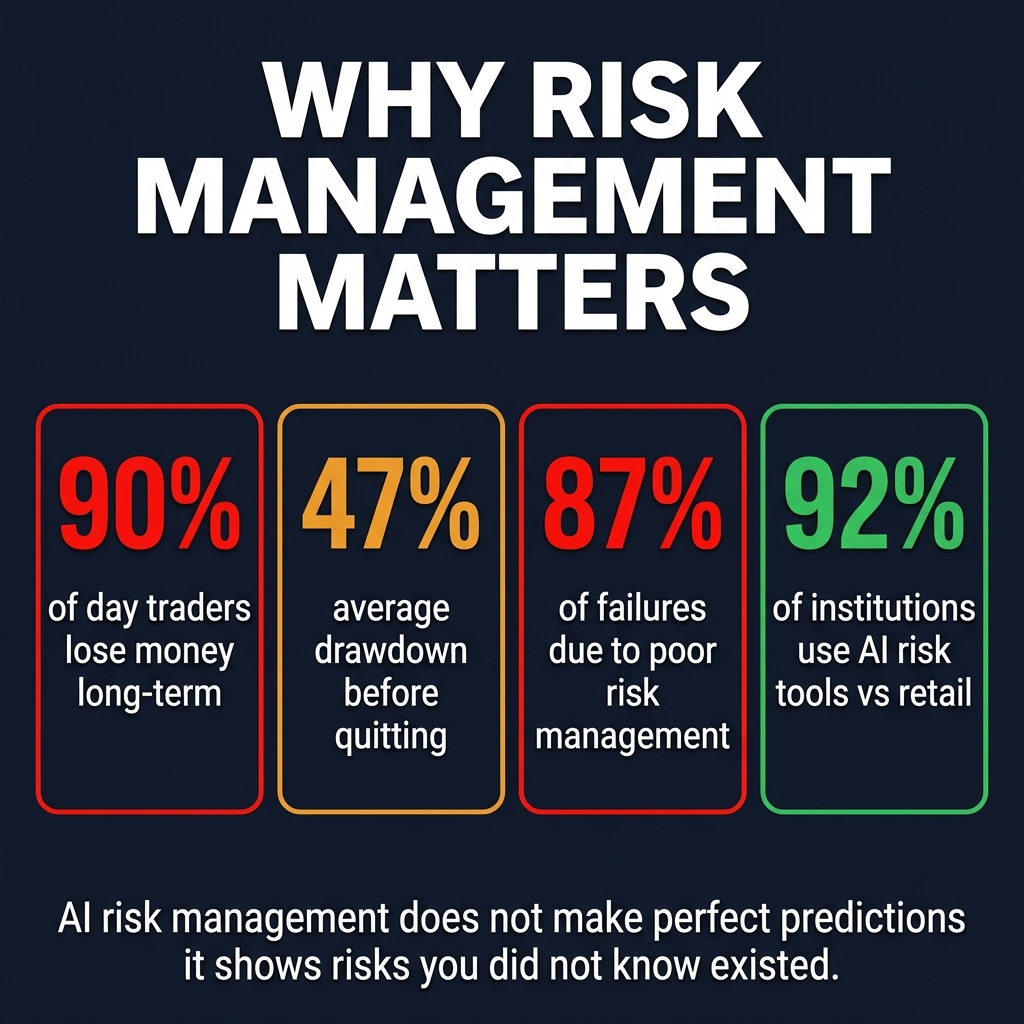
Stats That Should Scare You
Risk Metric
Reality
Traders who lose money
~90% of day traders lose money long-term
Average drawdown before quitting
47% of initial capital
Main reason for losses
Poor risk management (87% of failures)
Institutional vs retail risk
Institutions use AI risk tools; 92% of retail traders don't
The uncomfortable truth: You could have the best trading strategy in the world and still lose everything if your risk management is garbage. AI risk management doesn't make perfect predictions — it makes you aware of risks you didn't know existed.
Why Traditional Risk Management Fails in Crypto
Traditional risk metrics from TradFi don't translate well to crypto:
Traditional Metric
Problem in Crypto
Value at Risk (VaR)
Assumes normal distribution — crypto returns are fat-tailed
Sharpe Ratio
Doesn't capture crypto's extreme variance and black swans
Beta
Crypto correlations shift frequently (correlation breaks in crises)
Drawdown
Reactive, not predictive — alert happens AFTER losses
Volatility (VIX)
No VIX equivalent in crypto that captures tail risk
The result: Retail traders using traditional risk tools get blindsided by events that these metrics never predicted.
What AI Adds That Humans Don't
AI risk management doesn't replace human judgment — it augments it:
Pattern recognition: ML models detect emerging risk patterns across thousands of assets simultaneously
Multi-dimensional analysis: Humans think in 2D (asset + time); ML thinks in 10D (asset, time, correlation, liquidity, sentiment, on-chain flows, macro, regime, volatility, leverage)
Real-time alerting: Humans check risk periodically; AI monitors continuously
Predictive signals: AI identifies risk before it materializes using early-stage data patterns
Emotion removal: AI doesn't get FOMO or panic — it executes risk rules consistently
How AI Detects Portfolio Risk: The Technology
1. Anomaly Detection: Finding the Unusual
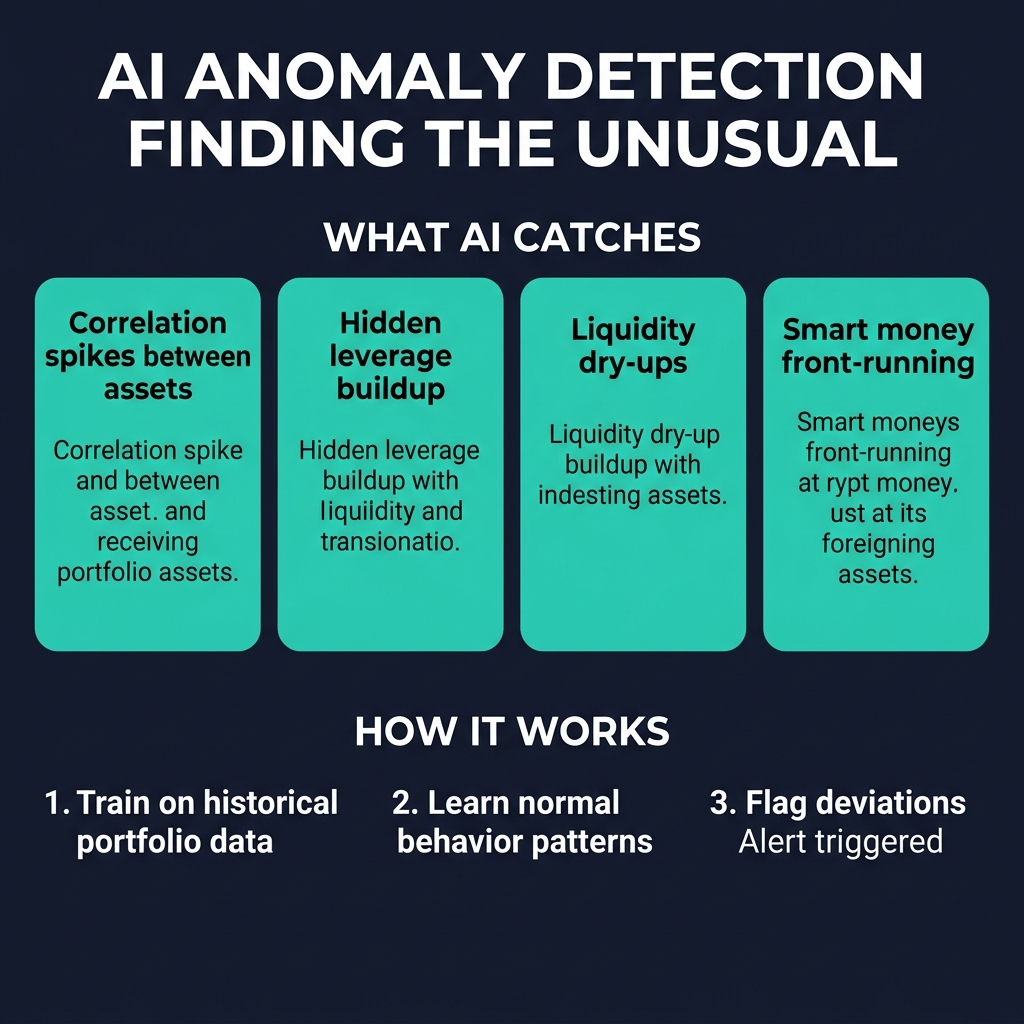
Anomaly detection models learn what "normal" portfolio behavior looks like and flag deviations:
How it works:
Train ML model on historical portfolio data (returns, correlations, volatility patterns)
Model learns the "normal" behavior of your specific portfolio allocation
When new data deviates significantly from normal → alert triggered
What it catches that humans miss:
Correlation spikes between supposedly uncorrelated assets
Hidden leverage buildup in derivatives positions
Liquidity dry-ups in normally liquid markets
Smart money front-running appearing as volume patterns
Example: If BTC drops 5%, but your DeFi portfolio typically drops 15-20% with BTC, but this time only drops 2% — anomaly detection flags this as suspicious (potential hidden risk in DeFi positions).
2. Regime Detection: Knowing Which Market We're In
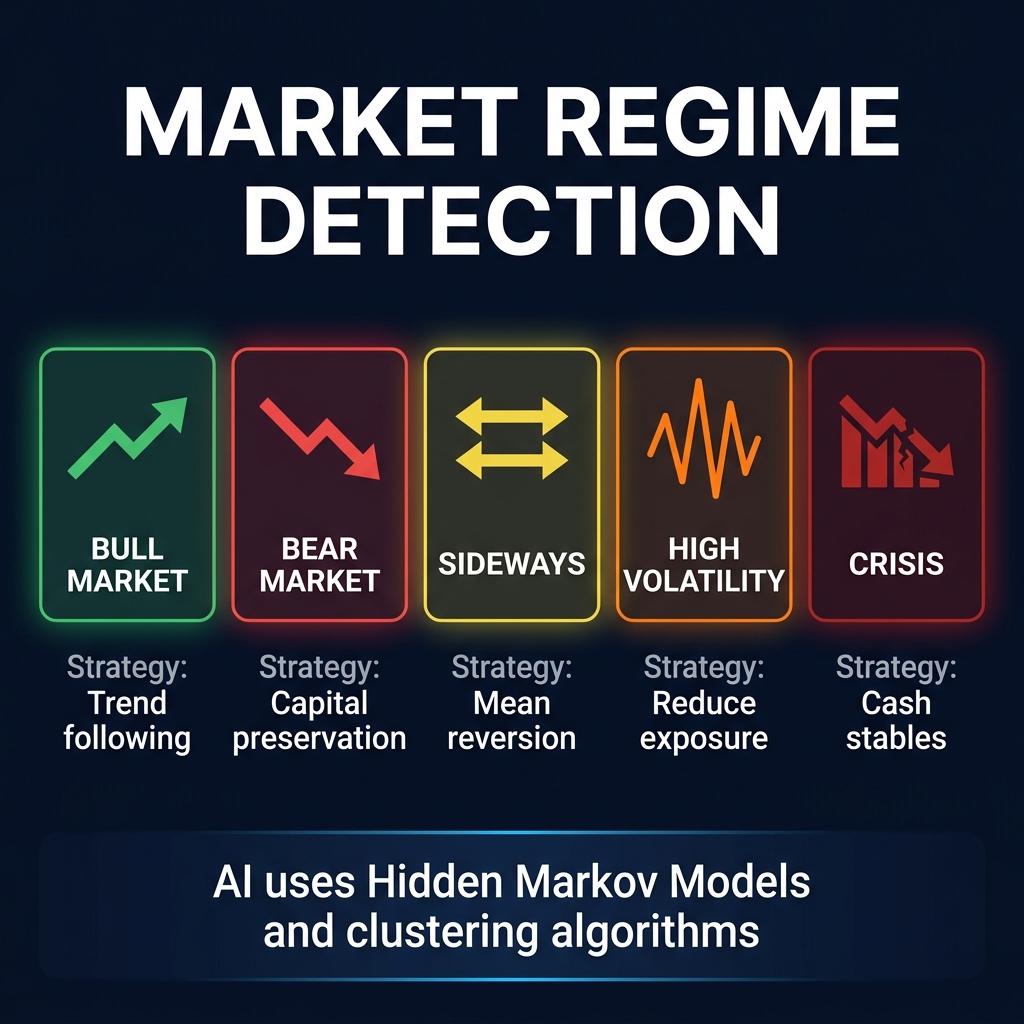
Markets operate in different "regimes" — and strategies that work in one regime fail in another:
Regime
Characteristics
Best Strategy
Bull market
BTC/DeFi climbing, low fear
Trend following, momentum
Bear market
BTC declining, high fear
Capital preservation, hedging
Sideways
Range-bound, low direction
Mean reversion, range trading
High volatility
Extreme price swings
Reduce exposure, volatility targeting
Crisis
Correlation = 1, everything sells
Cash, stables, deflation hedges
AI regime detection uses:
Hidden Markov Models (HMMs) to identify regime states
Clustering algorithms (k-means, DBSCAN) to detect structural changes
Sentiment analysis (from social data, news flow) as regime indicators
CoinXSight Application: Our AI Analysis module continuously evaluates market regime and adjusts risk parameters accordingly.
3. Portfolio-Level Risk Metrics (AI-Enhanced)
AI-enhanced versions of standard risk metrics that work in crypto:
Metric
Traditional
AI-Enhanced
Volatility
Historical std dev
Volatility forecasting with GARCH + ML ensemble
Correlation
Pearson correlation
Dynamic correlation with regime switching
Beta
Single-period beta
Multi-horizon beta with decay functions
Drawdown prediction
Historical max drawdown
ML-predicted drawdown based on current exposure
Tail risk
Assumes normal distribution
Extreme value theory + Monte Carlo simulation
4. Natural Language Processing for Sentiment Risk
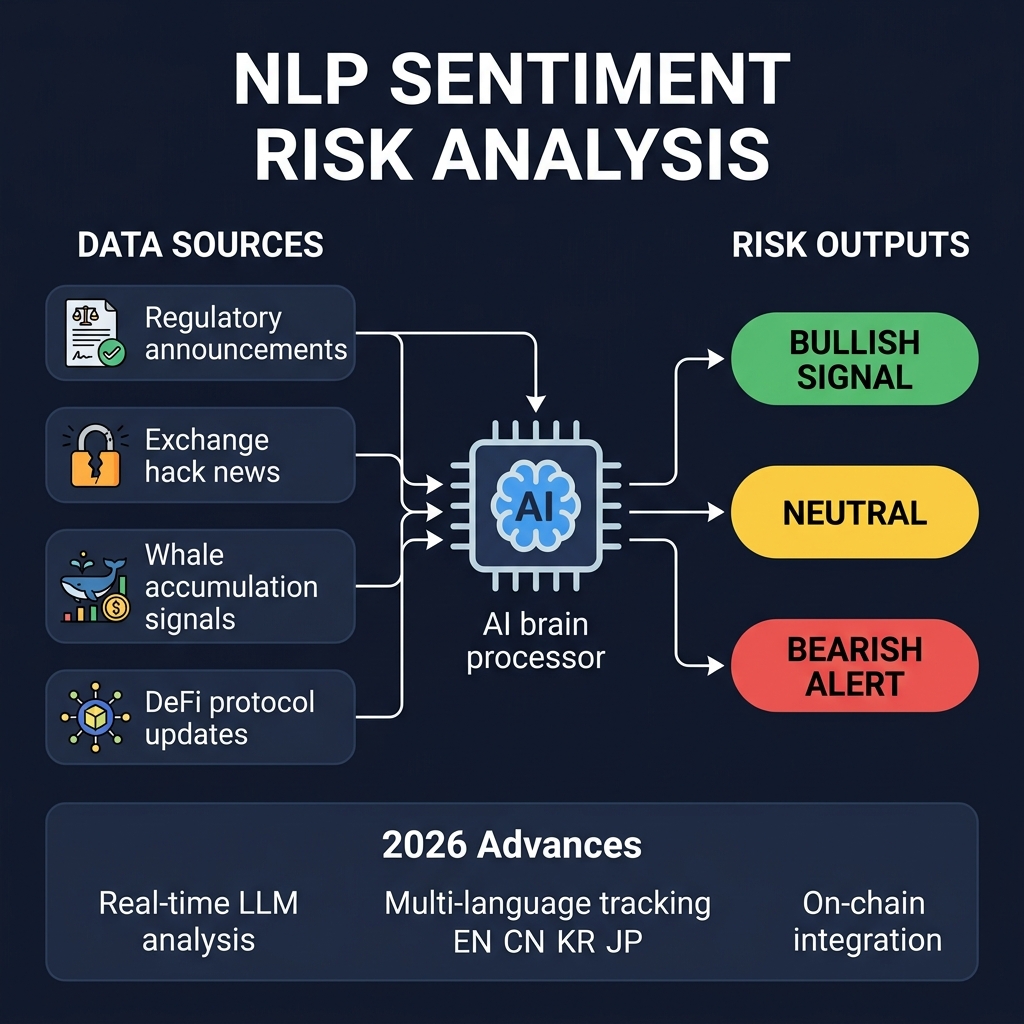
NLP models parse news, social media, and on-chain data to detect sentiment-driven risks:
What NLP risk models track:
Regulatory announcement sentiment → position adjustment signals
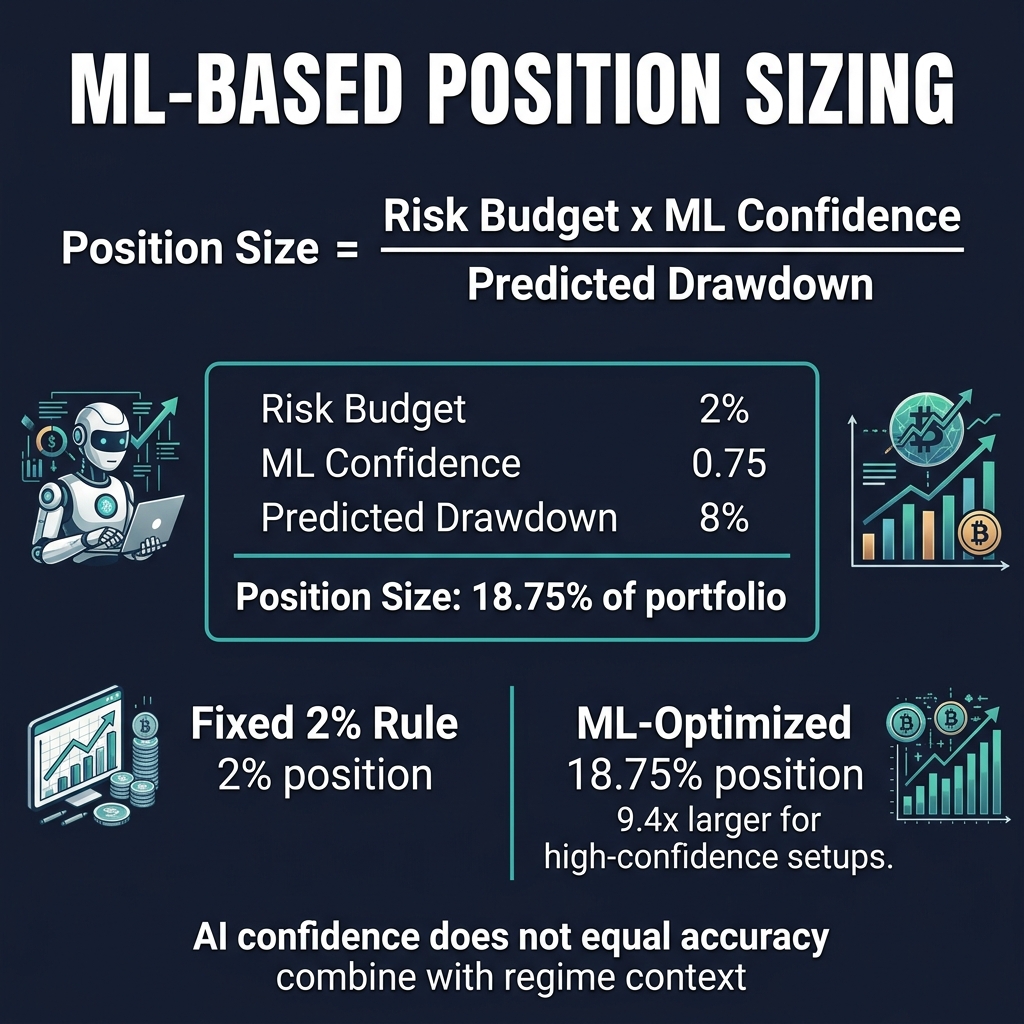
Problem: Fixed percentage position sizing ignores the risk of each individual setup.
AI Solution: ML models predict the probability and magnitude of loss for each position, then recommend position sizes based on your risk tolerance.
Position Size = Risk Budget × ML Confidence Score / Predicted Drawdown

Example:
- Risk budget: 2% of portfolio per trade
- ML confidence score: 0.75 (moderate confidence in setup)
- Predicted drawdown if wrong: 8% of position
- Recommended size: (2% × 0.75) / 8% = 18.75% of portfolio

vs Fixed 2% rule: 2% of portfolio
→ ML model recommends 9.4x larger position (because it's 75% confident)
Tool 2: Automated Drawdown Detection
Problem: By the time humans notice a drawdown, they're already down 20-30%.
AI Solution: Trained on historical portfolio blowups, ML models detect the early warning signs of drawdowns:
Warning Signal
What AI Detects
Action Triggered
Correlation spike
Assets moving together (diversification failing)
Reduce exposure by 20%
Volatility regime shift
Volatility compressing before expansion
Tighten stops, reduce leverage
Leverage over-accumulation
Total portfolio leverage > 3x
Margin call prevention, de-leverage
Smart money divergence
Whales selling while retail buys
Flip to hedge mode
Sentiment divergence
Euphoric sentiment + flat price = distribution risk
Take partial profits
Tool 3: Real-Time Liquidity Risk Monitor
Problem: Liquidity can vanish in seconds during volatile markets (cascading liquidations, exchange hacks).
AI Solution: On-chain and exchange data feeds into ML models that predict liquidity availability:
Order book depth analysis: ML predicts if order book can absorb your position
Exchange reserve monitoring: Track exchange BTC/ETH balances for liquidity signals
Cross-exchange liquidity scoring: If liquidity dries up on one exchange, detect it before price gaps
Tool 4: Portfolio Heat Maps and Concentration Risk
Problem: Traders often don't realize they're overexposed to a single sector (e.g., 60% DeFi when DeFi crashes).
AI Solution: Heat map visualization powered by ML recommendations:
Sector concentration: Flag if any single sector > 30% of portfolio
Correlation clustering: Auto-detect hidden concentrations (e.g., "Your SOL meme coins are 40% correlated with each other — you're effectively overexposed to one narrative")
Set max drawdown alerts per position (e.g., "Alert me if ETH position hits -15%")
AI adjusts stop-loss recommendations based on volatility regime
Smart alerts that don't trigger on normal noise
3. Correlation Risk Monitor
Real-time correlation matrix of all positions
Alert when correlations spike above 0.7 (diversification failing)
Historical correlation stress testing
4. Stress Testing
"What if BTC drops 30%?" → Portfolio impact simulation
"What if DeFi crashes?" → Sector-specific scenario analysis
Custom scenario builder for tail risk planning
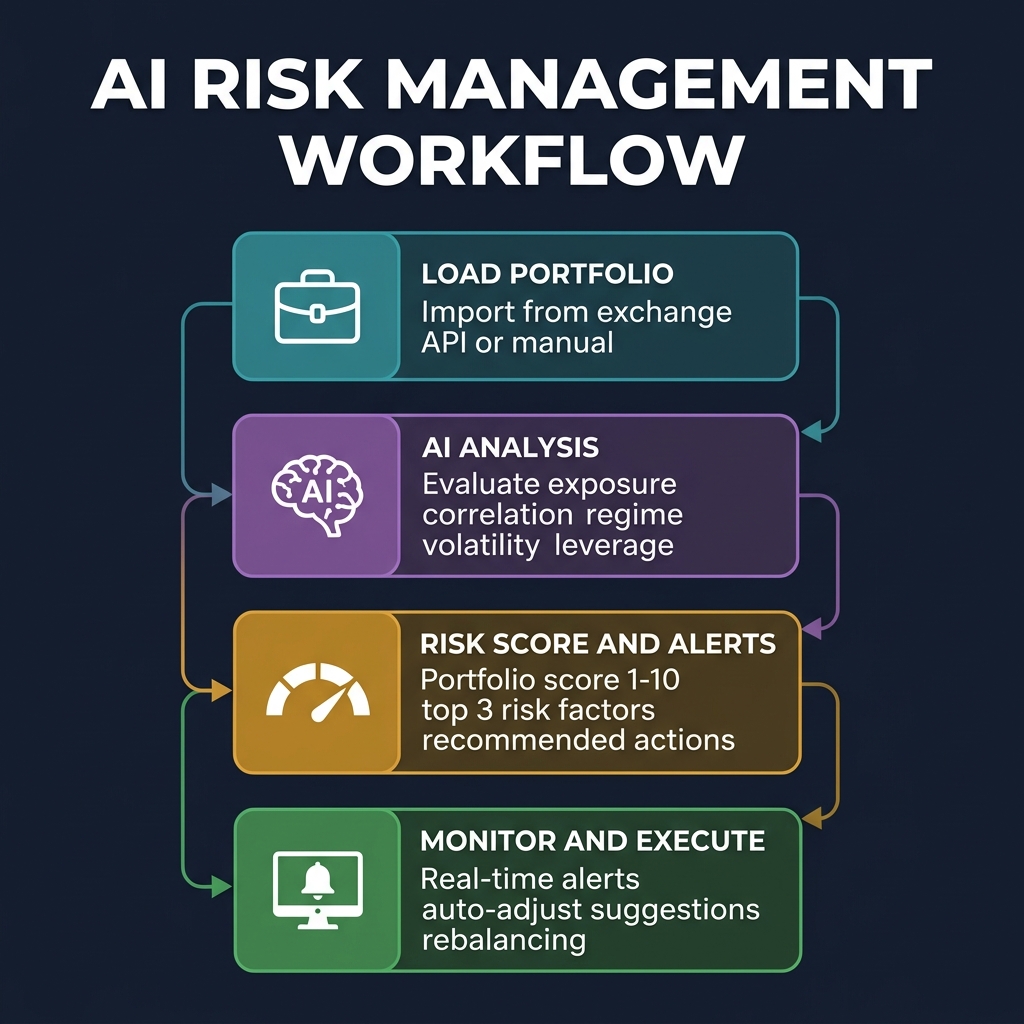
AI Risk Management Workflow in CoinXSight
┌──────────────────────────────────────────────────────────┐
│ 1. LOAD PORTFOLIO                                         │
│    → Import from exchange API or manual entry             │
├──────────────────────────────────────────────────────────┤
│ 2. AI ANALYSIS                                            │
│    → ML models evaluate: exposure, correlation, regime,   │
│      volatility, liquidity, leverage                      │
├──────────────────────────────────────────────────────────┤
│ 3. RISK SCORE & ALERTS                                    │
│    → Portfolio risk score (1-10)                          │
│    → Top 3 risk factors identified                        │
│    → Recommended actions (size down hedge, rotate)         │
├──────────────────────────────────────────────────────────┤
│ 4. MONITOR & EXECUTE                                      │
│    → Real-time alerts if risk profile changes             │
│    → Auto-adjust suggestions based on market regime       │
│    → Rebalancing recommendations if needed                │
└──────────────────────────────────────────────────────────┘
Common AI Risk Management Mistakes
Mistake 1: Over-Reliance on AI Without Human Oversight
AI tools are only as good as their training data and assumptions. In crypto's rapidly changing environment, models trained on historical data may not capture unprecedented events.
Rule: Use AI as a warning system, not a decision system. AI flags risks → you decide actions.
Mistake 2: Ignoring the Black Swan Risk
AI models are trained on historical data. Unprecedented events (exchange collapses, regulatory bans, protocol hacks) are, by definition, not in the training data.
Mitigation: Add a manual black swan buffer — always hold 10-20% in stablecoins or cash as protection against events AI can't predict.
Mistake 3: Confusing AI Confidence with Accuracy
A model can be highly confident AND wrong. This is especially dangerous in crypto where regimes shift frequently.
Critical: AI confidence scores should be combined with regime context. A model saying "95% confidence" in a bull market may be meaningless during regime transitions.
Mistake 4: Not Adjusting for Model Lag
AI models have inherent lag — they're trained on historical data. In fast-moving crypto markets:
Real-time models (online learning): Lowest accuracy, least lag
Daily models: Moderate accuracy, 1-day lag
Weekly models: Highest accuracy, 7-day lag
Best practice: Use multiple timeframes — real-time for alerts, daily for strategy adjustments, weekly for strategic allocation.
Building Your Own AI Risk Management System
If you want to build custom risk management, here's the tech stack:
Component 1: Data Pipeline
Exchange APIs → On-chain data (Glassnode, Nansen, Dune) →
Sentiment feeds (Twitter, NewsAPI) →
Alternative data (funding rates, open interest, liquidations) →
Unified data store
Component 2: Feature Engineering
Raw data → Features:
  - Portfolio-level: allocation, sector concentration, leverage
  - Market-level: volatility, correlation, regime indicators
  - On-chain: exchange flows, whale activity, stablecoin flows
  - Sentiment: social volume, news sentiment, fear/greed
  - Derivatives: funding rates, OI changes, liquidation levels
Component 3: ML Models
Model
Purpose
Implementation
Anomaly Detection
Flag unusual portfolio behavior
Isolation Forest, LOF, Autoencoder
Regime Classification
Identify market regime
Hidden Markov Model, GMM
VaR Prediction
Predict tail risk
GARCH + ML ensemble
Correlation Forecasting
Predict future correlations
LSTM + Attention
Sentiment Analysis
Parse market sentiment from text
BERT-based fine-tuned on crypto
Drawdown Prediction
Predict max drawdown before it happens
Gradient boosting on portfolio features
Component 4: Alert & Action System
Trigger → AI Risk Alert → Human Review → Action (hedge/size down/take profit/do nothing)
Critical: Always keep a human in the loop. AI identifies risk, humans make decisions.
How to Avoid the Biggest Risk Mistake: Not Having a Risk Plan
The #1 risk management mistake isn't using bad AI — it's not having a risk plan at all.
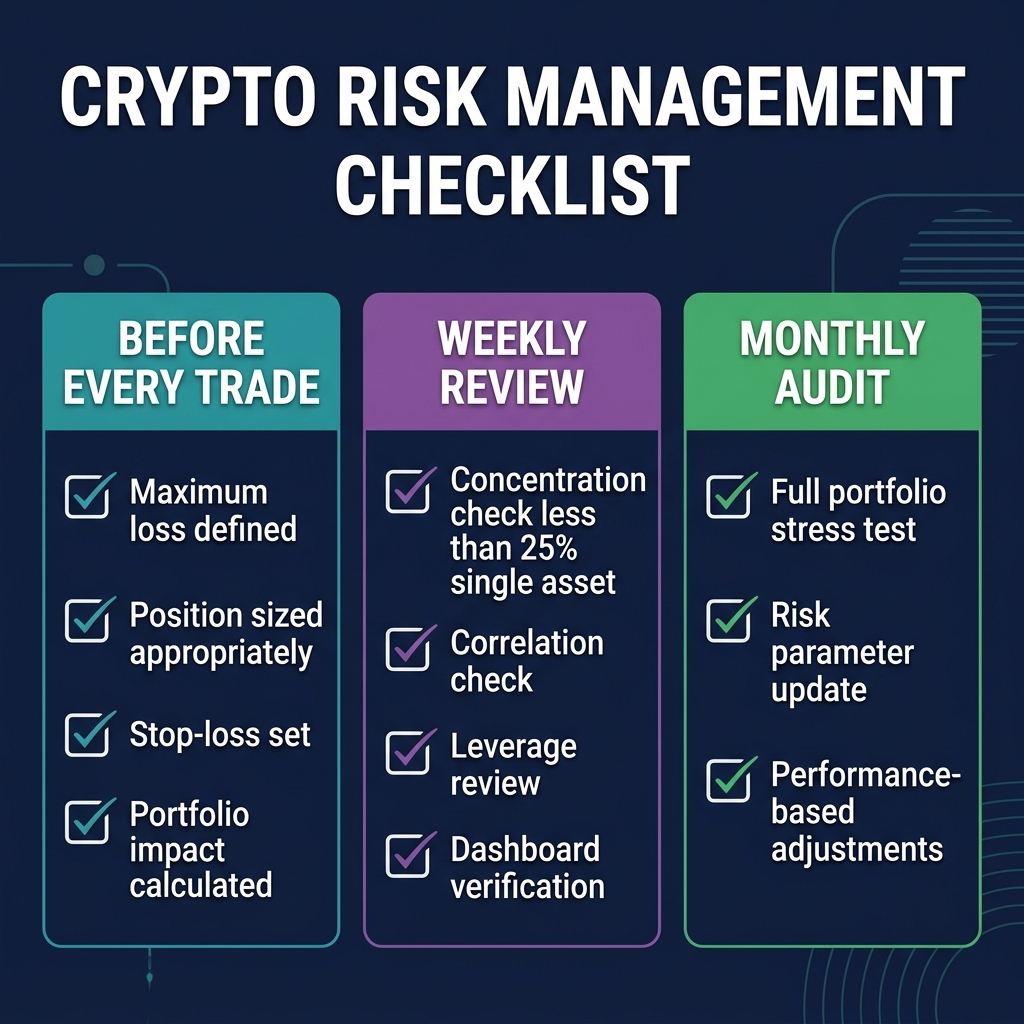
Your Crypto Risk Management Checklist
Before Every Trade:
[ ] Maximum loss defined: What's the worst-case scenario?
[ ] Position sized appropriately: Can you afford to be wrong?
[ ] Stop-loss set: Where do you exit if wrong?
[ ] Portfolio impact calculated: What happens if ALL positions hit stops?
Weekly:
[ ] Portfolio concentration check: Any single asset > 25%?
[ ] Correlation check: Are your "diversified" positions actually correlated?
[ ] Leverage review: Is total leverage within risk tolerance?
Q1: Is AI risk management better than traditional risk management?
A: AI risk management is complementary to, not a replacement for, traditional risk management. AI excels at: real-time monitoring, multi-asset analysis, pattern detection, and predictive signals. Traditional methods excel at: fundamental risk frameworks, human judgment on unprecedented events, and accounting for black swan scenarios. The best approach combines both.
Q2: Can AI really predict drawdowns before they happen?
A: AI can identify early warning signs of drawdowns with 60-75% accuracy over 1-2 week horizons. But it cannot predict black swan events (exchange hacks, regulatory bans, catastrophic crashes) — those are, by definition, outside training data. AI should be viewed as a warning system, not a crystal ball.
Q3: What's the best AI risk management tool for crypto in 2026?
A: For most traders, CoinXSight's AI-powered Crypto Dashboard provides the best balance of features, data coverage, and usability. For more advanced users: Glassnode, Nansen, and Dune Analytics for on-chain risk data, combined with custom ML models.
Q4: How much should I allocate to AI risk management vs manual risk management?
A: Use a layered approach:
AI monitoring (80%): Let CoinXSight's AI track portfolio risk continuously
Manual overrides (20%): Human judgment for regime shifts, black swan protection, strategic allocation changes
This ratio works because AI is better at continuous monitoring; humans are better at big-picture decisions.
Q5: What's the single most important AI risk signal to monitor?
A: Correlation breakdown. When assets that typically move independently suddenly move together, it signals a regime shift or liquidity crisis. AI correlation monitoring catches this faster than any other method. A correlation spike above 0.8 in your portfolio = immediate risk reduction action warranted.
Conclusion: AI Risk Management = Survival in 2026
In crypto 2026, AI risk management isn't a luxury — it's a requirement for survival. With markets becoming more complex, correlations shifting faster, and black swan events more frequent, the traders who survive (and profit) are those with AI-powered early warning systems.
The AI risk management advantage:
Detects risks humans can't see in real-time
Monitors continuously across thousands of data points
Removes emotion from risk decisions
Learns and adapts to new market regimes
But it's not enough:
AI needs human oversight
Models need periodic recalibration
Black swan events still require manual hedging
Risk management is only as good as the person executing the plan
The Bottom Line: AI risk management gives you the information you need to make better decisions. Whether you act on that information is still up to you. Use CoinXSight's AI Dashboard to set up real-time portfolio risk monitoring and stay ahead of drawdowns.
Remember: The best trade is the one you didn't lose money on. Protect your capital first, profits will follow.
KZ
Dr. Kevin Zhang
AI // QUANT LABS
Principal AI & Quantitative Researcher·Deep Alpha Engine Labs
Ph.D. in Computational Statistics. Leads machine learning architecture, regime-switching detection, and automated execution systems at CoinXSight Labs.
QUANTITATIVE SUITE // DEEP ALPHA ENGINEACTIVE
BTC/USDT // LIVE SCANNER
CONFLUENCE 77
LIVE SPOT PRICE$83,669.23MODERATE_BUY
TP2
$89,021.25
+7.04%
TP1
$85,510.14
+2.81%
ENTRY
$83,169.41
ZONE
SL
$81,999.04
-1.41%
Auto-detect Order Blocks, Fair Value Gaps and risk-adjusted DCA ladders in < 5s.
Learn Marcos López de Prado's Triple-Barrier Method, Meta-Labeling, and Purged Cross-Validation to eliminate overfitting in crypto algorithmic trading.