Meme Coin Trading: Risk Management and AI Safety Scoring
Navigate the meme coin market with data-driven risk assessment. Learn rug pull detection, safety scoring, smart money filtering, and position sizing using CoinXSight's Meme Hunter.
MC
Marcus ChenSenior Quantitative Strategist·May 18, 2026 · 12 min read · Updated Oct 6
The Meme Coin Paradox: Biggest Returns, Biggest Risks
Meme coins represent the most extreme risk/reward spectrum in all of crypto. A $500 investment in a meme coin can return $50,000 in a week — or go to zero in 15 minutes through a rug pull. According to on-chain data, over 90% of meme coins launched on Solana lose value within 7 days, while the top 1% produce returns exceeding 10,000%.
This guide doesn't tell you meme coins are safe — they're not. Instead, it provides a systematic framework for reducing catastrophic risk (rug pulls, scams, concentrated ownership dumps) while maintaining exposure to the genuine opportunities. The difference between gambling and trading is risk management.
Why Meme Coins Are Different from Other Crypto
Traditional crypto analysis (technical indicators, fundamentals, tokenomics) applies partially but not fully to meme coins. Here's what makes them different:
Dimension
Standard Crypto (BTC, ETH)
Meme Coins
Price driver
Technology, adoption, macro
Narrative, virality, community
Liquidity
Deep ($100M+ daily)
Shallow ($100K-$5M daily)
Holder concentration
Distributed (top 10 = <5%)
Concentrated (top 10 = 30-70%)
Development team
Known, funded, accountable
Anonymous, often zero roadmap
Manipulation risk
Low (too much liquidity)
Extreme (one wallet can move 20%+)
Rug pull risk
Near zero
15-40% of new launches
Information edge
Technical/fundamental analysis
Speed + safety verification
The key implication: traditional technical analysis is necessary but insufficient for meme coins. You need an additional safety layer that specifically addresses the unique risks.
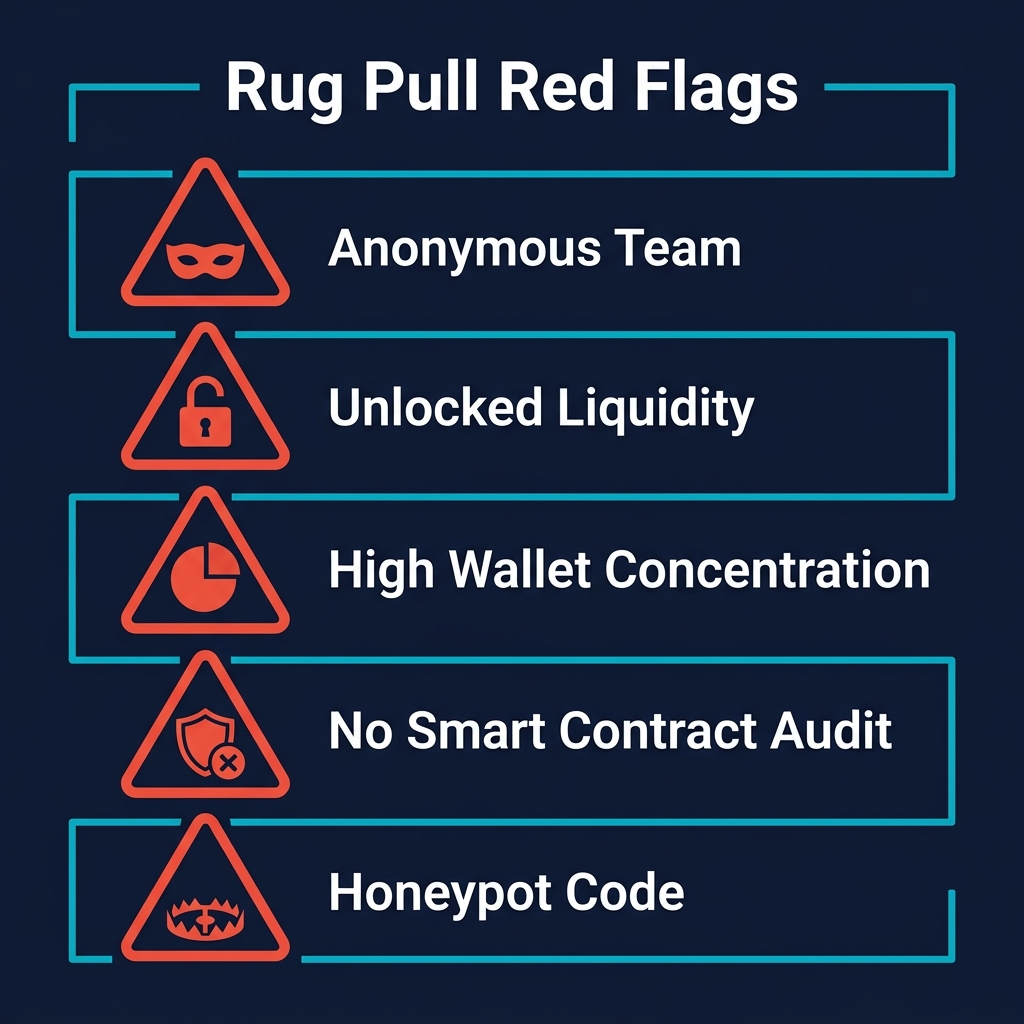
The 5 Types of Meme Coin Scams
Before you can protect yourself, you need to understand what you're protecting against:
1. Rug Pull (Liquidity Removal)
How it works: The developer creates a token, adds initial liquidity to a DEX (creating a trading pool), waits for buyers to push the price up, then removes all liquidity. Buyers are left with tokens they can't sell — there's no one on the other side of the trade.
Detection: Check if LP (Liquidity Pool) tokens are locked or burned. If the dev can remove liquidity at any time, the token is a rug pull waiting to happen.
2. Honeypot
How it works: The smart contract allows buying but blocks selling — either entirely or with extreme fees (99% sell tax). Buyers can get in but can never get out.
Detection: Before buying, simulate a sell transaction. If the simulation fails or shows an extreme tax, it's a honeypot. CoinXSight's Meme Hunter runs this check automatically.
3. Mint Authority Attack
How it works: The developer retains the ability to mint (create) new tokens. After buyers push the price up, the dev mints millions of new tokens and sells them, diluting existing holders to near zero.
Detection: Check if mint authority has been revoked. If the developer can still mint tokens, the supply is not fixed and your investment can be diluted at any time.
4. Coordinated Pump and Dump
How it works: A group of wallets buys a token to inflate the price, then sells simultaneously once retail traders FOMO in. This is more sophisticated than a simple rug pull — the contract itself is legitimate, but the trading activity is coordinated manipulation.
Detection: Check wallet concentration. If 5-10 wallets control 40%+ of supply, a coordinated dump is likely.
5. Social Engineering / Fake Influencer Pump
How it works: Fake endorsements (or paid real endorsements) from social media influencers create artificial demand. The influencer and/or their associates hold significant supply and dump after the promotion drives retail buying.
Detection: Check if the token's social engagement correlates with organic community growth or a sudden spike from a single promotional event.
CoinXSight Meme Hunter: The Safety Dashboard
CoinXSight's Meme Hunter module is specifically designed to address meme coin risks. Let's examine the live data:
Summary Metrics Explained
Metric
Current Value
What It Means
Tokens Scanned
50
The module actively monitors 50 Solana meme tokens
Active Signals
20
20 of 50 tokens have actionable buy/sell signals
Avg Safety
53
Average safety score across all tokens — moderate overall
Top Trend
57
The strongest trending token has a trend score of 57
Total Liquidity
$21.5M
Combined DEX liquidity across all monitored tokens
The Safety Score System (0-100)
The Safety Score is the core risk assessment metric. It aggregates multiple on-chain safety checks into a single number:
Score Range
Label
Interpretation
80-100
Very Safe
LP locked, mint revoked, low concentration, active community
60-79
Safe
Most safety checks pass, minor concerns
40-59
Moderate
Some safety flags — trade with caution and smaller sizes
20-39
Risky
Multiple safety issues — experienced traders only
0-19
Dangerous
High probability of scam/rug pull — avoid
The current Top Pick: CATCOIN shows Safety 64 — in the "Safe" range, meaning LP is likely locked, mint authority revoked, and wallet concentration is manageable.
Rug Shield Panel
The Rug Shield provides specific safety check results:
Check
Current Result
Meaning
Honeypot
0%
✅ No honeypot detected — you can sell freely
Mint Auth Revoked
88%
✅ 88% of scanned tokens have revoked mint authority — supply is fixed
Rug Pull Risk
0%
✅ For the top pick, no rug pull indicators detected
Top 10 Holders
42%
⚠️ Top 10 wallets hold 42% of supply — moderate concentration risk
⚠️ Interpretation of Top 10 Holders: 42%: This is the one caution flag. In large-cap crypto, the top 10 holders controlling 42% would be extreme concentration. In meme coins, 42% is actually moderate — many tokens have 60-80% concentration. However, it means that coordinated selling by even 2-3 of these wallets could crash the price by 30-50%. This is why position sizing is critical.
Smart Money Score
CATCOIN's Smart Money score is 47 — meaning smart money wallets are present but not strongly accumulating. Compare this to the trend score of 58 — retail interest is higher than institutional interest. This isn't inherently bad (meme coins are largely retail-driven), but it means you shouldn't treat this as a "smart money endorsed" trade.
The Meme Coin Trading Framework
Pre-Trade Checklist (2 minutes per token)
Before buying ANY meme coin, run through these checks on Meme Hunter:
Safety Score ≥ 60 — Non-negotiable minimum. Below 60, the risk of catastrophic loss is too high.
Honeypot: 0% — If there's any honeypot detection, do not buy under any circumstances.
Mint Authority: Revoked — If mint authority is active, the dev can dilute your position to zero.
LP Status: Locked or Burned — LP must be locked (with a lock duration of 30+ days) or burned (permanently locked).
Top 10 Holders: <50% — Above 50% concentration means a few wallets control the price. Exception: if one of the top holders is the LP pool itself (which is locked).
Liquidity: ≥$50K — Below $50K, you won't be able to exit your position without massive slippage.
Smart Money Score ≥40 — Some smart money participation adds credibility. Below 40, the token is purely retail-driven speculation.
Position Sizing Rules
Safety Score
Max Position Size (% of portfolio)
Max Position Size (USD equivalent)
80-100
2%
Based on your portfolio
60-79
1%
Half of standard meme allocation
40-59
0.5%
Quarter allocation — "lottery ticket"
Below 40
0%
Do not trade
The key principle: No single meme coin trade should ever risk more than 2% of your total portfolio. A 100% loss on a 2% position reduces your portfolio by 2% — painful but recoverable. A 100% loss on a 20% position is catastrophic.
Entry Strategy
Method 1: Momentum Entry (For trending tokens)
Token appears on Meme Hunter with Safety ≥60 and Trend ≥50
Confirm active BUY signal on the Active Signals panel
Check that the token has been trending for <24 hours (fresh momentum)
Enter with 50% of your allocated position size
Add the remaining 50% only if price confirms with a higher low within 4 hours
Method 2: Smart Money Following (For institutional picks)
Set a wider stop-loss (smart money trades take longer to play out — 24-72 hours)
Exit Strategy
Meme coins require aggressive profit-taking — do NOT use the same hold-and-let-it-run approach as with large-cap crypto:
Price Move
Action
+50%
Sell 25% — recover a quarter of your initial investment
+100% (2x)
Sell another 25% — you've now recovered 75% of your initial capital
+200% (3x)
Sell another 25% — you're now playing entirely with house money
+500% (6x)
Sell remaining 25% or set a tight trailing stop (10% from peak)
The rationale: Meme coins mean-revert aggressively. A token that goes up 500% can drop 80% in 30 minutes. By taking profits at 50%, 100%, and 200%, you ensure that even if the token crashes afterward, you've extracted meaningful returns.
Real-World Meme Coin Analysis: Reading the Dashboard
Let's analyze the current Meme Hunter data for a practical example:
CATCOIN — The Top Pick
Data from Meme Hunter:
Price: $0.000662
Trend Score: 58 — Moderate trending, not parabolic (good — parabolic entries are usually late)
Safety Score: 64 — In the "Safe" range. All critical safety checks pass.
Smart Money: 47 — Some institutional interest, but not strong conviction
Active Signal: BUY
Analysis:
CATCOIN passes all pre-trade checklist requirements. Safety 64 qualifies it for a 1% portfolio allocation. The Trend Score of 58 suggests momentum is building but hasn't peaked — this is a reasonable entry point.
Concerns:
Top 10 Holders at 42% means moderate concentration risk
Smart Money 47 means this is primarily a retail-driven trade
Liquidity context: with $21.5M total liquidity across 50 tokens, individual token liquidity needs verification
Decision: Qualified for a trade with the following parameters:
Position size: 1% of portfolio (Safety 64 = "Safe" range)
Entry: At current price with limit order (not market order — reduce slippage)
Stop-loss: -30% from entry (meme coins are volatile — tight stops get triggered by normal movement)
Take-profit: 50% at +50%, 25% at +100%, remainder trailing at 10%
HOT Tokens Bar
The HOT tokens panel shows:
OSOR: +16.9% — Strong positive momentum, but check Safety Score before chasing
PIGEON: -2.5% — Slight pullback, might be a buy-the-dip opportunity if safety checks pass
MEM: -10.6% — Significant decline, could be distribution or normal correction
Rule: Never chase a hot token based solely on the price change. Always run the full Safety Score checklist first. A token up 50% with Safety Score 30 is a trap, not an opportunity.
Advanced: Meme Radar and Real-Time Pool Monitoring
The Meme Radar (Live) panel at the bottom of Meme Hunter shows real-time pool updates — new liquidity additions, trades, and pool creations on Solana DEXs.
What to watch for:
New pool creation for a token you're tracking — potential liquidity expansion (bullish)
Large liquidity removal — warning sign of an impending rug pull
Burst of small buy transactions — retail FOMO entering (could indicate you're late)
Large single sell transaction from a top holder — check if this triggers a Safety Score downgrade
This real-time feed is the most advanced feature for active meme traders. It provides millisecond-level intelligence that would otherwise require monitoring raw Solana block explorers.
The Psychological Trap: FOMO vs. FOJI
Meme coins are engineered to trigger emotional reactions:
FOMO (Fear of Missing Out)
You see a token up 300% in 2 hours. Your friend made $5,000. Twitter is exploding. Every fiber of your being screams "I need to get in NOW."
Reality: By the time a meme coin is on Twitter and your friend is talking about it, the smart money has already entered and is preparing to exit. Buying at this point means you're providing their exit liquidity.
Counter-measure: If you didn't find it on Meme Hunter's early signal list, you're probably too late. Set a hard rule: only enter meme coins that appear as Active Signals on Meme Hunter with Safety ≥60.
FOJI (Fear of Joining In)
After getting burned on 3 meme coins, you swear off them entirely. A legitimate opportunity appears — Safety Score 85, Smart Money 72, early trend — but you can't pull the trigger because past losses created a psychological block.
Reality: Not all meme coins are scams. The ones that pass all safety checks with strong smart money participation are statistically worth the risk-adjusted allocation.
Counter-measure: Use the position sizing framework. A 1% position in a Safety 85 token isn't gambling — it's calculated risk-taking. The safety system exists specifically to protect you from the scenarios that caused your past losses.
What's the difference between this guide and the Sol Meme Hunter Guide?
The Sol Meme Hunter Guide is a platform walkthrough — it shows you how to use each feature of the Meme Hunter module. This guide is a strategy guide — it teaches you how to think about meme coin risk, build a trading framework, and integrate safety scoring into your decision-making process.
How often do Safety Scores update?
Safety Scores update in real-time as on-chain conditions change. If a developer mints new tokens (violating the "Mint Authority Revoked" check), the Safety Score drops immediately. If a large holder dumps 20% of supply, the concentration metrics update within minutes.
Can I trade meme coins on other chains besides Solana?
CoinXSight's Meme Hunter currently focuses on Solana-based meme tokens, as Solana hosts the majority of meme coin activity due to low transaction fees and fast settlement. The principles in this guide (safety scoring, concentration analysis, position sizing) apply to meme coins on any chain.
What if a token has Safety Score 95 but drops 50%?
Safety Score measures scam risk, not market risk. A token can be completely safe (no honeypot, LP locked, mint revoked) and still lose value because of normal market forces — declining interest, broader market downturn, or a competing token gaining attention. Safety protects against catastrophic risk (rug pulls, honeypots), not against normal volatility.
How much of my portfolio should be allocated to meme coins?
Conservative recommendation: 5-10% maximum of your total crypto portfolio. Within that allocation, diversify across 3-5 tokens that pass safety checks. This ensures that even if every meme coin goes to zero (worst case), your overall portfolio loses only 5-10%.
Summary
Meme coin trading is not inherently gambling — but trading meme coins without a risk framework IS gambling. CoinXSight's Meme Hunter transforms the meme coin space from a casino into a filtered, data-driven opportunity set by providing real-time Safety Scores, Rug Shield verification, Smart Money tracking, and trend analysis.
The three rules that keep you alive:
Never buy a token with Safety Score below 60 — this single rule eliminates 90%+ of rug pulls
Never allocate more than 2% of your portfolio to a single meme coin — this ensures no single loss is catastrophic
Take profits aggressively — sell 25% at each doubling; meme coins don't trend like large caps
Master risk management for crypto trading. Learn position sizing formulas, stop-loss strategies, and how CoinXSight's Portfolio module tracks your risk…