The Fed Just Called It an ‘Inflation Failure’ — Bitcoin Reclaims $75,000 Hours Before CPI
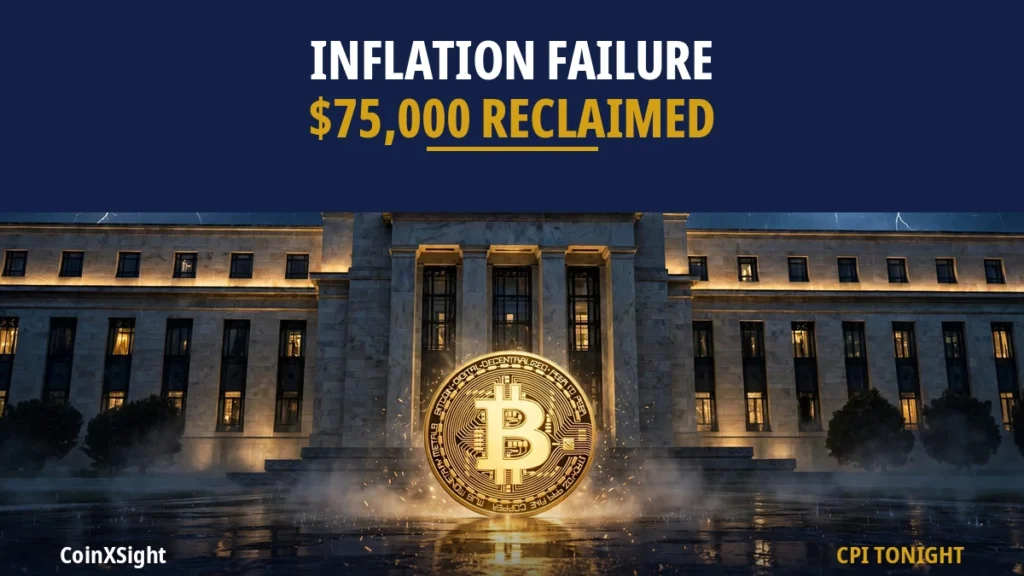
Goolsbee called the Fed’s record an ‘inflation failure’ and Barkin said the direction of policy is straightforward — hours after Bitcoin reclaimed $75,000 and pressed the $75,500 flip. Tonight’s CPI, the last print before December, decides whether the reclaim holds.
CX
CoinXSight Alpha DeskQuantitative Research Desk·Nov 10, 2026 · Updated Nov 11
Bitcoin spent Monday doing something it could not do all weekend: it climbed back above $75,000 and stayed there. The reclaim came on a day when the Federal Reserve’s own officials stopped pretending the inflation problem was nearly solved — and that combination, a hawkish Fed and a recovering bitcoin, is exactly what makes tonight’s CPI report the most dangerous print of the year for crypto.
Chicago Fed President Austan Goolsbee said it plainly on Monday night, in a Q&A at a Leadership Greater Chicago event: “We’ve got to come to terms with inflation failure.” Not a slowdown. Not a bump. A failure — the Fed’s word, not ours.
Goolsbee said the quiet part out loud
Goolsbee has spent months calling inflation the economy’s biggest problem. On Monday he went further, and the details matter more than the headline.
“Employment and growth are actually pretty stable,” he said. “The big problem has all been on the inflation side.” That is a clean split of the Fed’s dual mandate: the jobs half is fine, the prices half is not. October payrolls rose 165,000 — nearly triple the consensus — and unemployment sits at 4.1%. There is no employment emergency for the Fed to cut its way out of. There is, in Goolsbee’s telling, an inflation problem it has not yet fixed.
Then came the part that should worry anyone hoping the tariff story explains everything away. Inflation, Goolsbee said, is “kicking up” in services — areas that “probably weren’t from oil prices and tariffs.” The supply-shock excuse, the one that let the Fed look through price rises for years, is wearing thin. “It was supposed to have gone away by now,” he said.
And then the AI twist. The data-center buildout, Goolsbee said, is “starting to look like old-fashioned demand overheating” — everyone trying to hire an electrician at the same time, land and power and chips all getting more expensive at once. His warning was blunt: “Once it gets overheated, it’s extremely painful to get rid of.” He allowed that AI could eventually mean “long-run deflation,” but added that anticipating those gains “can lead to inflation right now,” as rising valuations encourage spending and companies accelerate investment.
Goolsbee does not vote on rates this year — he joins the FOMC as a voter in January — so his words do not set the December decision. But he is the first Fed official to address the rate outlook after the blowout jobs report, and he chose to spend that outing calling the inflation record a failure. That is not the language of a central banker looking for a reason to hold, let alone cut.
Barkin: the direction is clear, the pace is not
Richmond Fed President Tom Barkin, speaking in Greer, South Carolina, in the early hours of Tuesday Vietnam time, landed in almost the same place — with one important brake pedal.
“Today, with demand healthy and inflation stubbornly elevated, the appropriate direction of monetary policy is relatively straightforward,” Barkin said. “However, risks to the demand outlook remain easy to envision. Because of that, it is wise to move policy with care.”
The first sentence is the hawkish one: direction straightforward, and the direction is up. “Should the economy remain on its current path, the risk lies on the inflation side of our dual mandate,” he said — inflation has now run above the Fed’s 2% target for more than five years, and September PCE came in at 3.6% headline and 3.1% core. Firms, he added, are passing on broad-based cost increases they had previously absorbed: health insurance, fuel, freight, travel, memory chips, tariffs.
But Barkin refused to pre-commit to December. “I don’t have a base case,” he told reporters afterward. “We’ll get inflation. We’ll get another jobs report… Let’s see where the economy goes.” His caution centers on AI, which he called “particularly consequential”: if it underdelivers, business investment could pull back, stocks could follow, and asset-fueled consumer spending with them. If it overdelivers and displaces more workers than expected, spending pulls back that way instead. Either scenario, he said, “would move attention to the maximum employment part of our mandate.”
So Monday gave crypto two hawkish voices and zero dovish ones — but also a reminder that the December hike is not yet a done deal. It is a data-dependent one, and tonight’s CPI is the data.
Households are stuck at 3.9% — and scared of losing their jobs
The third piece of Monday’s puzzle came from the New York Fed’s October Survey of Consumer Expectations, released at 11:00 a.m. Eastern — 23:00 Vietnam time. Median one-year inflation expectations held at 3.9%, unchanged from September. Three-year expectations held at 3.3%, five-year at 3.0%. All three are parked nearly double the Fed’s 2% target, and the one-year figure has now sat near 4% for months.
The more striking number sits on the other side of the survey. The perceived probability that unemployment will be higher a year from now jumped 1.4 percentage points to 45.3% — the highest reading since April 2020, the first month of the pandemic. Households expect their earnings to grow just 2.6% over the next year, while expecting prices to rise 3.9%. That gap is the affordability squeeze in one line.
There was one small relief: expected gasoline price rises eased to 4.2% from 4.8%, and expected household spending growth ticked down to 5.3% from 5.5%. But the survey’s message, read whole, is a consumer that expects inflation to stay and jobs to get scarcer — the exact combination that makes the Fed’s job hardest, because easing to protect jobs risks entrenching the inflation households already expect.
Monday’s Fed, in one table
Who
What they said (verbatim)
Signal for December
Goolsbee, Chicago Fed (non-voter 2026)
“We’ve got to come to terms with inflation failure”
Hawkish — inflation is the problem; AI buildout looks like “old-fashioned demand overheating”
Barkin, Richmond Fed (non-voter 2026)
“The appropriate direction of monetary policy is relatively straightforward” — but “it is wise to move policy with care”
Hawkish direction, cautious pace; “I don’t have a base case” for December
Bowman, Fed Vice Chair for Supervision (voter)
Spoke on community banking; no new signal on rates
Neutral Monday — her economic-outlook speeches come Tuesday, after CPI
Bailey, Bank of England
Spoke in Zurich on central-bank independence; no new policy signal
Neutral — BoE’s last move (hike to 4.00%, 8–1) stands
NY Fed consumer survey (Oct)
1-year inflation expectations 3.9% (unchanged); job-loss fear 45.3%, highest since April 2020
Households expect inflation to stay and jobs to get scarcer
The tape: Bitcoin took back $75,000 and is knocking on the flip
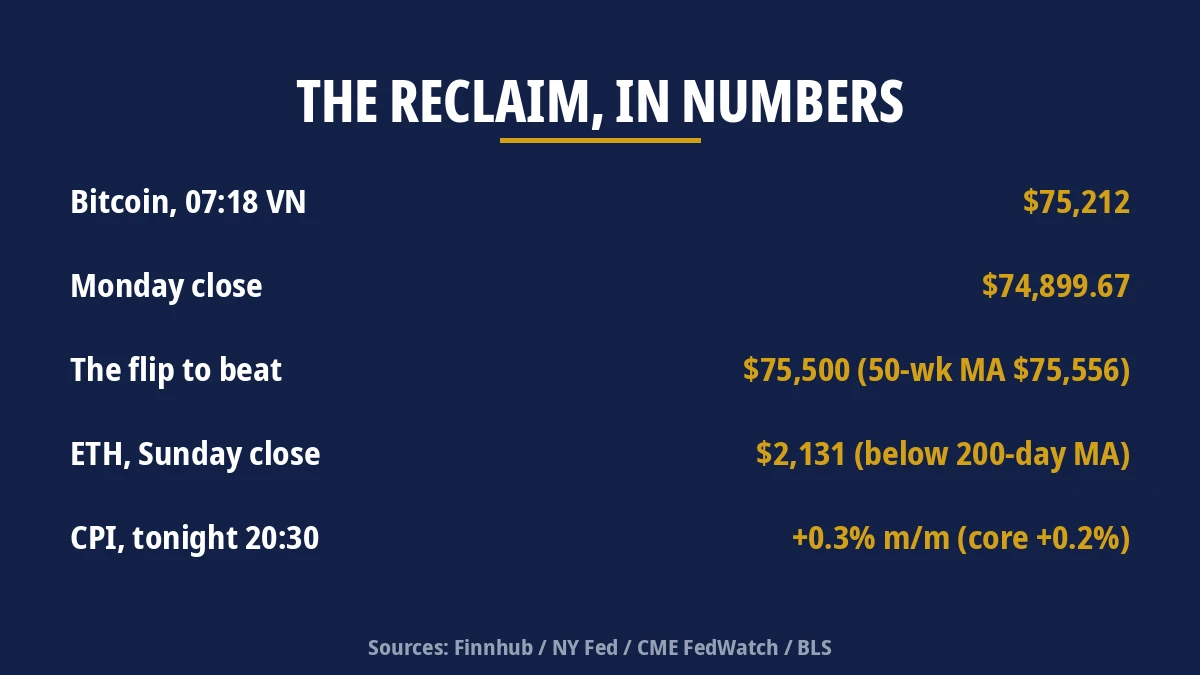
For all the hawkish talk, bitcoin did not fold on Monday. It closed the day at $74,899.67 on Binance, after trading a $73,750–$75,599 range — and by 07:18 Vietnam time on Tuesday it was changing hands at $75,212, back above the $75,000 line it lost in the final hour of last week.
The levels from Monday’s breakdown still frame the trade. The weekly close was $74,737.9, down 4.5% from the $78,232 open — a fifth straight red week. The 200-day moving average near $73,150–$73,200 held: Monday’s low of $73,750 never tested it. And the $75,500 flip — the level that capped every bounce last week — is now being tested from below: Monday’s high of $75,599 poked through it intraday before fading.
That is the honest read of the tape: not a recovery, and not a breakdown. Bitcoin reclaimed the round number and is pressing the first resistance that matters, with the 50-week moving average at $75,556 sitting just above it. A daily close above $75,500 would be the first sign the sellers have lost control of the level. A rejection there, into tonight’s CPI, would leave the $73,200 support — and the 200-day average just under it — as the next test.
Ethereum tells the weaker half of the story. It closed Monday at $2,132.13, essentially flat on the day after a $2,083–$2,161 range, but it closed Sunday below its 200-day moving average for the first time since August 18, and its Sunday low of $2,060 is the level that matters now. ETH led Sunday night’s $1 billion flush — more than $500 million of the liquidated positions were ether, against roughly $310 million of bitcoin — and it has not led the recovery since. The Crypto Fear & Greed Index reads 29, in Fear, ticking up to 32 at Monday’s close. There was no new liquidation sweep overnight; the $1.15–$1.2 billion figure still belongs to the Sunday–Monday flush, with about $1.04 billion of it longs and roughly 168,000 traders wiped out. Do not let anyone re-date it as a Tuesday event.
Stocks rallied anyway — the divergence that matters
Here is the part that should make crypto holders uncomfortable: everything else rallied on Monday, and crypto barely participated.
The S&P 500 rose 2.35% to 7,549.94 — its best day since April, and its second straight gain. The Nasdaq Composite added 2.74% to 25,253.14, the Nasdaq 100 jumped 3.40%, and the Dow gained 2.15% to 52,389.75. The VIX collapsed 22.3% to 19.92. All eleven S&P sectors rose. Oil did the heavy lifting: WTI fell 4.25% to $86.97 and Brent slid 5.6% to $92.81 after President Trump said further strikes on Iran were “highly unlikely” while talks progress. The 10-year Treasury yield barely moved, near 4.86%.
Even the AI trade, supposedly the thing the Fed is worried about overheating, split in two: AMD jumped 13% on an upgrade, while Nvidia fell 4.27% to $178.67 after its board opened an independent investigation into chief executive Jensen Huang. Chips as a group still soared — the Philadelphia Semiconductor Index reclaimed 10,000, up 6.85%.
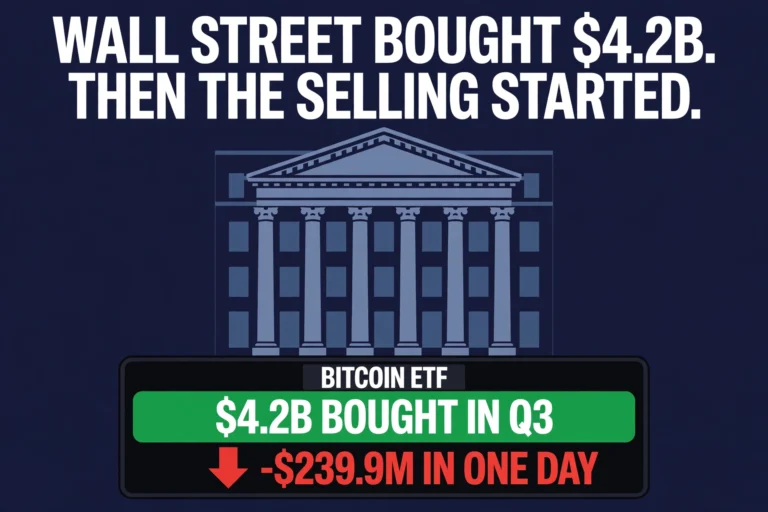
Bitcoin, meanwhile, finished Monday up less than 0.1% on the day. The divergence is the story: equities treated the oil slide as a green light, while crypto — still nursing a $1.28 billion weekly ETF outflow detailed in the weekly recap, the worst since late June — could not convert the same risk-on session into anything more than a reclaim of a round number. If the equity rally is real and durable, crypto usually catches up. If it is a one-day oil trade, tonight’s CPI will decide which market was right.
Tonight: CPI, the last print before December
October CPI lands at 20:30 Vietnam time tonight — 8:30 a.m. Eastern — and it is the last inflation reading before the Fed’s December 8–9 meeting. The consensus is a 0.3% monthly rise in headline CPI, down from September’s 0.6%, and a 0.2% rise in core, down from 0.3%. Deutsche Bank expects 0.2% on both; Goldman Sachs is softer still, at 0.21% headline and 0.16% core; the Cleveland Fed’s nowcast sits at 0.24% headline and 0.21% core.
Two things to get right before the number hits. First, there will be no year-over-year CPI this month. The Bureau of Labor Statistics is not publishing 12-month figures for October 2026 because last October’s index levels were never produced during the government shutdown. Any headline quoting a “3.7% annual rate” is a model estimate — the Cleveland Fed’s nowcast is about 3.74% — not a BLS print. This article, and the recap that follows it, will write month-on-month only.
Second, the branches are genuinely two-sided, and the market knows it:
Core at 0.1% (soft): a downside surprise that would ease December hike odds from the 77–81% range they occupy now — about 81% on CME FedWatch per Reuters on Monday, 77.1% on centralbank.watch’s futures model, 77% on Polymarket. Bitcoin would have a real reclaim case toward $75,500 and beyond, with the equity rally behind it.
Core at 0.3% or hotter (in line with RBC’s call, or above): confirmation of what is already priced. Hike odds hold near 80%, the Fed’s December decision becomes a near-formality, and bitcoin stays pinned below the flip into the print — with $73,200 and the 200-day average as the floor if sellers press.
What did not happen on Monday is also worth recording, because the absence is the signal. Fed Vice Chair for Supervision Michelle Bowman spoke on community banking in the morning and offered no new signal on rates — her remarks were about regulation, not policy. Her economic-outlook speeches come on Tuesday, at the Council on Foreign Relations and later in the evening, and they will be read closely after CPI. Bank of England Governor Andrew Bailey spoke in Zurich about central-bank independence in an age of AI and geopolitical shocks; no new policy signal there either.
So the scoreboard heading into tonight is simple. Two Fed officials called inflation the problem and the direction of policy straightforward. Households expect 3.9% inflation and fear for their jobs at levels not seen since the pandemic. Bitcoin has its foot back on $75,000 and its nose pressed against $75,500. And the one number that can move all of it lands in about thirteen hours.
Know your levels before the print, not after it. The recap — with the actual CPI, Waller’s first reaction, and whether the flip finally gave way — lands in Wednesday morning’s slot. Bonds are closed that day for Veterans Day, so there will be no yield read-through to hide behind: the price action will have to speak for itself.
Track real-time institutional orderflow, liquidity heatmaps, and whale positioning across global crypto venues with the CoinXSight Intelligence Terminal.
Disclaimer: This article is for informational purposes only and does not constitute financial advice. Figures are cited from official releases and market data as reported at the time of writing and are subject to revision. Cryptocurrency markets are volatile; always do your own research before making investment decisions.
CX
CoinXSight Alpha Desk
ALPHA // DESK
Quantitative Research Desk·Global Alpha Division
CoinXSight Institutional Research Desk produces quantitative crypto market intelligence, algorithmic models, and on-chain forensics.
QUANTITATIVE SUITE // DEEP ALPHA ENGINEACTIVE
BTC/USDT // LIVE SCANNER
CONFLUENCE 74
LIVE SPOT PRICE$82,807.47WEAK_BUY
TP2
$89,522.75
+9.07%
TP1
$85,056.42
+3.63%
ENTRY
$82,078.86
ZONE
SL
$80,590.09
-1.81%
Auto-detect Order Blocks, Fair Value Gaps and risk-adjusted DCA ladders in < 5s.