AI-Powered On-Chain Analysis: What Machines See That Humans Can’t
Discover 5 on-chain patterns only AI can detect — from cross-chain wallet linkage to micro-transaction accumulation. Essential crypto technical analysis for smarter trading.
KZ
Dr. Kevin ZhangPrincipal AI & Quantitative Researcher·May 29, 2026 · 15 min read · Updated Oct 6
Imagine a librarian asked to read one million books per day. Not skim them — actually read every page, cross-reference every footnote, compare writing styles across authors, and flag the twelve books that contain a specific hidden pattern. No human librarian could survive a single morning. Yet this is precisely the challenge that on-chain analysis presents to any trader attempting to do it manually.
In May 2026, the numbers are staggering. Bitcoin processes over 500,000 transactions daily. Ethereum handles millions more. Solana, with its sub-second block times, generates tens of millions of transaction records each day. Across all major blockchains combined, the daily data stream exceeds 15 million transactions — and that figure grows every quarter.
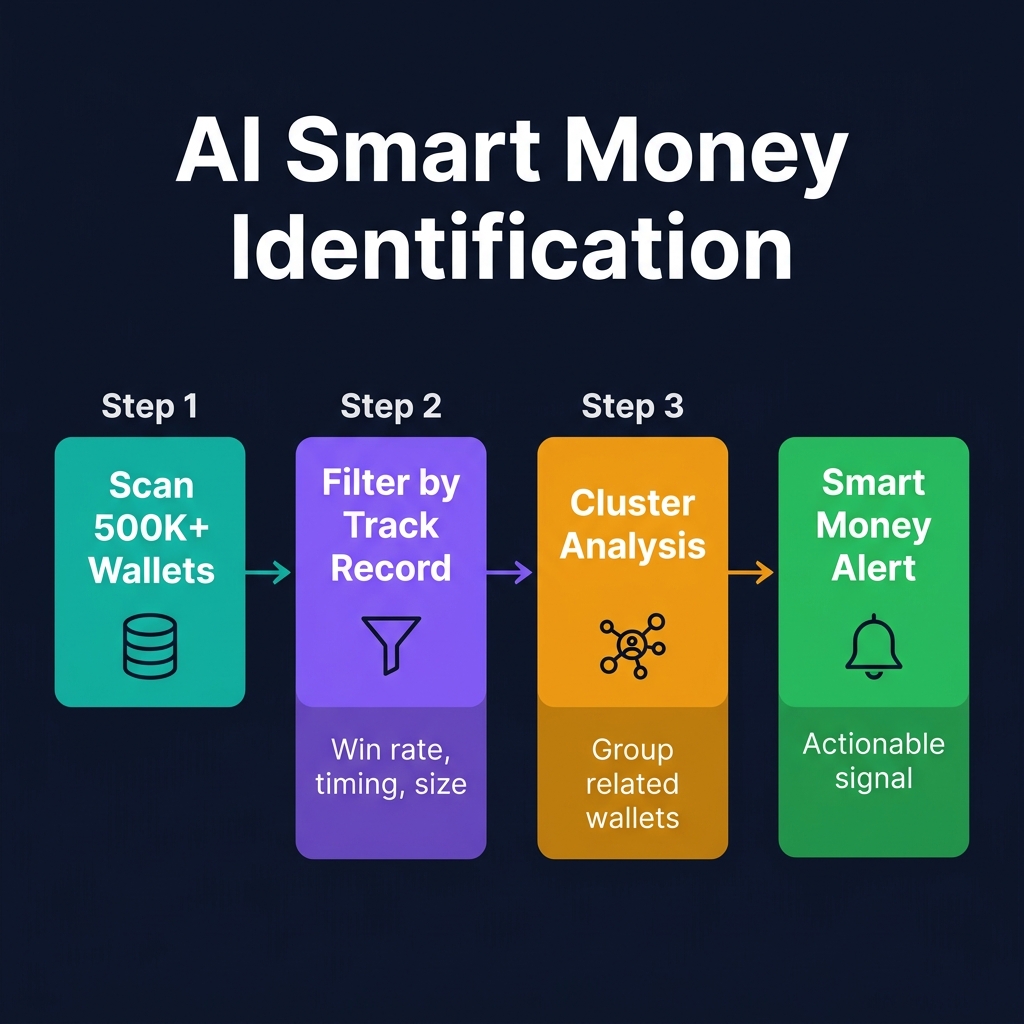
Now consider what a trader monitoring on-chain data actually needs to do. They must track over 500,000 active wallets across multiple chains. They need to monitor inflows and outflows across more than 100 centralized exchanges. They must watch for behavioral shifts among thousands of previously flagged whale and smart money wallets. And they need to do all of this in real time, because a signal that arrives six hours late is not a signal — it is a history lesson.
This is not a difficulty problem. It is an impossibility problem. No team of human analysts — regardless of skill, experience, or caffeine intake — can process this volume of data with the speed and consistency required to generate actionable trading signals.
AI changes the equation entirely. Machine learning models ingest millions of transactions per hour, apply pattern recognition across hundreds of dimensions simultaneously, and surface the handful of signals that actually carry predictive value. With BTC trading near $111,000, ETH above $2,650, and SOL pushing past $178, the traders gaining a genuine edge in May 2026 are not the ones staring at block explorers. They are the ones letting AI read the blockchain for them.
This article is about something different. It is about what AI sees that you cannot — the patterns, correlations, and anomalies that are mathematically invisible to the human eye, no matter how experienced it is.
Key Terms Glossary
On-chain analysis has its own vocabulary, and AI-powered analysis adds several terms to the lexicon. Understanding these terms will make the rest of this article immediately more actionable.
Term
Definition
Why It Matters
On-Chain Data
Information recorded directly on the blockchain — transactions, balances, contract interactions
The raw material for all blockchain analytics
Wallet
A unique blockchain address that holds, sends, or receives cryptocurrency
Every movement of funds starts and ends at a wallet
Transaction Hash (TxHash)
A unique identifier assigned to every blockchain transaction
Allows anyone to verify and trace any specific transfer
Block Explorer
A web tool (like Etherscan) that lets you browse blockchain data visually
Your window into on-chain activity without needing technical skills
Mempool
The waiting room for unconfirmed transactions before they are added to a block
Monitoring the mempool reveals intent before execution
Clustering Algorithm
An AI method that groups related wallets together based on shared behavioral or transactional patterns
Reveals that 50 "independent" wallets may actually be controlled by a single entity
Pattern Recognition
AI's ability to identify recurring sequences of behavior across millions of data points
Detects subtle accumulation, distribution, and coordination patterns invisible to human review
Anomaly Score
A numerical rating (typically 0-100) that quantifies how unusual a specific transaction or wallet behavior is compared to historical norms
Prioritizes which signals deserve immediate attention versus background noise
Cross-Chain Correlation
The process of linking wallet activity, timing, and behavioral patterns across multiple blockchains (e.g., Ethereum, Solana, BSC)
Reveals coordinated strategies that span multiple networks, invisible to single-chain analysis
Gas Fees
Transaction fees paid to validators for processing blockchain operations
Spikes in gas fees often indicate surging network demand and activity
TVL (Total Value Locked)
The total amount of crypto deposited into DeFi protocols
Measures the health and adoption of decentralized finance ecosystems
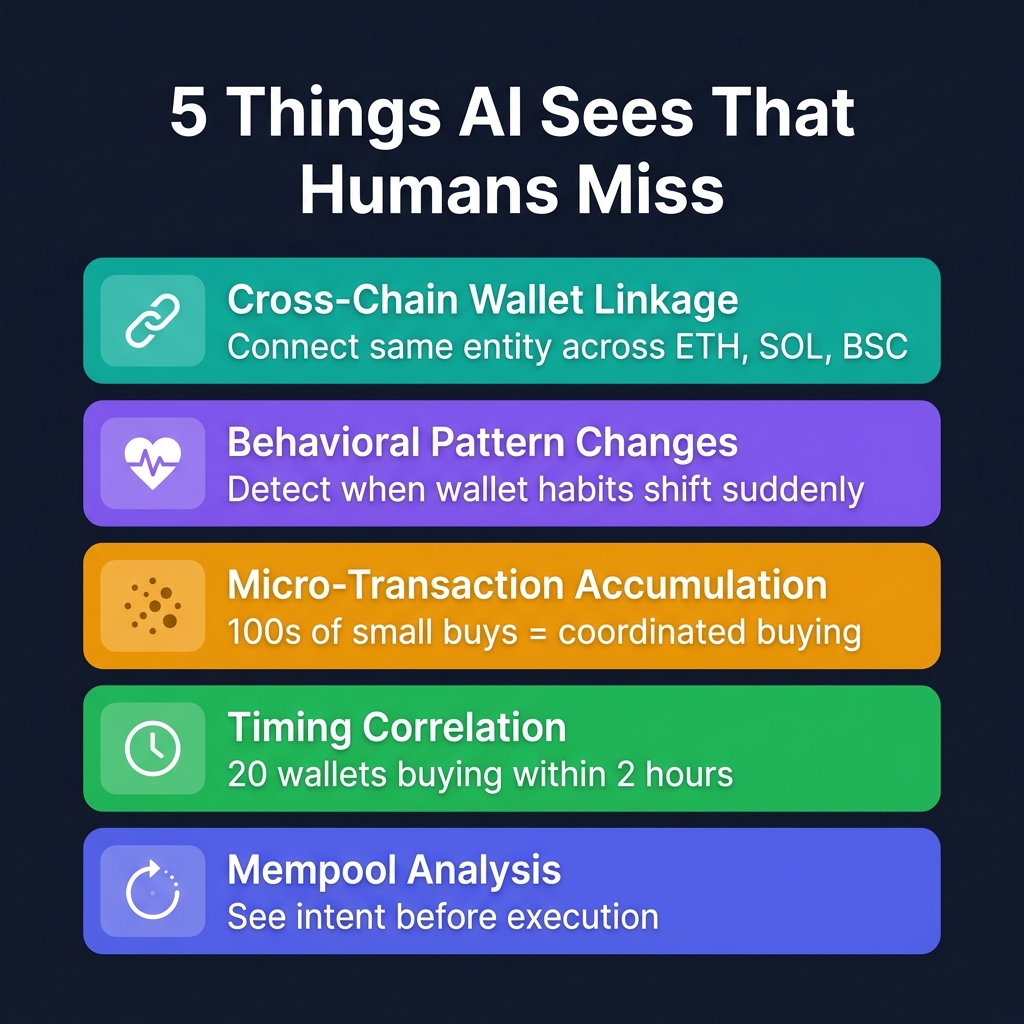
5 Things AI Sees That Humans Miss
Understanding 5 Things AI Sees That Humans Miss is a key part of crypto technical analysis. Most professional trading indicators on any crypto trading platform will help you apply these concepts in real time.
The on-chain data itself is public. Anyone with an internet connection can browse Etherscan, check Solscan, or query a Bitcoin node. The data advantage is zero. What creates the edge is processing speed, dimensional analysis, and pattern recognition at a scale that is physically impossible for human cognition. Here are five specific categories of insight that only AI can reliably extract from blockchain data.
1. Cross-Chain Wallet Linkage
Why humans miss it: A trader manually reviewing Ethereum transactions has no practical way to simultaneously track whether the same entity is operating wallets on Solana, BSC, Arbitrum, Base, and Avalanche. Each blockchain has its own address format, its own block explorer, and its own transaction structure. To a human analyst, a wallet on Ethereum and a wallet on Solana look completely unrelated — even when they are controlled by the same person or institution.
How AI catches it: Clustering algorithms analyze behavioral fingerprints across chains. Two wallets on different blockchains might share remarkably similar patterns — identical transaction timing windows, matching position sizes (adjusted for asset prices), correlated entry and exit points, and synchronized bridging activity. AI compares these dimensions across millions of wallet pairs and assigns probability scores for same-entity linkage.
Real 2026 scenario: In April 2026, CoinXSight's AI identified a cluster of 7 wallets spanning Ethereum, Solana, and BSC that exhibited a 94% behavioral correlation score. Individually, each wallet appeared modest — holding between $800,000 and $2.5 million in various assets. Together, the cluster represented over $11 million in coordinated capital. Over a 12-day period, all 7 wallets began accumulating SOL-ecosystem tokens. By mid-May, when SOL pushed above $178, the cluster had built a combined position worth approximately $14 million. No single-chain analysis would have flagged any individual wallet as noteworthy. The AI saw the constellation where humans saw only isolated stars.
2. Behavioral Pattern Changes (Regime Shifts)
Why humans miss it: Tracking one whale wallet's behavior over time is feasible for a dedicated analyst. Tracking the behavioral patterns of 10,000 wallets simultaneously — and detecting the exact moment when any of them deviates from its historical norm — is not. Humans can notice obvious changes ("this wallet just sold everything"), but subtle regime shifts in holding duration, position sizing cadence, or DeFi interaction patterns are invisible at scale.
How AI catches it: Machine learning models build behavioral profiles for every wallet that meets significance thresholds. These profiles establish baselines: average holding period, typical transaction size, preferred trading hours, usual counterparty exchanges, and historical asset allocation patterns. When a wallet's behavior deviates from its established baseline by a statistically significant margin, the AI generates an anomaly alert with a score reflecting the severity of the deviation.
Real 2026 scenario: Consider a well-known ETH whale wallet that had maintained a consistent pattern for 14 months — buying during dips, holding for an average of 32 days, then selling into strength. In early May 2026, AI detected that this wallet sold its entire ETH position after holding for only 5 days, a behavioral deviation that scored 91 out of 100 on the anomaly index. Furthermore, the wallet immediately rotated proceeds into stablecoins rather than its typical pattern of rotating into altcoins. This regime shift — from "buy the dip and hold" to "exit quickly into cash" — preceded a 4% ETH pullback by approximately 48 hours. A human analyst following this wallet might have noticed the sell. They almost certainly would not have quantified how anomalous the 5-day holding period was compared to the wallet's 14-month behavioral profile.
3. Micro-Transaction Accumulation
Why humans miss it: Whale tracking naturally focuses on large transactions — the $5 million buys, the $20 million transfers. This makes intuitive sense: big money moves markets. But sophisticated accumulators have adapted. Instead of making one $10 million purchase that triggers every whale alert on the internet, they split the buy into 200 transactions of $50,000 each, spread across 50 different wallets, executed over 72 hours, routed through 8 different exchanges.
How AI catches it: AI aggregates micro-transactions by timing, asset, and behavioral clustering. It asks a question no human could practically answer: "Among the 3 million transactions processed in the last 24 hours, are there groups of small-to-medium transactions that, when viewed collectively, represent a coordinated large position build?" Pattern recognition algorithms detect statistical anomalies in the distribution of buy-side transactions — when the number, timing, and sizing of small buys exceeds what random market activity would predict, the AI flags it as potential coordinated accumulation.
Real 2026 scenario: In the third week of May 2026, AI detected 347 individual purchase transactions of a mid-cap DeFi token across 52 distinct wallets over a 48-hour period. Each transaction ranged from $15,000 to $85,000 — small enough to be invisible on any whale tracker. But the clustering algorithm identified that 41 of the 52 wallets had been funded from the same three exchange withdrawal addresses within the previous 7 days. Total coordinated accumulation: approximately $18 million. The token's price was $4.12 at the time of detection. Within 10 days, it reached $5.78 — a 40% move. No individual transaction in the cluster would have registered on any conventional whale alert system.
4. Timing Correlation Across Unrelated Wallets
Why humans miss it: When 20 wallets all buy the same token within a 2-hour window, it could be coincidence. Or it could be an information leak — a group of insiders acting on non-public information about an upcoming partnership, listing, or product launch. A human analyst might notice if 2 or 3 well-known wallets make similar moves. But identifying timing correlations across 20 or more wallets that have no apparent connection requires comparing the transaction timestamps of thousands of wallets against each other — a combinatorial problem that grows exponentially with each additional wallet.
How AI catches it: Statistical models calculate the probability that a given number of wallets would buy the same asset within a given time window by chance alone. If the actual observed clustering exceeds the probability threshold by a significant margin, the AI flags it as a timing anomaly. The system also cross-references the buying wallets against each other's historical activity to assess whether any hidden connections exist (shared funding sources, similar past trade patterns, overlapping DeFi protocol interactions).
Real 2026 scenario: In mid-May 2026, AI detected that 23 wallets — none of which had any previously identified connection to each other — purchased the same Layer 2 token within a 97-minute window. The statistical probability of this occurring by random chance was less than 0.003%. AI flagged this as a high-severity timing anomaly with an anomaly score of 88. The token received a major exchange listing announcement 4 days later, and its price increased by 35% within 24 hours of the announcement. The timing correlation signal had provided nearly a full week of advance warning that something significant was about to happen — not by predicting the specific catalyst, but by detecting the behavioral footprint of people who already knew about it.
Why humans miss it: The mempool — the holding area for transactions that have been submitted but not yet confirmed on the blockchain — is an enormous, constantly churning stream of data. On Ethereum alone, thousands of transactions sit in the mempool at any given moment, some for seconds and some for minutes. Manually monitoring the mempool is like trying to read a scrolling ticker that moves at 100 lines per second. Even if you could keep up, distinguishing between meaningful pending transactions and routine noise requires instant context about the sending wallet, the receiving address, the transaction size relative to the asset's liquidity, and the historical behavior of the sender.
How AI catches it: AI monitors the mempool continuously, applying the same wallet classification and behavioral analysis it uses for confirmed transactions. When a wallet that has been flagged as smart money submits a large pending transaction, the AI can detect the intent before the transaction is mined into a block. This creates a narrow but valuable window — typically seconds to minutes — during which AI-equipped traders receive advance notice of significant moves. The system also detects when multiple large pending transactions target the same asset simultaneously, signaling imminent heavy volume.
Real 2026 scenario: On May 21, 2026, AI detected three large pending ETH sell orders in the Ethereum mempool within a 45-second span — totaling approximately $8.2 million. All three sending wallets had been classified as smart money with win rates above 68%. The transactions had not yet been confirmed, but the AI system immediately generated an alert with the assessment: "High-probability sell pressure imminent — 3 verified smart money wallets liquidating ETH positions." Traders who acted on this mempool intelligence had a roughly 2-minute head start before the sell orders were confirmed and their impact began showing on exchange order books.
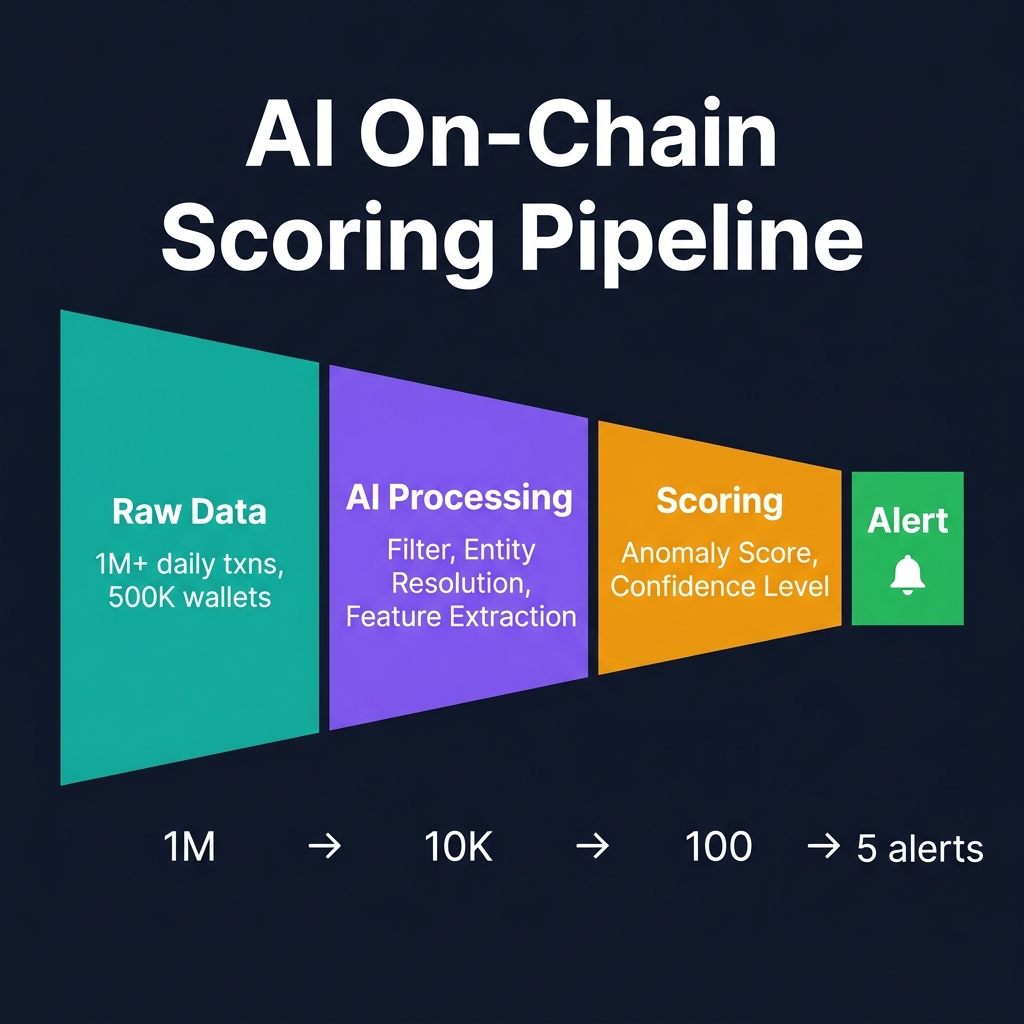
AI On-Chain Scoring: From Raw Data to Confidence
Understanding what AI detects is valuable. Understanding how AI transforms those detections into actionable scores is what separates conceptual knowledge from practical trading application.
The process follows a structured pipeline. At each stage, the data becomes more refined, more contextualized, and more useful — until what began as millions of raw transaction records becomes a single confidence score attached to a clear trading signal.
Pipeline Stage
What Happens
Data Volume
Output
1. Raw Ingestion
AI scans every transaction across all monitored blockchains in real time
15M+ daily transactions
Indexed, categorized transaction records
2. Noise Filtering
Removes exchange internal transfers, known bot activity, contract deployment transactions, and dust attacks
~60-70% filtered out
4-5M potentially meaningful transactions
3. Entity Resolution
Clustering algorithms group related wallets, resolve cross-chain identities, and tag known entities
Millions of address pairs analyzed
Enriched wallet graph with entity labels
4. Feature Extraction
For each significant transaction or wallet cluster, AI extracts behavioral features — timing, sizing, historical patterns, deviation scores
Hundreds of features per entity
Structured feature vectors ready for scoring
5. Anomaly Detection
Statistical models compare current behavior against historical baselines and flag deviations
Every feature compared to baseline distributions
Anomaly scores (0-100) for flagged events
6. Cross-Signal Correlation
AI cross-references on-chain anomalies with price action, volume, funding rates, sentiment data, and macro indicators
Multi-dimensional correlation analysis
Contextualized signal with supporting or conflicting factors identified
7. Confidence Scoring
A final composite score is generated reflecting both the strength of the on-chain signal and the degree of confirmation from other data sources
All factors weighted and combined
Single confidence score (e.g., 84/100) with classification (Strong Bullish, Weak Bearish, etc.)
8. Alert Delivery
The scored signal is routed to traders via dashboard, push notification, or API based on their configured thresholds
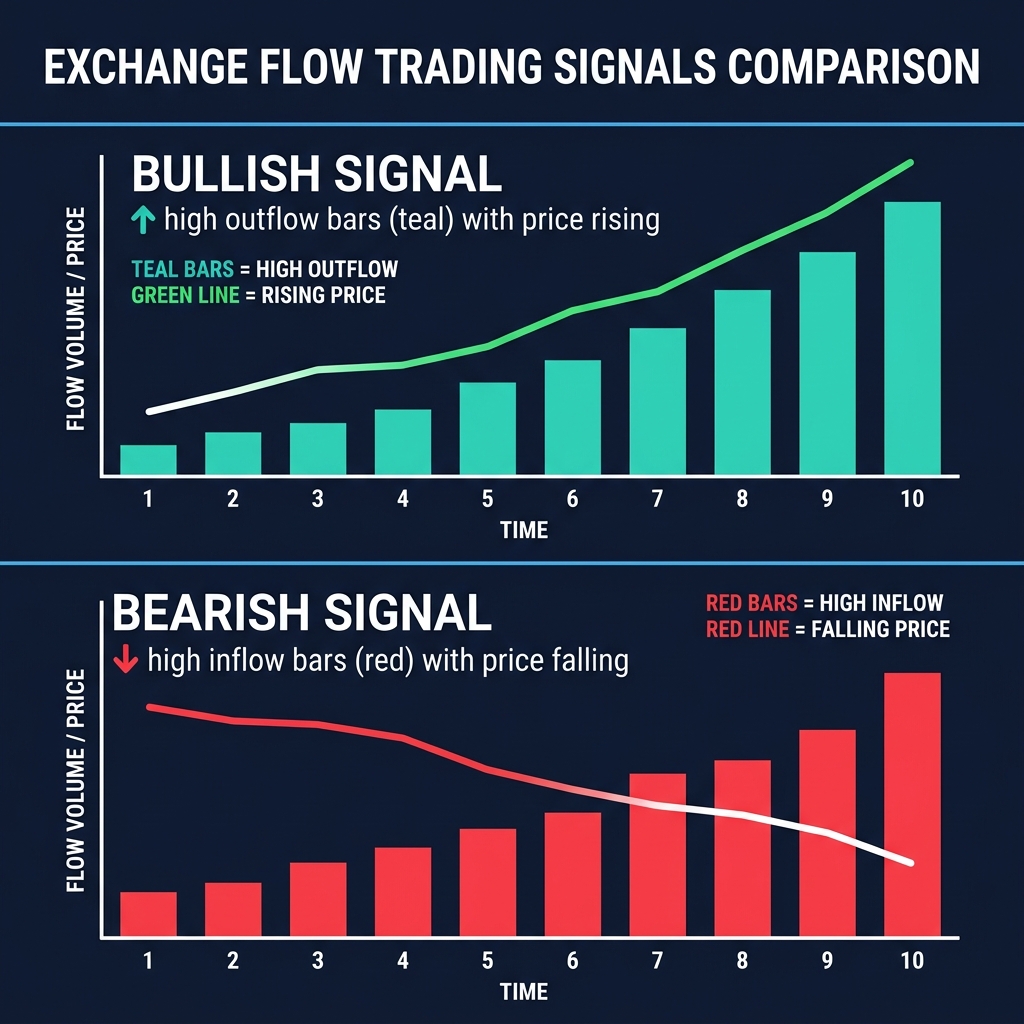
The critical insight is that the confidence score is not just about the on-chain signal itself. A whale accumulation pattern that occurs during rising exchange outflows, positive funding rate trends, and bullish sentiment readings will score significantly higher than the same accumulation pattern occurring during exchange inflow spikes and bearish sentiment. AI builds context that no single data source can provide alone.
This scoring pipeline processes continuously — not once per hour or once per day, but in near real time. When a new anomaly is detected, it flows through the entire pipeline in seconds, ensuring that alerts reach traders while the information is still actionable.
When AI On-Chain Signals Are Most Valuable
AI on-chain analysis does not perform equally well in all market conditions. Like any analytical approach, it has scenarios where it excels and scenarios where its edge is thinner. Understanding this distinction prevents over-reliance and helps you weight on-chain signals appropriately within your broader trading framework.
Market Scenario
Why AI On-Chain Shines
What to Watch For
Signal Reliability
Pre-Breakout Accumulation
Smart money and whale wallets accumulate before public catalysts. AI detects this buildup days or weeks before price moves.
Coordinated micro-accumulation, exchange outflow divergence, timing correlations across unrelated wallets
Very High — on-chain footprints of accumulation are difficult to hide completely
Distribution Before a Dump
Large holders cannot exit a major position without leaving on-chain traces. AI detects distribution patterns — wallet splitting, exchange inflow staging, gradual selling — before the impact hits the order book.
High — distribution is harder to disguise than accumulation because it requires interaction with exchange infrastructure
Regime Change Detection
When market structure shifts from bullish to bearish (or vice versa), the earliest indicators often appear on-chain before they appear on price charts. Behavioral profile changes across dozens of smart money wallets simultaneously signal a collective reassessment.
Multiple smart money wallets changing behavior in the same direction within a short window, cross-chain capital rotation patterns
High — regime changes create statistically significant behavioral deviations that AI is specifically designed to detect
New Narrative Emergence
When capital begins flowing into a new sector (AI tokens, RWA protocols, new L2s), on-chain data reveals the rotation before social media or price charts catch up. AI tracks where smart money is deploying capital across categories.
Sector-level accumulation patterns, new wallet creation in specific token ecosystems, cross-chain bridging into new networks
Moderate to High — depends on whether the narrative has genuine on-chain capital behind it or is purely social media hype
The common thread across all four scenarios is that on-chain activity provides a leading indicator — it shows you what participants are doing with their capital before the outcome of those actions becomes visible in the price. AI's role is to detect these leading signals at a scale and speed that makes them actionable rather than merely observable after the fact.
Limitations of AI On-Chain Analysis
Intellectual honesty demands acknowledging what AI on-chain analysis cannot do — at least not yet. No analytical tool is infallible, and understanding the limitations is as important as understanding the capabilities.
Privacy coins and mixer protocols. Transactions involving privacy-focused cryptocurrencies (Monero, Zcash with shielded transactions) or mixing services are deliberately designed to break the chain of traceability. AI can detect that funds entered a mixer, but it cannot reliably trace them through to the other side. Any wallet analysis that relies on transaction tracing hits a wall when mixers or privacy coins are involved.
Bridge obfuscation. Cross-chain bridges add complexity to entity resolution. When assets are bridged from Ethereum to Solana, the on-chain trail is broken at the bridge contract. AI can correlate timing and amounts to infer cross-chain connections, but this is probabilistic, not deterministic. Sophisticated actors who deliberately vary bridge amounts and add time delays can reduce the accuracy of cross-chain linking.
Smart contract complexity. DeFi protocols introduce layers of indirection between a wallet and its actual economic exposure. A wallet might interact with a lending protocol, which lends to a liquidity pool, which is used by an automated market maker. Tracing the ultimate economic intent through multiple layers of smart contract interaction requires sophisticated analysis, and current AI models can miss edge cases in novel protocol architectures.
False positives. AI pattern recognition is probabilistic, not certain. A timing correlation across 15 wallets might look like coordinated insider buying — or it might be 15 independent traders all reacting to the same publicly available information (a blog post, a tweet, a technical breakout on the chart). AI assigns probability scores, not guarantees. Treating every anomaly alert as a certainty is a recipe for overtrading and losses.
Adversarial behavior. As AI on-chain analysis becomes more prevalent, sophisticated actors will increasingly attempt to game it — creating fake accumulation patterns, generating misleading exchange flows, or deliberately spacing transactions to avoid timing correlation detection. This is an arms race, and while AI continuously adapts, the adversaries adapt too.
Data freshness and chain coverage. Not all blockchains are equally well-indexed, and newer chains or Layer 2 networks may have limited historical data for AI to build behavioral baselines against. Signal quality is directly proportional to data quality and depth.
The honest conclusion: AI on-chain analysis is a powerful tool that provides genuine informational advantages, but it is not omniscient. It works best as one component within a multi-factor analytical framework — combined with technical analysis, sentiment data, macro awareness, and sound risk management. For a detailed exploration of how AI detects and handles anomalies and false positives, see our anomaly detection guide.
How CoinXSight's AI Processes On-Chain Data
CoinXSight's on-chain analytics suite is built around the AI layer — the pattern recognition, entity resolution, anomaly scoring, and cross-chain correlation capabilities discussed throughout this article. The platform does not simply show you raw on-chain data and expect you to interpret it. It applies the full AI processing pipeline to deliver scored, contextualized, and actionable intelligence.
Cross-Chain Entity Resolution. CoinXSight's clustering algorithms continuously analyze wallet behavior across Ethereum, Solana, BSC, Arbitrum, Base, Avalanche, and over 25 additional networks. When the AI identifies wallets that exhibit high behavioral correlation across chains, it groups them into unified entity profiles — giving you a complete picture of coordinated capital movement that no single-chain tool can provide.
Behavioral Baseline Engine. Every wallet that meets CoinXSight's significance thresholds receives a continuously updated behavioral profile. The platform tracks holding patterns, transaction timing, position sizing, preferred assets, DeFi interaction patterns, and counterparty preferences. When any dimension of behavior shifts beyond the statistical norm, the system generates an anomaly alert with a severity score and plain-language context explaining what changed and why it matters.
Micro-Accumulation Detection. CoinXSight's AI specifically monitors for coordinated small-transaction patterns that conventional whale trackers miss entirely. The platform identifies statistically improbable clusters of buy-side activity, traces funding sources to detect shared origins, and surfaces potential coordinated accumulation events with size estimates and confidence scores.
Mempool Intelligence. For supported networks, CoinXSight monitors pending transactions from flagged wallets and surfaces pre-execution alerts when smart money or whale wallets submit significant orders. This provides the narrow but valuable early-warning window discussed earlier in this article.
Real-Time Scoring Dashboard. All signals flow through the AI scoring pipeline and are displayed on a unified dashboard with confidence scores, supporting context, and historical accuracy metrics for similar signal types. You can filter by chain, asset, signal type, confidence threshold, and wallet tier to focus on exactly the intelligence that matches your strategy.
For the foundational on-chain concepts that CoinXSight's AI layer builds upon — exchange flow mechanics, smart money identification criteria, and whale behavior taxonomy — refer to the dedicated guides linked at the beginning of this article.
Ready to see what AI sees on the blockchain?Explore CoinXSight's Whale Flow module and start receiving AI-powered on-chain intelligence that goes far beyond what any human analyst can process.
The blockchain is transparent — every transaction, every wallet, every movement of capital is recorded permanently on a public ledger. But transparency without processing power is like having a library card to a library with a million books and no catalog. AI on-chain analysis is the catalog, the librarian, and the reading assistant all at once. It links wallets across chains that no human could connect, detects behavioral regime shifts across thousands of wallets simultaneously, surfaces coordinated micro-accumulation hiding beneath conventional radar, identifies timing correlations that signal information leaks, and reads the mempool to reveal intent before execution. With BTC at $111,000, ETH above $2,650, and SOL past $178, the traders who gain a genuine edge in 2026 are not the ones with access to better data — the data is public and identical for everyone. The edge belongs to those who let AI read it at machine speed, with machine precision, and at a scale that the human brain was never designed to handle.
Start seeing what machines see.Open CoinXSight's AI on-chain analytics and transform millions of blockchain transactions into scored, actionable signals — automatically.
KZ
Dr. Kevin Zhang
AI // QUANT LABS
Principal AI & Quantitative Researcher·Deep Alpha Engine Labs
Ph.D. in Computational Statistics. Leads machine learning architecture, regime-switching detection, and automated execution systems at CoinXSight Labs.
QUANTITATIVE SUITE // DEEP ALPHA ENGINEACTIVE
BTC/USDT // LIVE SCANNER
CONFLUENCE 67
LIVE SPOT PRICE$82,290.00WEAK_SELL
TP2
$92,244.59
+11.63%
TP1
$86,480.01
+4.65%
ENTRY
$82,636.95
ZONE
SL
$84,558.48
2.33%
Auto-detect Order Blocks, Fair Value Gaps and risk-adjusted DCA ladders in < 5s.