Layer 2 Crypto 2026: Which L2s Are Actually Winning?
Ethereum Layer 2s have reached critical mass in 2026. We compare Arbitrum, Optimism, Base, zkSync, and other leading L2s by TVL, user adoption, transaction volume, and ecosystem strength to determine which L2s are winning — and which to watch.
CB
Chloe BennettMarket Intelligence & Narrative Lead·Jul 10, 2026 · 14 min read · Updated Oct 6
The Ethereum Layer 2 (L2) wars have officially reached critical mass in 2026. With Base launching to mainstream success, Arbitrum solidifying its DeFi dominance, and zkSync pushing the boundaries of ZK technology, the L2 landscape is no longer just a technical debate — it's an investment thesis.
But here's the uncomfortable truth: not all L2s are winning. Several promising projects have faded, while others have quietly built the infrastructure that'll power the next wave of DeFi, AI+crypto, and social applications.
In this guide, we cut through the noise and analyze:
The L2 landscape in 2026 — who's still standing and who's struggling
Head-to-head metrics — TVL, transaction volume, active addresses, developer activity
Ecosystem health — number of protocols, user retention, tokenomics
Investment thesis — which L2 tokens have the highest Q4 2026 upside
Risks — why "L2 token" is different from "L2 technology"
The State of L2 in 2026: Technical Maturity Achieved
Ethereum L2s have gone from experimental scaling solutions to production infrastructure in just 3 years.
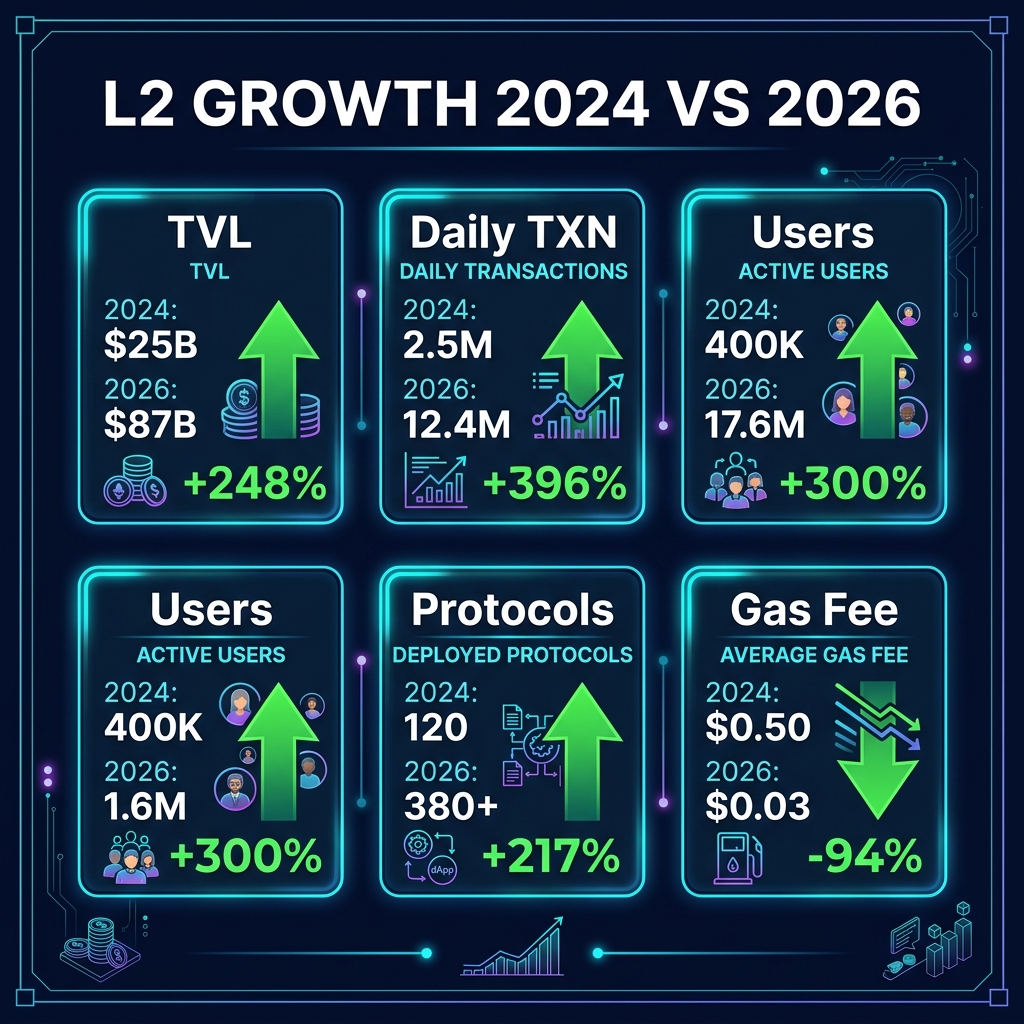
Key Metrics Summary
Metric
Early 2024
Early 2025
Mid 2026
Growth
Combined L2 TVL
$25B
$55B
$87B
+248%
Daily Transactions
2.5M
6.8M
12.4M
+396%
Unique Daily Addresses
400K
950K
1.6M
+300%
Number of Protocols
120
240
380+
+217%
Avg. Gas Fee (USD)
$0.50
$0.15
$0.03
-94%
What this means: L2s are handling the majority of Ethereum's economic activity. If you're not using L2s, you're paying 20-50x more in fees for the same transactions.
Why L2s Matter Now (Not Just in 2025)
Layer 2s have become critical infrastructure because:
Ethereum mainnet fees remain $3-15 per transaction — prohibitive for most use cases
DeFi TVL migration — major protocols have moved entirely to L2s
AI + crypto workloads — AI agents need cheap, fast transactions (L2s enable this)
Social applications — Farcaster, Lens, and other social protocols run on L2s
Gaming — on-chain games need sub-cent transaction costs
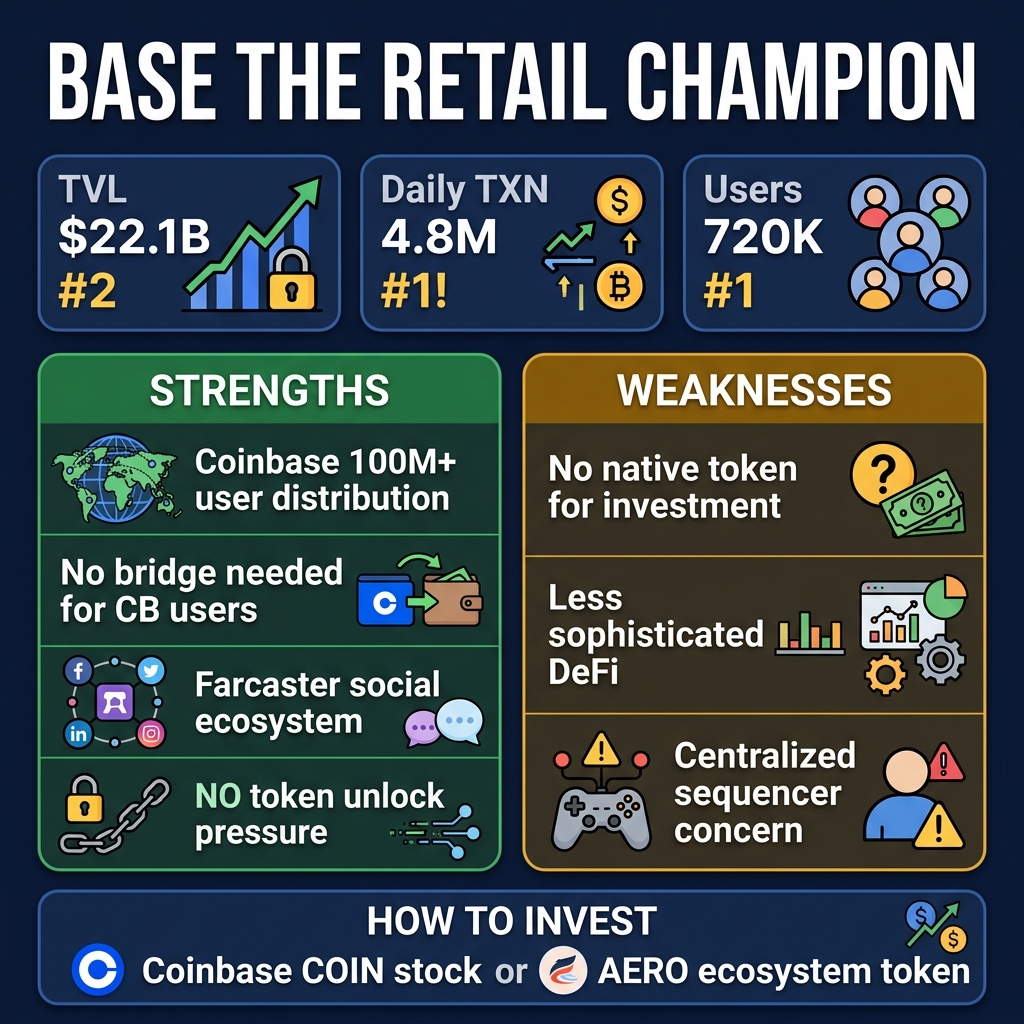
Investment Thesis: Base doesn't have its own token, but Coinbase (COIN) is the proxy. Base's growth = more Coinbase revenue from fees and user engagement. Also, the Base ecosystem tokens (aero.xyz ecosystem, etc.) represent the largest L2 opportunity for altcoin investors.
Optimism (OP)
Status: The Superchain Visionary 🔗
Metric
Value
Rank
Notes
TVL
$16.8B
#3
Decentralized but slower growth
Daily TXN
1.8M
#3
Modest growth
Protocols
90+
#3
Balanced ecosystem
Unique Addresses
410K
#3
Steady user base
Token
OP
Market Cap: $3.1B
Governance + fee revenue sharing
Strengths:
Superchain narrative: OP Stack enables other chains to inherit Optimism's security
Gitcoin, Worldcoin use Optimism — high-profile projects
Fee revenue shared with token holders (real yield)
Most decentralized governance structure
Strong "public goods" funding model (retroactive public goods funding)
Weaknesses:
Growth has plateaued vs Base and Arbitrum
Less viral consumer apps
Developer migration to Base and Arbitrum
Investment Thesis: OP is the "quality but slow" bet. The superchain vision is compelling long-term, but near-term momentum favors Arbitrum and Base.
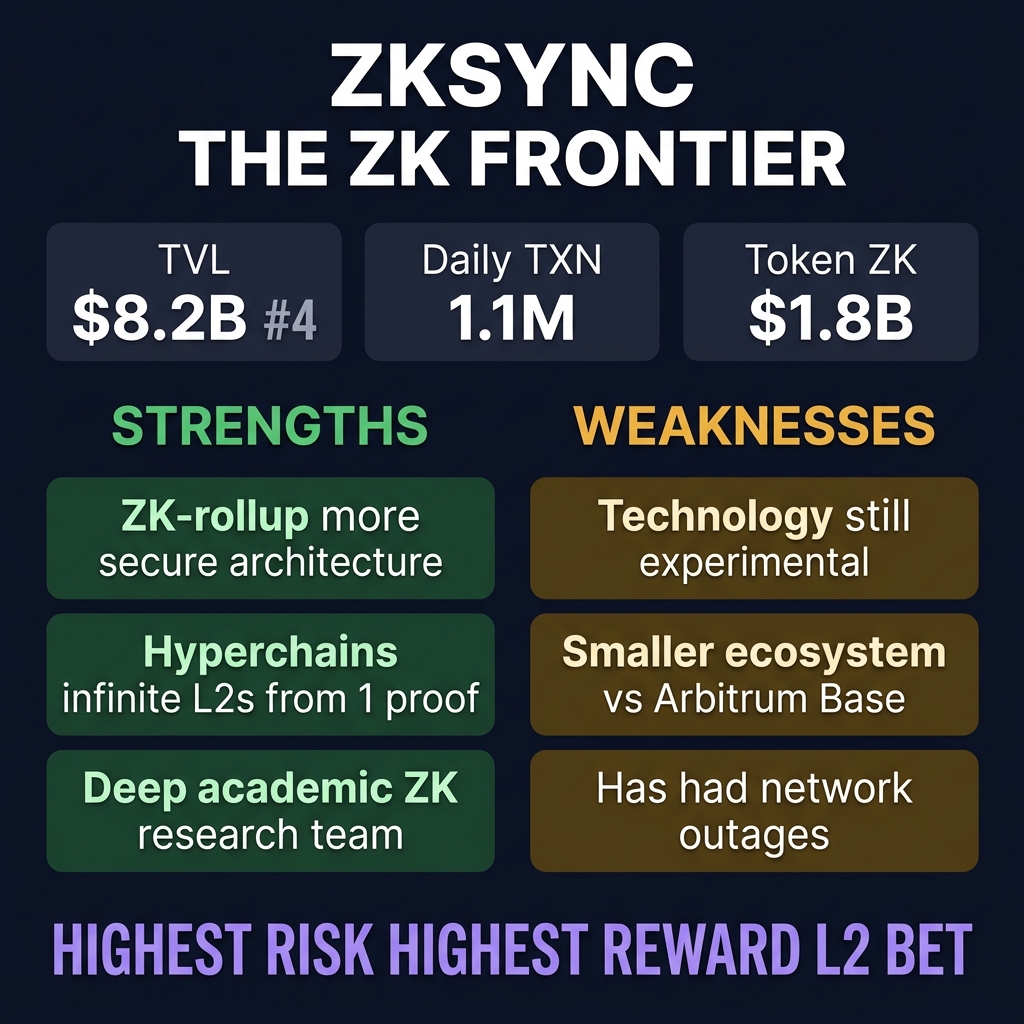
zkSync (ZK)
Status: The Frontier of ZK Tech 🔬
Metric
Value
Rank
Notes
TVL
$8.2B
#4
Growing fast
Daily TXN
1.1M
#4
Accelerating
Protocols
65+
#5
Developer focus
Unique Addresses
320K
#4
Consistent growth
Token
ZK
Market Cap: $1.8B
Early-stage token
Strengths:
ZK-rollup architecture = theoretically more secure and scalable than OP-rollups
zkSync Era — general-purpose ZK rollup
zkSync Hyperchains — enabling infinite L2s secured by one ZK proof
Strong developer community focused on ZK tech
Academic backing (Matter Labs team has deep ZK research background)
Weaknesses:
ZK technology still experimental — has had network outages
Smaller ecosystem vs Arbitrum/Base
Token economics still being refined
Investment Thesis: ZK is the highest-risk, highest-reward L2 bet. If ZK-rollups become the dominant scaling solution, zkSync is well-positioned. But technology risk is real — ZK is unproven at scale.
Aggressive MICE (Making ICONS Ecosystem) program for user acquisition
Weaknesses:
Losing mindshare to newer L2s (Base, Arbitrum)
Token performance has underperformed peers
Developer migration to other ecosystems
Identity crisis: are they L1? L2? ZK? PoS?
Investment Thesis: Polygon is the "value trap" of L2s. The tech is solid, but the competitive moat has eroded. POL token has structural headwinds due to inflation schedules. Only consider if you believe in a "L2 consolidation" where Polygon's first-mover advantage wins.
Other L2s Worth Watching
L2
Key Feature
Status
Starknet (STRK)
ZK-rollup, strong dev community
Niche, academic focus
Scroll (SCR)
zkEVM, native Ethereum alignment
Early stage, small TVL
Linea (Consensys)
zkEVM, backed by Consensys/MetaMask
Promising but slow growth
Manta Pacific
Privacy-focused L2
Small but specialized user base
The Investment Thesis: Which L2 Token to Buy?
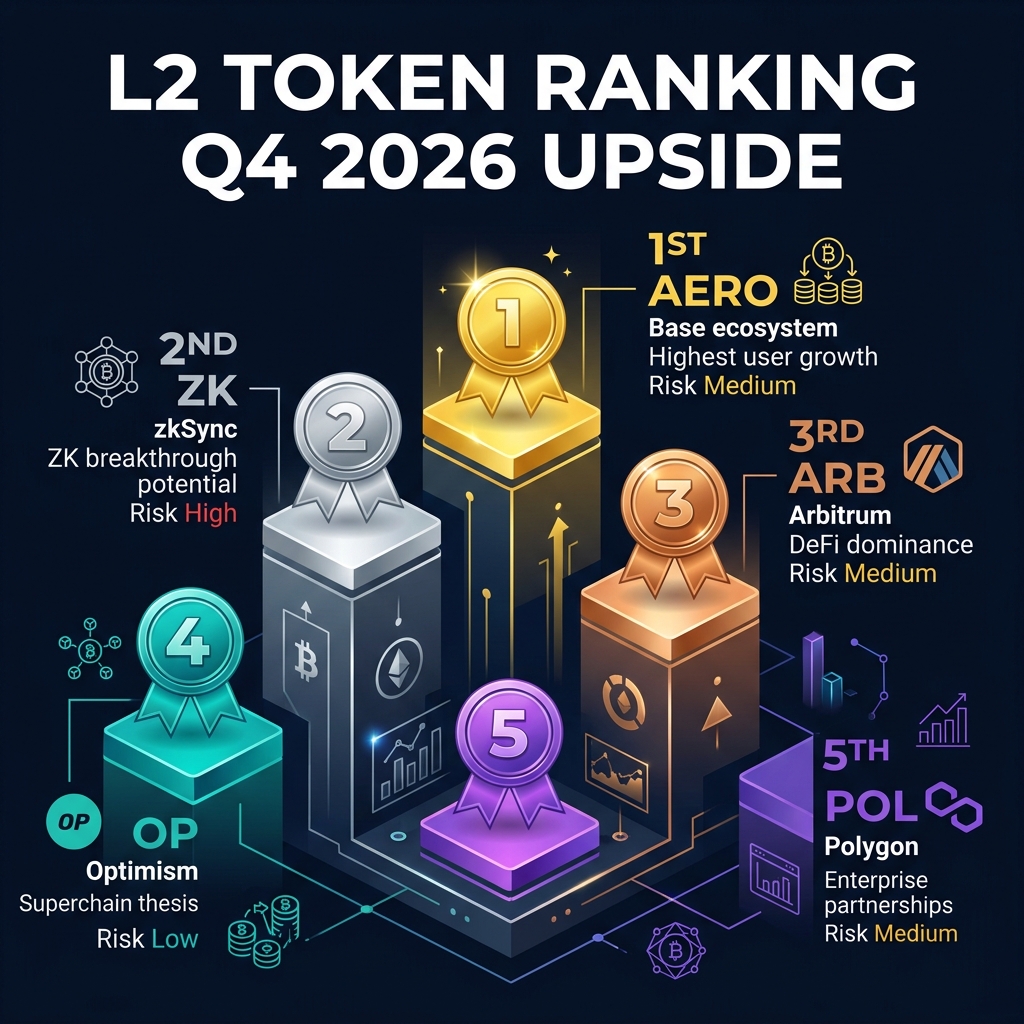
Ranking by 2026 Q4 Upside Potential
Rank
L2
Token
Upside Thesis
Risk Level
1
Base ecosystem
AERO (aerodrome)
Base has highest user growth trajectory
🟡 Medium
2
zkSync
ZK
ZK technology breakthrough potential
🔴 High
3
Arbitrum
ARB
DeFi dominance, but token unlocks
🟡 Medium
4
Optimism
OP
Superchain thesis, fee revenue sharing
🟢 Low
5
Polygon
POL
Enterprise partnerships, but declining share
🟡 Medium
Important distinction: L2 protocols generate real revenue and have real products. But L2 tokens are primarily governance tokens with economic value tied to protocol governance and (sometimes) fee sharing. Evaluate each token's token economics separately from the protocol's fundamentals.
What "Winning" Actually Means for L2s
Winning in Q4 2026 means different things for different stakeholders:
Stakeholder
"Winning" Means
Traders
L2 tokens outperform BTC + ETH in Q4
Developers
TVL and protocol count continue growing
Users
Fees stay < $0.05, UX indistinguishable from centralized apps
Protocols
More apps migrating to their chain
Investors
Sustainable revenue + token value accrual
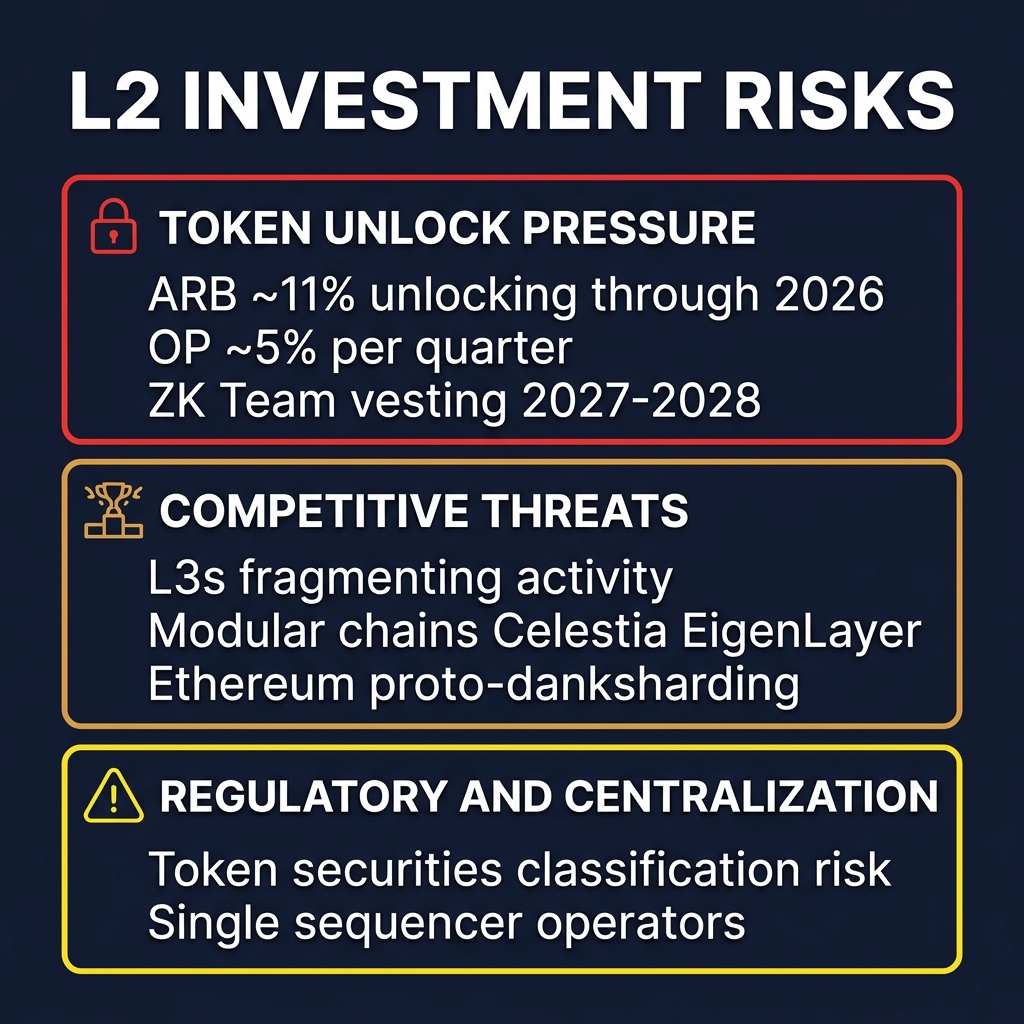
Risks of L2 Investing in 2026
1. Token Unlock Overhangs
Many L2 tokens have large unlocks coming in 2026 that create selling pressure:
Token
Unlock Schedule
Notable Events
ARB
Monthly cliff + vesting
~11% of supply unlocks through 2026
OP
Quarterly unlocks slowing
~5% unlocks per quarter
ZK
Early stage, team vesting
Team tokens unlock 2027-2028
STRK
Major unlocks
Significant sell pressure from early investors
2. Competitive Risk: New L2s and L3s
The L2 space is highly competitive. New entrants include:
L3s (L2s built on L2s): These could fragment activity further
Modular blockchains: Celestia, EigenLayer creating alternative scaling paths
Ethereum roadmap: Proto-danksharding (EIP-4844 improvements) may reduce L2 value prop
3. Regulatory Risk on Tokens
L2 tokens face regulatory risk as securities:
If classified as securities → restricted trading, potential SEC enforcement
L2s without tokens (Base) have zero regulatory token risk
L2s with clear utility (fee discount, governance) have lower risk
4. Centralization Risk
Sequencer centralization: Most L2s have single sequencer operators
If a sequencer goes down, the L2 stops processing transactions
Decentralization roadmap varies by L2
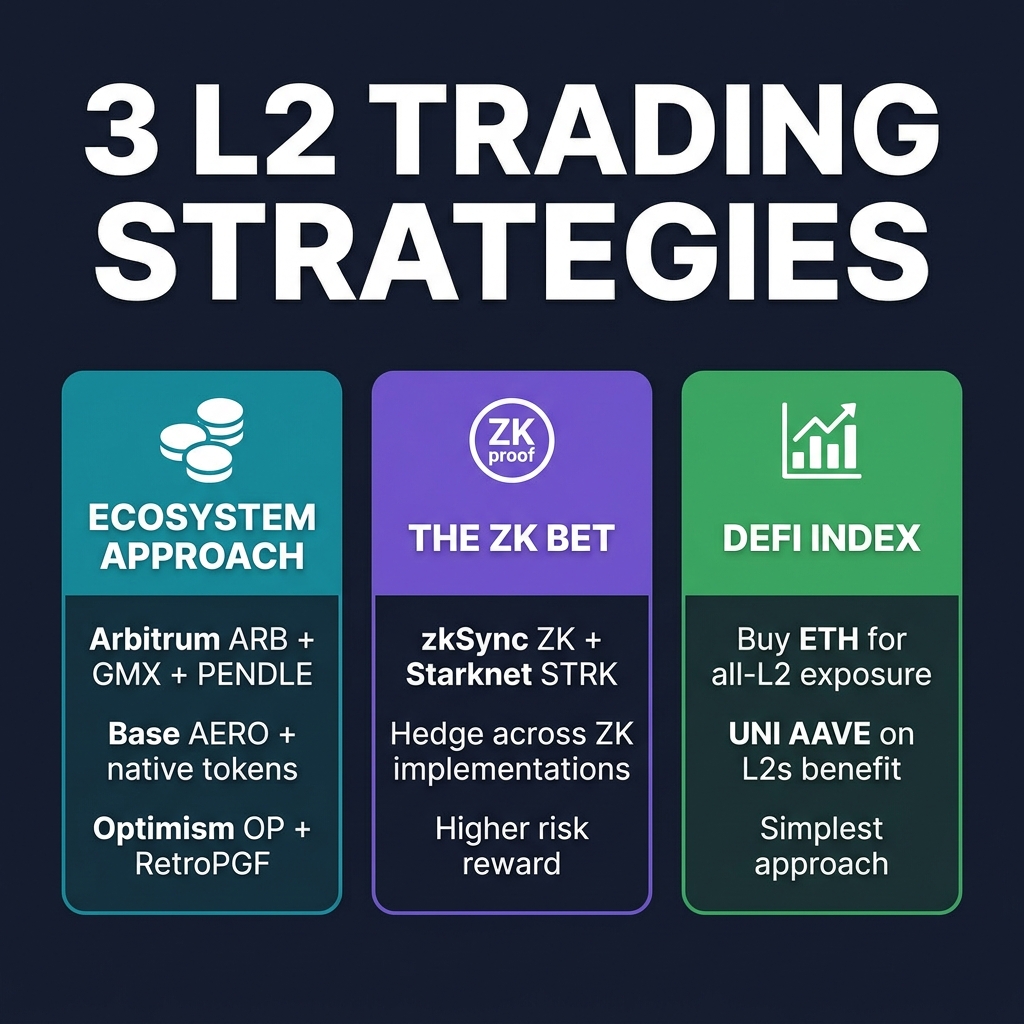
How to Trade L2s in Q4 2026
Strategy 1: The "Ecosystem" Approach
Instead of picking one L2, build exposure to the L2 sprint:
Risk Alert: L2 tokens have historically underperformed the underlying protocols' success. Revenue sharing (like Optimism's fee distribution to OP holders) is NOT guaranteed and requires active participation. Read CoinXSight Alpha Strategy guide for how to evaluate token economics properly.
Frequently Asked Questions
Q1: Should I buy L2 tokens or just invest in Ethereum?
A: It depends on your conviction level. Buying ETH gives you exposure to ALL L2s (since they all settle on Ethereum) without picking a winner. L2 tokens offer the possibility of higher returns IF that specific L2 wins — but you have to pick correctly. Consider a mix: 60-70% ETH, 30-40% across 2-3 L2 tokens you believe in.
Q2: Base doesn't have a token yet. How do I invest in Base's success?
A: Two main ways:
Coinbase (COIN) — Base is built by Coinbase, so Base growth drives Coinbase revenue and stock price
Base ecosystem tokens — Aerodrome (AERO) is the leading DEX on Base; other native Base protocols will emerge as Base "meme coin" and consumer app ecosystems grow
Layer 2s are no longer experimental — they're the infrastructure layer of Ethereum's future. In 2026, the L2 landscape has matured into a competitive ecosystem where protocol quality, user experience, and developer ecosystem matter more than hype.
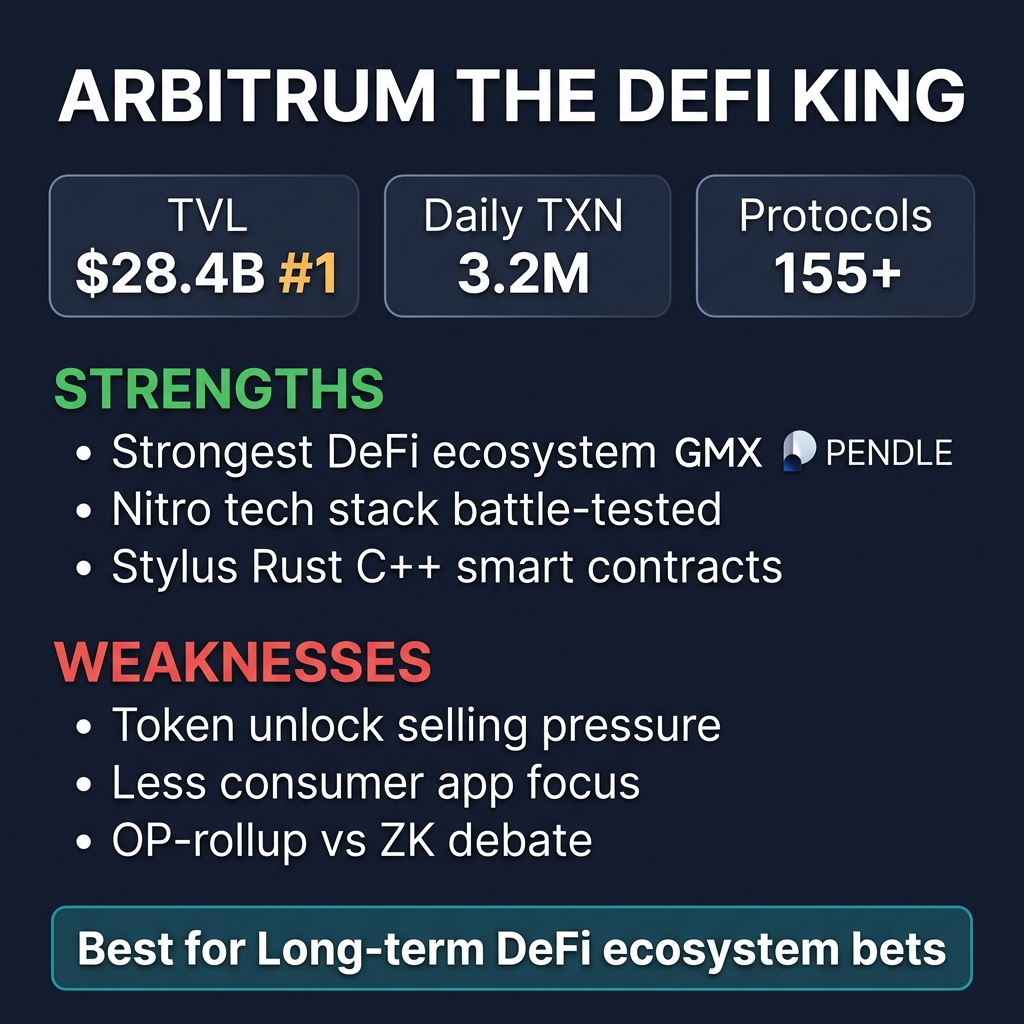
Our verdict: Base is the retail momentum play. Arbitrum remains the DeFi king. zkSync is the high-risk ZK bet. Optimism has the most compelling long-term vision but slower momentum.
For Q4 2026 positioning:
Core: ETH (benefits from all L2 growth)
Growth: ARB or AERO (Arbitrum/Base ecosystem dominance)
Speculative: ZK (if you believe ZK-rollups become dominant architecture)
Remember: The best L2 investment strategy isn't about one token — it's about understanding which narrative (consumer apps, DeFi, ZK tech, superchain) is gaining momentum and positioning accordingly. Use CoinXSight's confluence scoring framework to combine on-chain metrics, technical analysis, and fundamental catalysts.
The L2 wars aren't over — but the field is narrowing. Are you positioned for the winners?
Learn to identify altcoin season using BTC dominance charts, capital rotation patterns, sector analysis, and on-chain metrics. A data-driven framework…