The deadline passed at 18:38 UTC on Monday, and the addresses tell the story with more precision than any statement could. Chainflip’s designated Bitcoin return address has never received a single transaction. The Ether return address holds 10 wei — a dust speck worth less than a fraction of a cent, the blockchain equivalent of a shrug. The 90/10 white-hat offer — return 90% of the stolen funds, keep roughly $1.2 million, no questions asked — expired unclaimed. The negotiation phase of the Chainflip theft is over. What remains is a frozen protocol, a token worth a third of its pre-hack value, and an incident report that makes the original theft look worse than the market understood on Saturday — starting with the total.
Correction: it was 133.34 BTC, and there were two drains
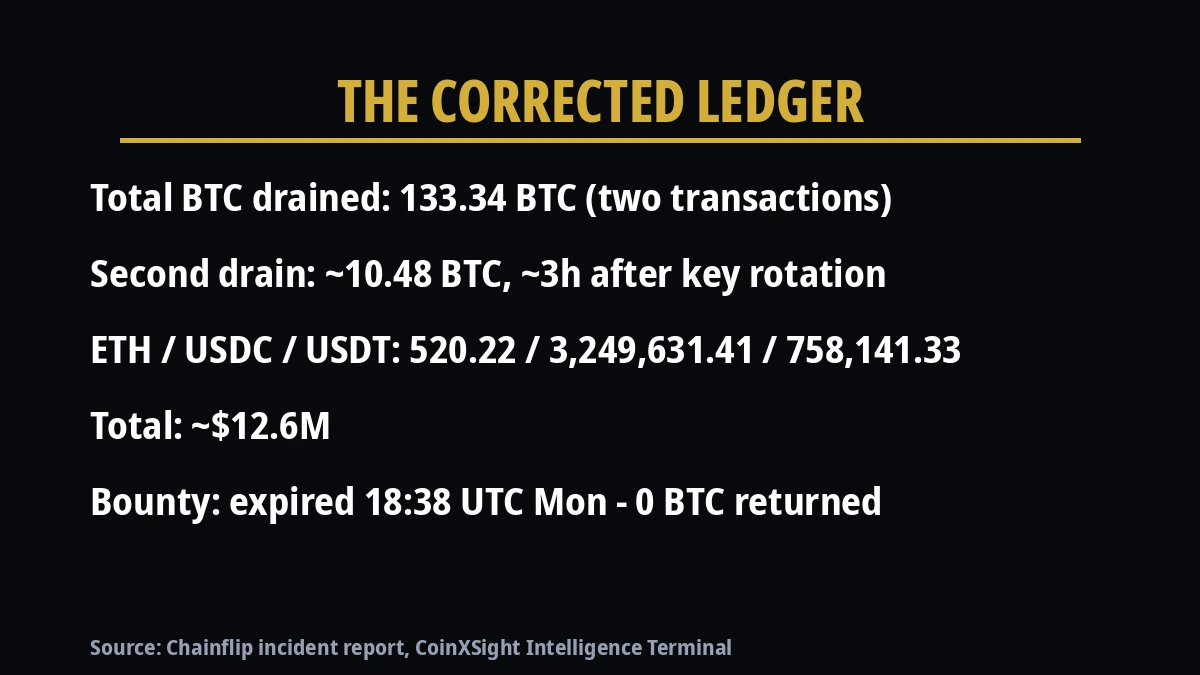
Detailed breakdown of Chainflip drained assets across two exploit waves totaling 133.34 BTC. Source: CoinXSight Telemetry & Protocol Incident Report.
Chainflip’s own incident accounting now puts the Bitcoin leg at 133.34425053 BTC across two transactions — not the 122.86 BTC in the first wave that Monday’s coverage, including ours, reported as the figure. The second transaction, some 10.48 BTC, left roughly three hours after the protocol rotated its aggregate signing key — a detail that changes the character of the incident. A single drain against a compromised key is a theft. A second drain after the emergency rotation means the compromise survived the first response, and the window of exposure was longer than the “under ten minutes” of the initial attack. The full tally stands at 133.34 BTC, 520.22 ETH, 3,249,631.41 USDC and 758,141.33 USDT — approximately $12.6 million.
The mechanism, per the protocol’s report — elements of which remain unconfirmed — is a study in how cross-chain security actually fails. A validator account was registered on November 20, seventy-nine seconds after being funded with 20,500 FLIP, and never joined the active validator set. Through what Chainflip describes as a memory-safety flaw in a third-party networking library, the attacker allegedly extracted key shares — not by breaking the threshold cryptography, but by reading the memory of machines that held its pieces. The lesson travels well beyond one protocol: a 150-validator threshold scheme is only as strong as the least-audited library running on its nodes.
Chainflip, the corrected ledger
Figure
Total BTC drained
133.34425053 BTC (two transactions)
Second drain
~10.48 BTC, ~3h AFTER key rotation
ETH / USDC / USDT
520.2243399 ETH / 3,249,631.41 / 758,141.33
Total
~$12.6M
Bounty outcome
Expired 18:38 UTC Mon — BTC return address: 0 transactions; ETH address: 10 wei
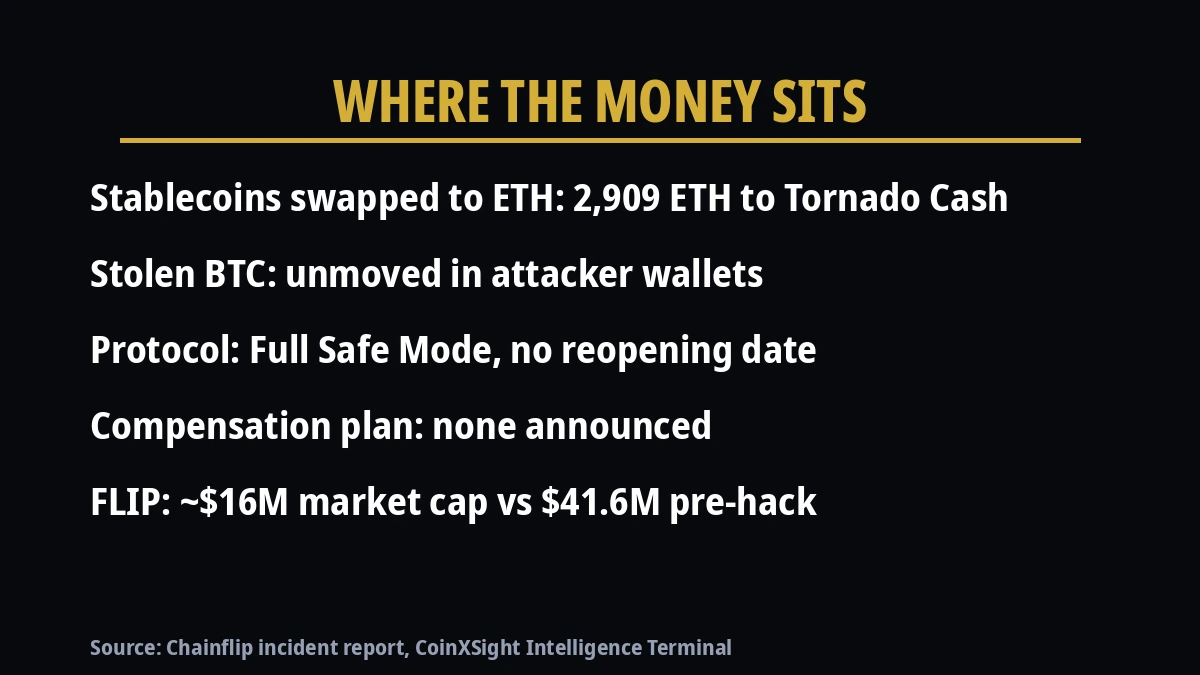
Stablecoin proceeds
Swapped to ETH, sent to Tornado Cash (2,909 ETH); stolen BTC unmoved
Protocol status
Full Safe Mode, no reopening date, NO compensation plan announced
Where the money sits, and what users actually get
Flow of stolen funds: Stablecoins converted to ETH and routed through Tornado Cash while Bitcoin remains unmoved. Source: CoinXSight Intelligence Terminal.
The proceeds have split into two postures. The stablecoins were swapped into Ether and pushed through Tornado Cash — 2,909 ETH into the same mixer infrastructure the Binance theft cluster has used all month. The stolen Bitcoin, by contrast, has not moved at all: it sits in the attacker’s wallets, visible to every tracing firm on earth, unsellable at scale without tripping the freeze network that has already immobilized more than $2.9 billion of the Binance loot. Unsold is not recovered — but it is not spent, either, and the distinction will matter if law enforcement’s forfeiture machinery, which claimed $1.17 billion of the Binance funds on Monday, eventually turns to this case.
For Chainflip’s own users, the position is narrower than the headlines suggest. The protocol remains in Full Safe Mode with no announced reopening date and — the sentence that matters — no compensation plan announced. Liquidity-provider balances held on unaffected chains are being returned, but a returned balance on a chain the attacker never touched is not compensation for the vault losses; it is simply the protocol giving back what was never stolen. FLIP’s market value, roughly $16 million against $41.6 million before the hack, with the token changing hands around $0.18–0.19, prices exactly that uncertainty: a paused bridge, an unresolved $12.6 million hole, and a recovery story that depends on an attacker who has already declined $1.2 million to give the money back.
The backdrop keeps deteriorating
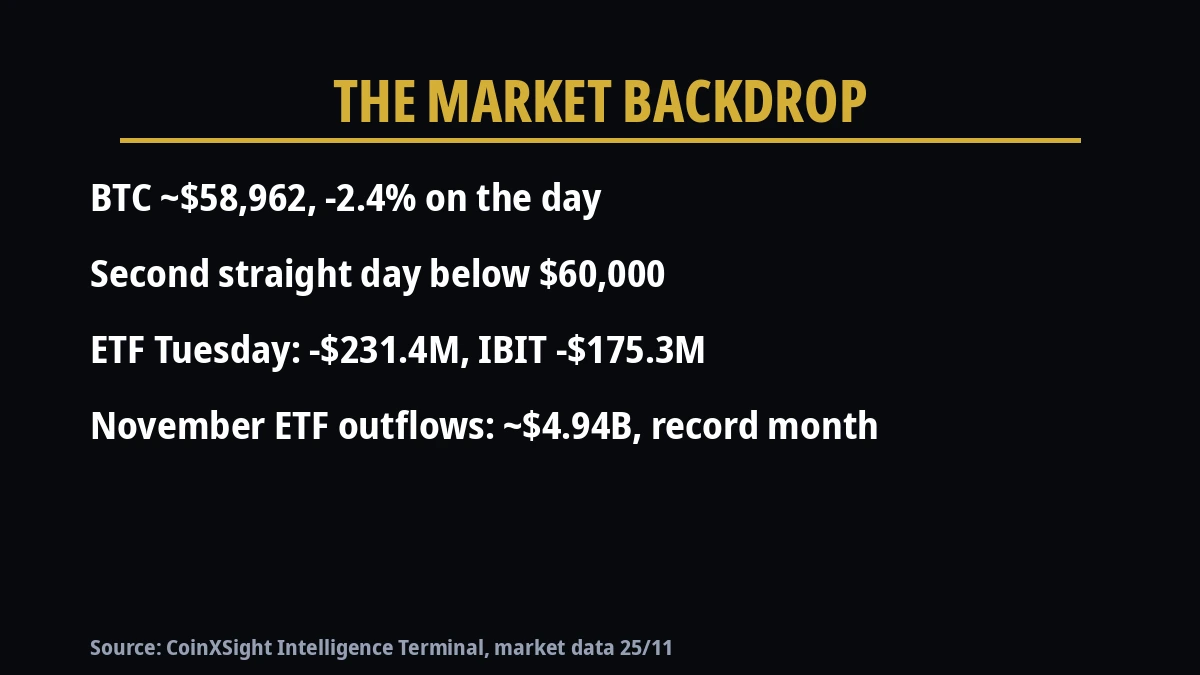
FLIP valuation collapse from $41.6M to ~$16M against broader macro weakness and persistent ETF outflows. Source: CoinXSight Quantitative Research.
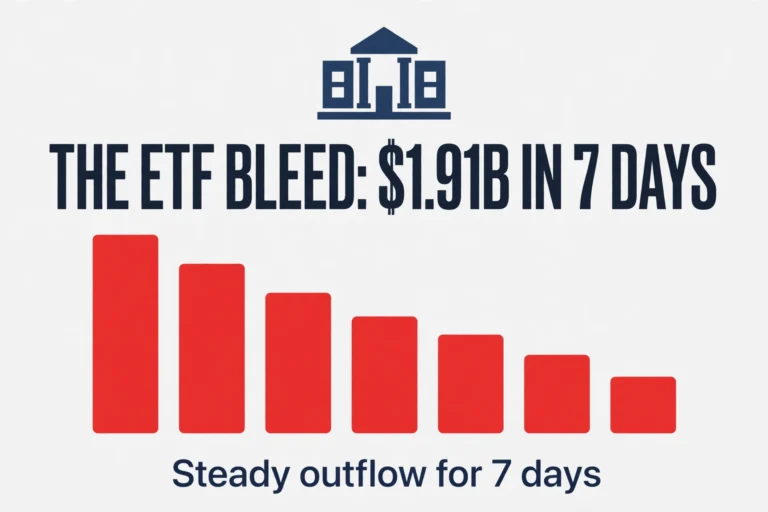
None of this is happening in a market with spare risk appetite. Bitcoin traded near $58,962 on Wednesday afternoon in Vietnam, down 2.4% on the day with an intraday low of $58,937.50 — a second consecutive day below $60,000, the Saturday low of $55,130 coming back into conversation. Tuesday’s ETF final, published at last, was a sixth consecutive outflow: −$231.4 million, IBIT −$175.3 million, taking November’s cumulative redemptions to roughly $4.94 billion in what was already the record month. (Larger figures circulating that combine Bitcoin and Ether flows, or omit funds, are not the Bitcoin total.) Tonight’s 20:30 PCE and GDP release is the week’s last scheduled chance to change the tape before Thursday’s Thanksgiving closure — and a thin, holiday market is precisely the environment in which this month’s ugliest prints have happened.
Chainflip’s attacker was offered $1.2 million to be reasonable and chose the mixers instead. The protocol’s users were offered nothing at all. Between those two facts sits the whole unresolved question of the incident — not how the key was taken, but who, in the end, pays for it.
Disclaimer: This article is for informational purposes only and does not constitute financial advice. Figures are cited from official releases and market data as reported at the time of writing and are subject to revision. Cryptocurrency markets are volatile; always do your own research before making investment decisions.
CX
CoinXSight Alpha Desk
ALPHA // DESK
Quantitative Research Desk·Global Alpha Division
CoinXSight Institutional Research Desk produces quantitative crypto market intelligence, algorithmic models, and on-chain forensics.
QUANTITATIVE SUITE // DEEP ALPHA ENGINEACTIVE
BTC/USDT // LIVE SCANNER
CONFLUENCE 74
LIVE SPOT PRICE$82,807.47WEAK_BUY
TP2
$89,522.75
+9.07%
TP1
$85,056.42
+3.63%
ENTRY
$82,078.86
ZONE
SL
$80,590.09
-1.81%
Auto-detect Order Blocks, Fair Value Gaps and risk-adjusted DCA ladders in < 5s.