Bitcoin Taps $61,000 on Thanksgiving as $143 Million in Shorts Get Liquidated — Then Pushes Toward $61,900 as ETFs Log a Seventh Straight Day of Outflows and $7 Billion in Options Expire
Bitcoin squeezed to 61,509 USD and pushed toward 61,900 USD on Thanksgiving as 143M USD in shorts liquidated. But spot ETFs logged their seventh outflow day and 7B USD in options expire today.
CX
CoinXSight Alpha DeskQuantitative Research Desk·Nov 27, 2026 · Updated Nov 27
Two days ago, Bitcoin looked finished. It had fallen to about $57,300 — its lowest since September 2024 — on the back of a hotter-than-expected October PCE print, and the Fear & Greed Index sat at 11, in Extreme Fear. Then Thanksgiving did what thin holidays do to a crowded trade: it turned the move inside out. Bitcoin squeezed to $61,509 within a day, and by late this morning it had pushed further, to around $61,600, with an intraday high near $61,880.
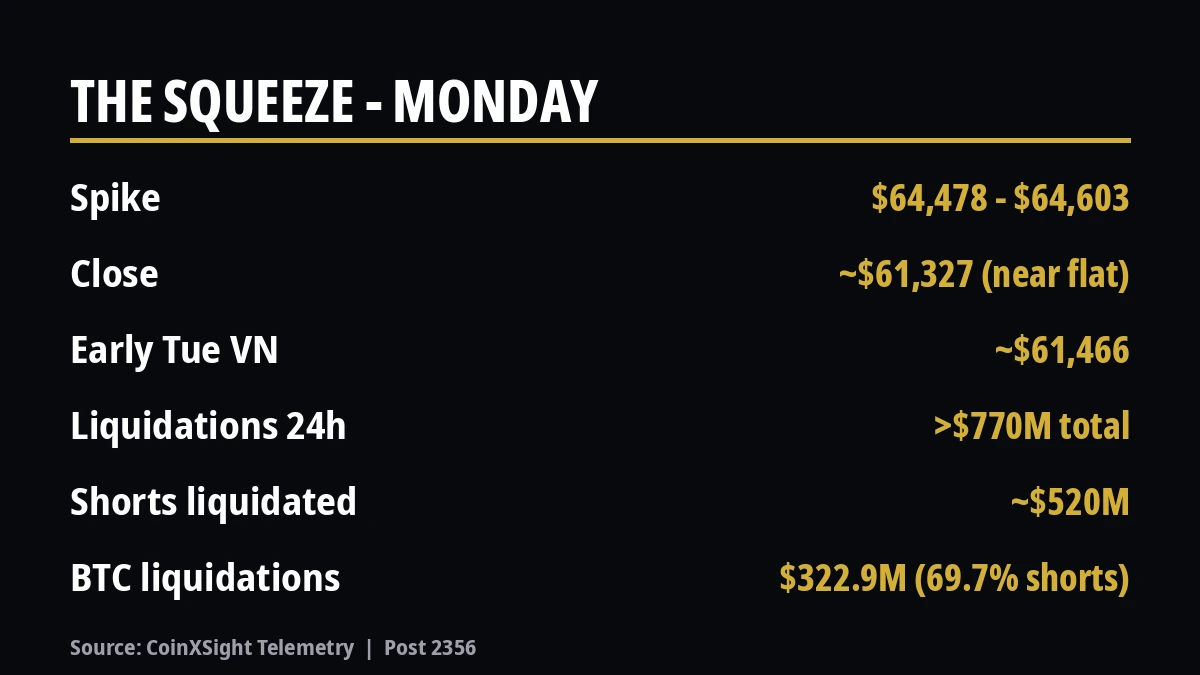
The squeeze was not a mystery. It was mechanics. Traders had piled into short positions as Bitcoin slid through November, funding rates had flipped negative — shorts paying longs to hold their positions — and the perpetual contract was trading below spot. When the price turned, every one of those shorts became a forced buyer. Between $100 million and $143 million in Bitcoin short positions were liquidated in the move, against roughly $22–120 million in liquidated longs, depending on the source and the window. Across the whole market, about 144,000 traders were liquidated, with shorts accounting for roughly three-quarters of the total. The range of estimates — $313 million to $692 million in total liquidations — reflects different counting windows, not disagreement about what happened: a short squeeze, in a market with almost nobody at the desk.
That last part matters. The U.S. market was closed for Thanksgiving, liquidity was thin, and thin order books amplify forced buying. As Talos put it, short covering has not turned into net buying pressure or durable spot demand — and until it does, the bounce stays fragile. A squeeze is a transfer, not an inflow: shorts closing looks like buying on the chart, but no new money has arrived. The test is what happens when the desks come back. To see how these mechanics play out in derivative orderbooks, our deep-dive on funding rates and basis explained details how traders track perpetual imbalances.
The other side of the tape: ETFs are still bleeding
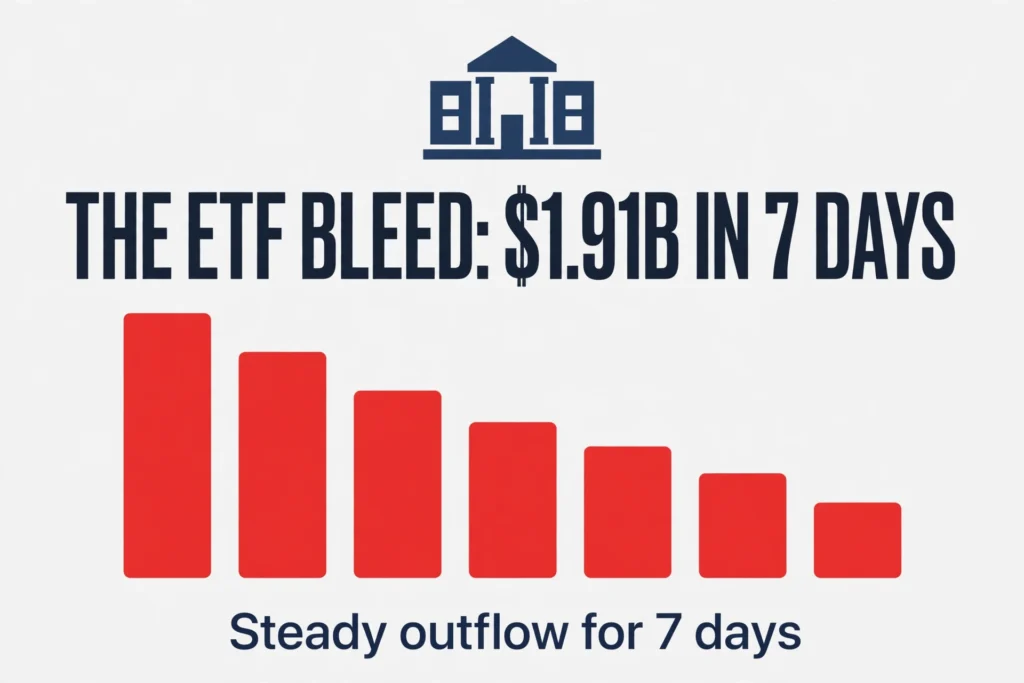
While the price bounced, the money kept leaving. U.S. spot Bitcoin ETFs logged their seventh straight day of outflows on November 26, losing $453.1 million in a single session by the SoSoValue count. A second count, by lookonchain, puts the same day at 5,802 BTC, or about $352.66 million — the two differ by methodology and closing time, and both point the same way. Over the last seven days, the funds have shed 41,312 BTC, roughly $2.51 billion.
November is now the worst month ever for Bitcoin ETFs: $5.39 billion out, beating the previous record of $4.51 billion from June by about $880 million — and there are still two trading days left in the month, so the final number could pass $5.5 billion. Only two of the month’s eighteen trading days saw inflows. BlackRock’s IBIT alone accounts for about $4.5 billion of the month’s outflows, roughly 84% of the total. The funds’ combined net assets have fallen from $104.27 billion on October 29 to $72.03 billion — a third gone in a month, part redemptions and part falling prices.
That is the tension in this market in one frame. The price is up 7.5% from its low in two days, and the largest buyers of the last two years are still selling. Neither fact cancels the other. ETF flows and price often react to the same news at the same time — risk-off sentiment, a hawkish Fed, the AI sell-off — rather than one causing the other. But the flow data sets a hard limit on how much conviction the bounce carries: a rally nobody is buying into with fresh money is a rally running on borrowed time, or at least on borrowed shorts.
Today’s test: $7 billion in options and a short session
Today brings the next test, and it arrives early. About $6.85–7 billion in Bitcoin options expire today, with a put/call ratio of 0.89, and the $57,000 put is the most traded contract — a reminder that a large part of the market spent the week positioned for lower prices. The U.S. session is a short one, closing at 13:00 ET, so the expiry lands in another thin-liquidity window, the same conditions that amplified the squeeze.
Two levels decide what happens next. Galaxy is watching $58,525 on the daily close and $59,517 on the weekly close: hold above them and the bounce has a floor to build on; lose them and the market is back to staring at $55,000, the level Arthur Hayes has pointed to, and $53,000, the realized price flagged by 21Shares. The macro backdrop does not help: the market prices a 25-basis-point Fed hike on December 9 at about 93%, Hayes has warned the weekend “could get spicy” if there is no dovish pivot before the pre-FOMC blackout begins late Friday U.S. time, and the Fed will then go silent for roughly ten days. This tension directly echoes the inflation pressures examined in our analysis of PCE inflation and Fed policy impact on Bitcoin.
The on-chain picture is just as stretched. Bitcoin has spent fourteen straight days with its daily RSI under 30, the longest such run since 2018. Glassnode calls this the first major capitulation of the current bear market, with realized losses the heaviest since FTX. Open interest in Bitcoin futures is rebuilding — $41.17 billion, up 2.2% in a day — and funding has flipped back positive, about +0.0069% per eight hours on an open-interest-weighted basis. That is a market re-levering slowly, not euphorically: funding sits below the 0.01% neutral baseline, and open interest relative to market cap is only about 3.3%.
How to read a squeeze without fooling yourself
The difference between a squeeze and a real breakout is what happens to open interest while the price rises. If the price rises while open interest falls, positions are closing — shorts covering, longs liquidating — and the move is running on forced orders. If the price rises while open interest rises, new positions are opening, and the move has a foundation. The Thanksgiving move was the first kind on the way up: a crowded short, a thin book, and a cascade of forced buying. The open interest that has built since is the question to watch now — whether it is new longs with conviction, or shorts re-opening into strength and setting up the next squeeze in the other direction.
None of this makes the bounce fake. Short squeezes are real price moves, and they have started real rallies before. But they are also the market’s cheapest way to punish a consensus, and the consensus being punished here was not wrong about the direction of the fundamentals — ETF outflows, a hawkish Fed, a record month of redemptions. It was wrong about the timing, and in a holiday market, timing is everything. The bounce bought Bitcoin a higher floor and a better chart. It did not buy it new buyers. Those arrive, if they arrive at all, when the flows turn — and the flows, as of this morning, have not.
Watch the options expiry, ETF flows, and liquidation levels move in real time — open the CoinXSight Terminal before the short U.S. session closes.
Disclaimer: This article is for informational and educational purposes only and does not constitute financial advice, investment advice, or a recommendation to buy or sell any asset. Cryptocurrency markets are volatile and you can lose some or all of your investment. Do your own research and consult a qualified financial adviser before making any investment decision.
CX
CoinXSight Alpha Desk
ALPHA // DESK
Quantitative Research Desk·Global Alpha Division
CoinXSight Institutional Research Desk produces quantitative crypto market intelligence, algorithmic models, and on-chain forensics.
QUANTITATIVE SUITE // DEEP ALPHA ENGINEACTIVE
BTC/USDT // LIVE SCANNER
CONFLUENCE 74
LIVE SPOT PRICE$82,807.47WEAK_BUY
TP2
$89,522.75
+9.07%
TP1
$85,056.42
+3.63%
ENTRY
$82,078.86
ZONE
SL
$80,590.09
-1.81%
Auto-detect Order Blocks, Fair Value Gaps and risk-adjusted DCA ladders in < 5s.