AI vs Crypto in 2026: The 5 Threats Already Costing Billions
AI scams are 4.5x more profitable than traditional ones, a voice deepfake stole €95M, and AI agents holding crypto are new targets. A data-backed look at the five AI threat vectors facing crypto in 2026 — and what to do this week.
AT
Alex ThorneHead of Macro & Market Structure·Oct 9, 2026 · 6 min read · Updated Oct 9
AI Already Steals Billions in Crypto. Breaking Cryptography Is the Least of It.
AI industrialized the crypto scam
An Ethereum Foundation researcher just warned that AI could crack crypto wallets “in months, not years.” The post got 4 million views. The warning matters. But the larger threat needs no prediction: AI already drains billions from crypto holders every year by fooling people, not by breaking math.
Key takeaways:
AI-powered crypto scams are 4.5x more profitable than traditional scams: $3.2M vs $719K per campaign (Chainalysis, 2026).
A single AI voice deepfake cost an Italian bank ~€95 million; €36M of it vanished into crypto.
AI agents that hold your money are now targets themselves: the first forensically confirmed AI-agent hack drained $216K via prompt injection hidden in token metadata.
No AI has actually broken real wallet cryptography yet. The “months not years” warning is one researcher’s risk assessment, not a published break.
Practical defenses exist today: fresh addresses, hardware wallets, verifying every URL by hand, and never letting an AI agent sign without your approval.
AI scams are already a $17 billion industry
The FBI’s Internet Crime Complaint Center logged $893 million in AI-factor crypto scam losses in the US alone in 2025, from 22,364 complaints. Chainalysis puts the global figure far higher: roughly $17 billion lost to crypto scams and fraud in 2025, with impersonation scams up 1,400% year over year.
The number that should worry you most isn’t the total. It’s the margin. AI-assisted scam campaigns pull in an average of $3.2 million each, 4.5 times the $719K of campaigns run without AI, moving roughly 9x the transaction volume. As TRM Labs’ Ari Redbord put it: what used to take a team of operators now takes one person with a subscription.
AI didn’t invent the crypto scam. It industrialized it.
A fake CEO’s voice stole €95 million in one phone call
Deepfakes: when the CEO’s voice steals millions
In February 2026, Italy’s Intesa Sanpaolo lost approximately €95 million after criminals used an AI-cloned voice of the CEO, backed by spoofed WhatsApp messages and forged emails, to push through transfers from its Fideuram private banking arm. About €36 million was converted into cryptocurrency and is still missing. Milan prosecutors are investigating.
This wasn’t a sophisticated blockchain exploit. No smart contract was hacked. Someone simply sounded like the boss, convincingly enough to move nine figures.
The same playbook now runs at consumer scale. Elon Musk remains the most impersonated figure in deepfake crypto scams, with AI-generated videos of him shilling fake investment schemes flooding feeds throughout 2026. TRM Labs reports deepfake scam losses in 2026 are already up 263% versus all of 2025.
The AI holding your money is the new attack surface
AI agents holding funds are the new attack surface
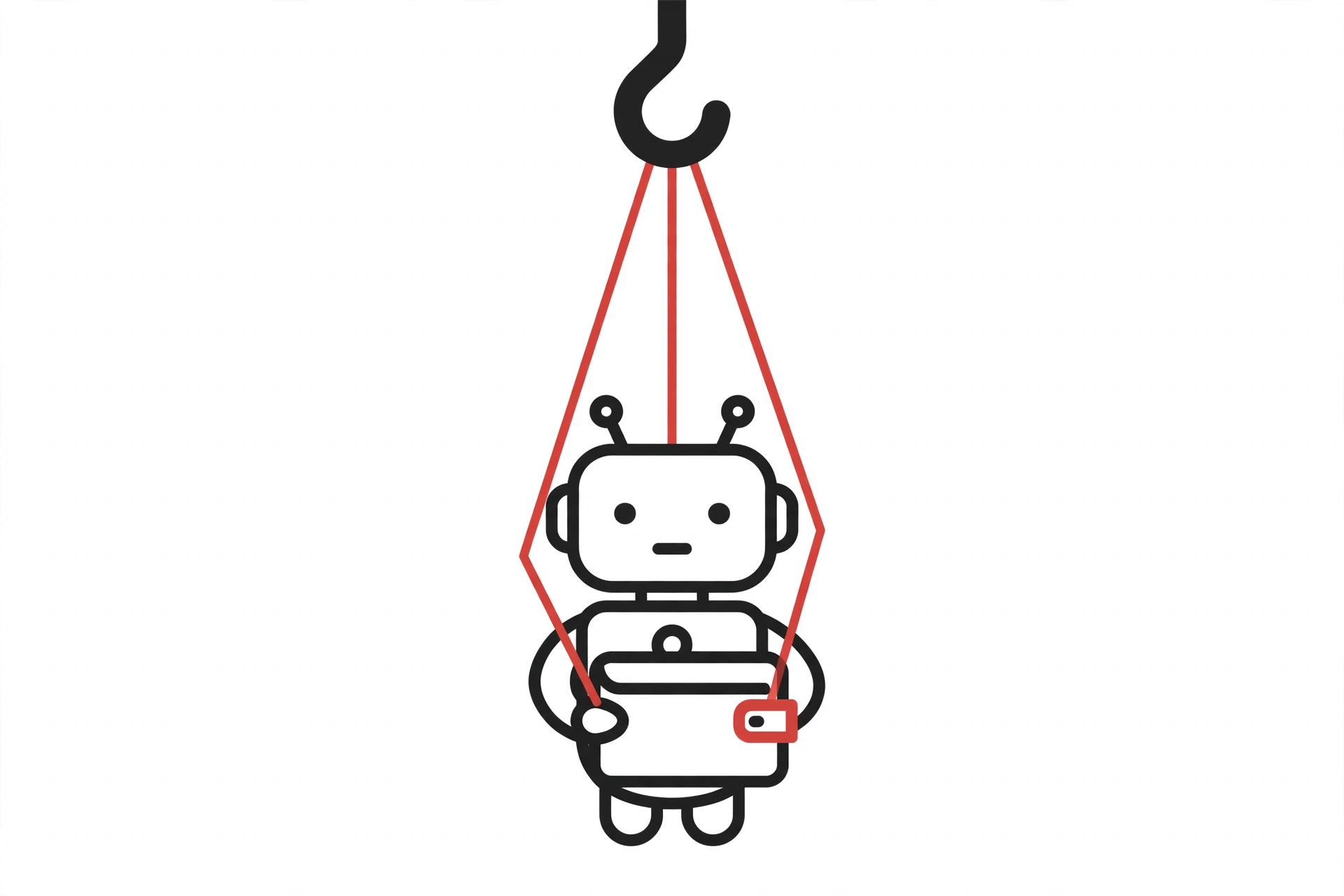
AI agents that can read data and sign transactions don’t need to fool humans. They can be fooled directly.
In September 2026, security firm Blockaid warned that attackers are embedding malicious instructions inside token names, symbols, and descriptions. An AI agent scanning token metadata can read those instructions as commands rather than untrusted data, triggering unintended buys, transfers, approvals, or visits to malicious sites. The risk explodes the moment an agent is connected to a wallet with execution rights.
It already happened. In May 2026, roughly $216K was drained in what Blockaid describes as the first forensically confirmed AI-agent hack of the year, via exactly this kind of prompt injection.
And the surface keeps growing. Robinhood’s “Loops” lets an AI agent trade 24/7 on your behalf, with terms stating customers “assume all risk” while the company does not control, supervise, monitor, recommend, or audit agents. Coinbase’s x402 protocol lets agents pay each other in stablecoins. Every new agent holding funds is a new target. HP’s security researchers have already documented fake “AI trading agents” that are actually malware hunting for MetaMask and Coinbase wallet extensions to replace with counterfeits.
Could AI actually break the cryptography? Honestly: not yet, but the timeline moved
Cryptography isn’t broken yet – but the timeline moved
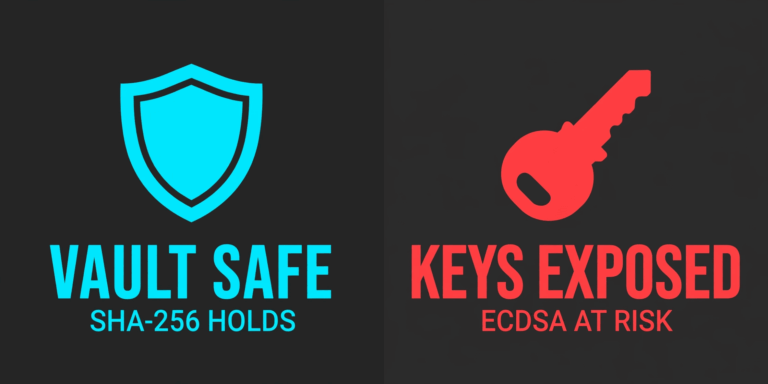
On October 7, 2026, Ethereum Foundation researcher Justin Drake posted that AI-accelerated mathematics could let attackers recover private keys from exposed public keys before “q-day,” the long-feared moment quantum computers break public-key crypto. His worst case: “months, not years.” He defines “break” as recovering a private key within about a week using available hardware, and urged the industry to start planning “bunker mode”: controlled migration of funds to addresses whose public keys were never exposed.
Vitalik Buterin responded the next day. He agreed the risk deserves serious attention, but warned against rushing wallet migrations, noting he’s personally lost more to botched upgrades than to hacks. His technical read: be more cautious with lattice-based cryptography parameters, prefer hash-based constructions where possible, and for individual holders, keeping funds at addresses that never signed a transaction is reasonable prevention if it’s easy.
Three things to keep straight:
No AI has broken real wallet cryptography. Drake’s timeline is a personal risk assessment, not a published attack. Crypto.news and The Block both emphasize this.
The exposed surface is measurable. Project Eleven’s Bitcoin Risq List tracks over 14 million BTC addresses with exposed public keys, with more than 8.1 million BTC classified as quantum-vulnerable.
The industry is moving. The Ethereum Foundation targets a fully quantum-resistant Layer 1 by December 2029, and NIST standardized the hash-based signature scheme SLH-DSA back in 2024.
Put together, the picture is this: cryptography isn’t broken, but the comfortable assumption that we have decades is gone.
AI cuts both ways: it’s also finding the bugs first
In June 2026, researcher Taylor Hornby used AI to find a critical vulnerability in Zcash’s Orchard shielded pool, a bug that could have allowed unlimited counterfeit tokens, before anyone exploited it.
AI now scans deployed smart contracts and surfaces vulnerabilities in codebases that were audited and assumed safe. CertiK recorded 73 cases in the first half of 2026 where flaws in contracts deployed over a year earlier were newly exploited, versus 45 in all of 2025.
The same technology that industrializes attacks is industrializing defense. Which side deploys it faster is still an open question.
What to actually do this week
Forget bunker mode unless you’re managing institutional funds. Here’s what matters for everyone else:
Use fresh addresses. Funds sitting at addresses that never signed a transaction keep their public keys hidden behind hashes. Don’t reuse addresses.
Verify everything by hand. Type URLs yourself. Check contract addresses character by character. The $2.1M FXRP phishing loss in June 2026 started with a poisoned ChatGPT answer containing a phishing link.
Keep AI agents on a leash. If you use a trading agent, cap its permissions, set slippage limits, and require your manual approval for anything irreversible.
Cold storage for size. Anything you can’t afford to lose belongs on a hardware wallet, not a hot wallet an AI agent can reach.
Treat every voice and video as suspect. If “your CEO” or “Elon Musk” is promising returns, it’s a scam until proven otherwise through a second channel.
AI didn’t change what crypto security requires. It changed how fast the attacks arrive, and how convincing they sound when they do.
Want to go deeper? CoinXSight Academy breaks down the on-chain data behind these threats, from whale flows to MEV. Start with our market microstructure series and learn to read what the chain is actually telling you.
Head of Macro & Market Structure·Global Macro Desk
Former institutional FX and macro derivative analyst. Specializes in global liquidity cycles, central bank balance sheets, and crypto market microstructure.
QUANTITATIVE SUITE // DEEP ALPHA ENGINEACTIVE
BTC/USDT // LIVE SCANNER
CONFLUENCE 28
LIVE SPOT PRICE$82,820.01NO_TRADE
TP2
$87,960.97
+7.17%
TP1
$84,431.71
+2.87%
ENTRY
$82,078.87
ZONE
SL
$80,902.44
-1.43%
Auto-detect Order Blocks, Fair Value Gaps and risk-adjusted DCA ladders in < 5s.