Europe’s top police agency just weighed in on crypto’s favorite doomsday scenario. Its verdict, published October 7: “Cryptocurrencies will not collapse due to quantum computing.”
Read the next line before you relax. Europol’s cybercrime centre estimates roughly 6.9 million bitcoin — about 30% of all BTC in existence — sits in addresses whose public keys have already been exposed on-chain. Those coins are the ones a future quantum computer would come for first.
Bitcoin’s Blockchain vs Your Wallet: Two Very Different Quantum Threats
The report draws a line most coverage blurs. There are two layers to crypto security, and only one of them is in trouble.
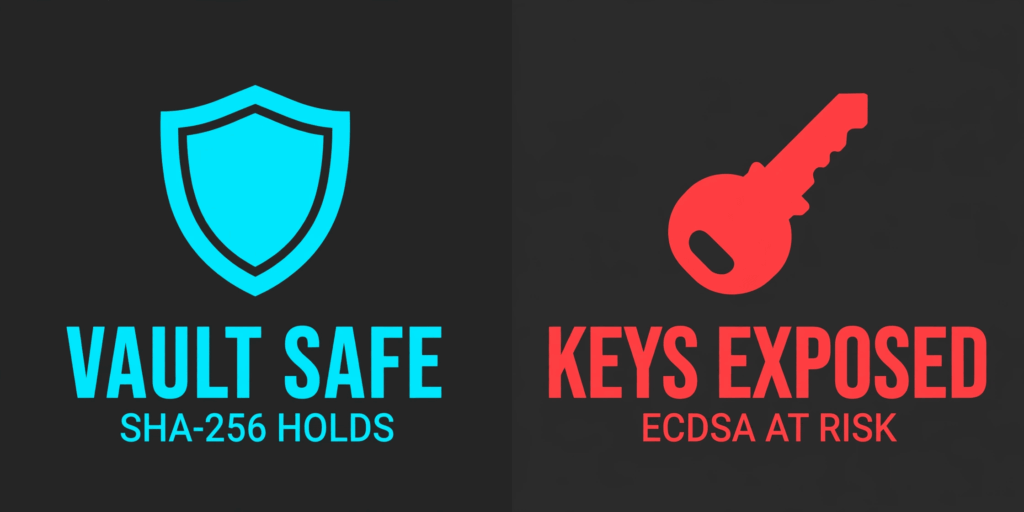
The vault is fine. Bitcoin’s blockchain is held together by SHA-256 hash functions, which Europol describes as largely resistant to quantum attack. The history of every transaction, the mining that secures it — that layer holds.
The keys are the problem. Every time you spend from a Bitcoin address, your public key gets recorded on-chain permanently. A sufficiently powerful quantum computer could run that public key backward through Shor’s algorithm and derive your private key. Then it signs transactions you never approved. The vulnerable piece isn’t the blockchain — it’s ECDSA, the signature scheme guarding the door.
Why Quantum Computers Threaten ECDSA Wallets
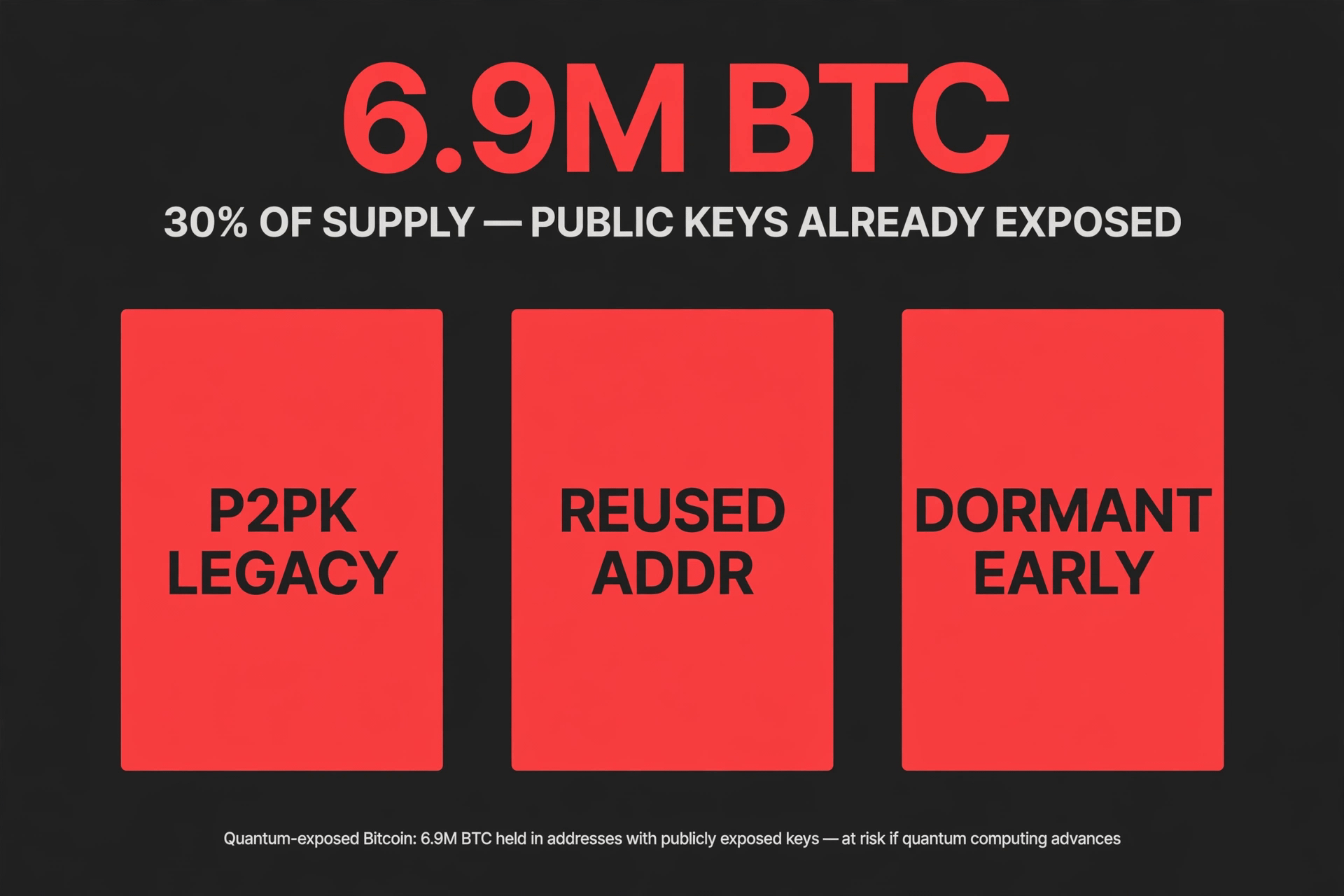
And here’s the part that should make you uncomfortable: exposed keys cannot be un-exposed. Blockchains don’t forget. Every revealed public key is archived forever, waiting for the day a machine exists that can break it. Security researchers call this “harvest now, decrypt later” — except on a public ledger, the harvesting already happened years ago.
AI Could Crack ECDSA Before Q-Day: The Drake Warning
This stopped being theoretical chatter this week. On October 7, Ethereum Foundation researcher Justin Drake warned that AI-accelerated mathematics could crack ECDSA before “q-day” — the moment quantum hardware catches up — with a worst case he measured in “months, not years.” His definition of broken: recovering a private key from an exposed public key within about a week, using GPU clusters you can rent today. The trigger for his warning: OpenAI’s models produced 722 formalized mathematics manuscripts in a single week. Mathematical superintelligence, he called it, and it’s already here.
Drake’s prescription was “bunker mode” — calmly, methodically moving funds to fresh addresses whose public keys have never touched the chain. An address that has only ever received coins keeps its public key hidden behind a hash. An address that has spent even once is standing in the open.
Vitalik Buterin: Don’t Panic-Migrate Your Crypto Wallet
Vitalik Buterin agreed the risk deserves respect — then pumped the brakes hard. Responding a day later, he warned against rushing wallet migrations, noting that botched migrations have cost him personally more than hacks ever did. His advice for ordinary holders: fresh receiving addresses are sensible hygiene if they’re easy to set up, but don’t contort your security setup around a headline. Panic moves lose money; the threat doesn’t.
Post-Quantum Crypto: Ethereum 2029, BIP-361, and NIST Standards
So what is actually being built? More than most people realize. The Ethereum Foundation has set a self-imposed deadline of December 2029 for a fully quantum-resistant Layer 1, with a dedicated post-quantum team running since January. Bitcoin developers have drafted BIP-361, a planned migration path away from ECDSA once post-quantum output types exist — still a draft, not activated. And NIST already standardized a hash-based post-quantum signature scheme, SLH-DSA, back in 2024.
The standards exist. The migration doesn’t — yet. And Europol’s math explains why: post-quantum signatures run 10 to 120 times larger than ECDSA. Moving every Bitcoin UTXO to quantum-resistant addresses would eat roughly 76 days of total network processing time.
Bitcoin has no IT department to push a mandatory update.
5 Steps to Protect Your Bitcoin From Quantum Risk
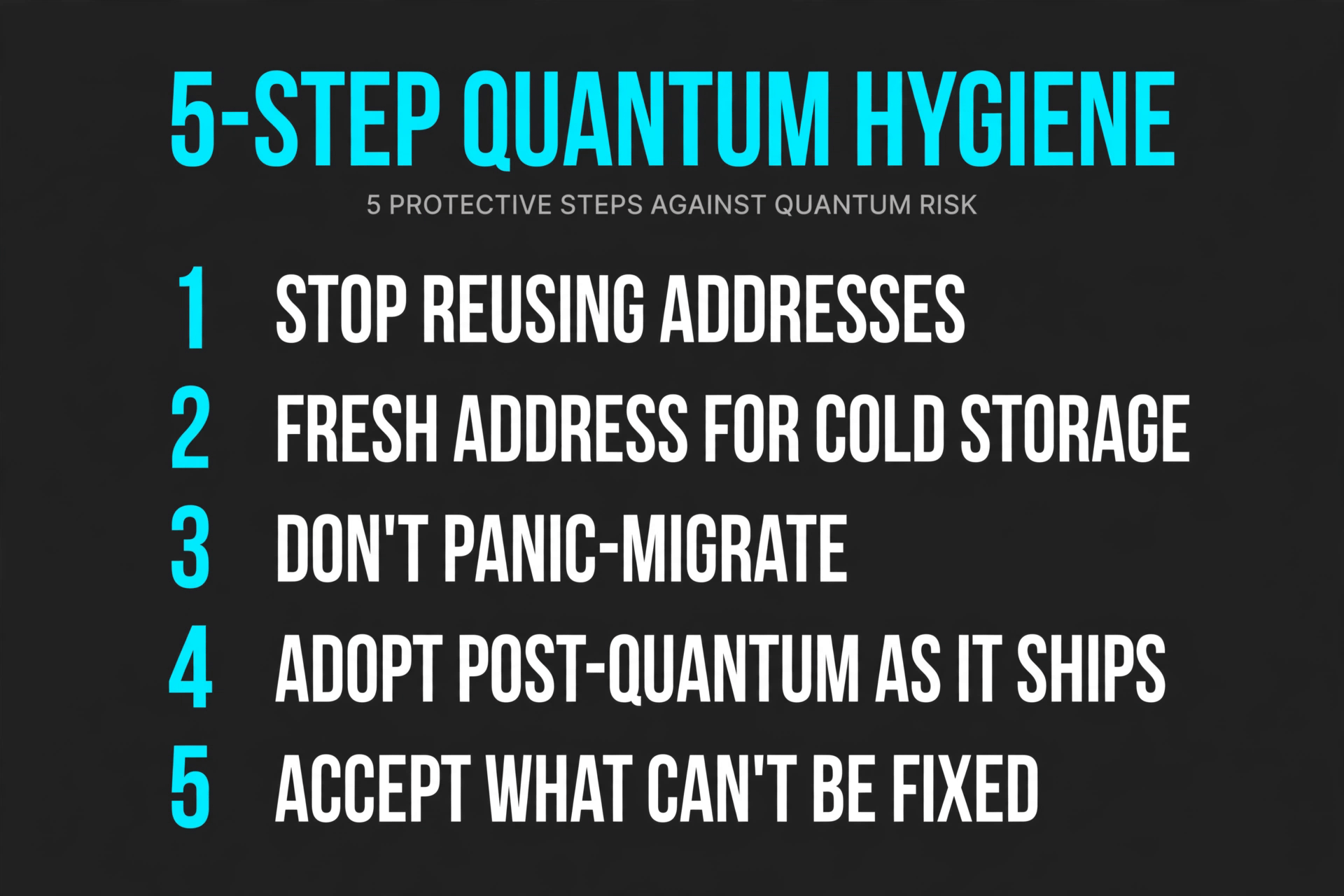
What should you actually do? Five things, none of them dramatic:
- Stop reusing addresses. Every spend from the same address re-exposes the key.
- For long-term holdings, move to a fresh address that has never sent a transaction — the public key stays hidden behind its hash.
- Don’t panic-migrate everything this weekend. Rushed migrations cause more losses than the threat they’re fleeing.
- Watch wallet providers for post-quantum support and adopt it as it ships — hybrid signatures first, full migration later.
- Understand what you can’t fix: coins in long-dormant early addresses cannot be protected retroactively. That debate — what happens to unmigratable coins — is the industry’s hardest conversation, and it hasn’t happened yet.
The honest summary: no quantum computer in 2026 can touch your coins. But the exposure is already priced into the ledger, permanently. Quantum computing doesn’t need to break Bitcoin. It just needs to break your key — and for 30% of all bitcoin, the key is already half out the door.