XRPN: The $1 Billion Bet That XRP Belongs on Wall Street
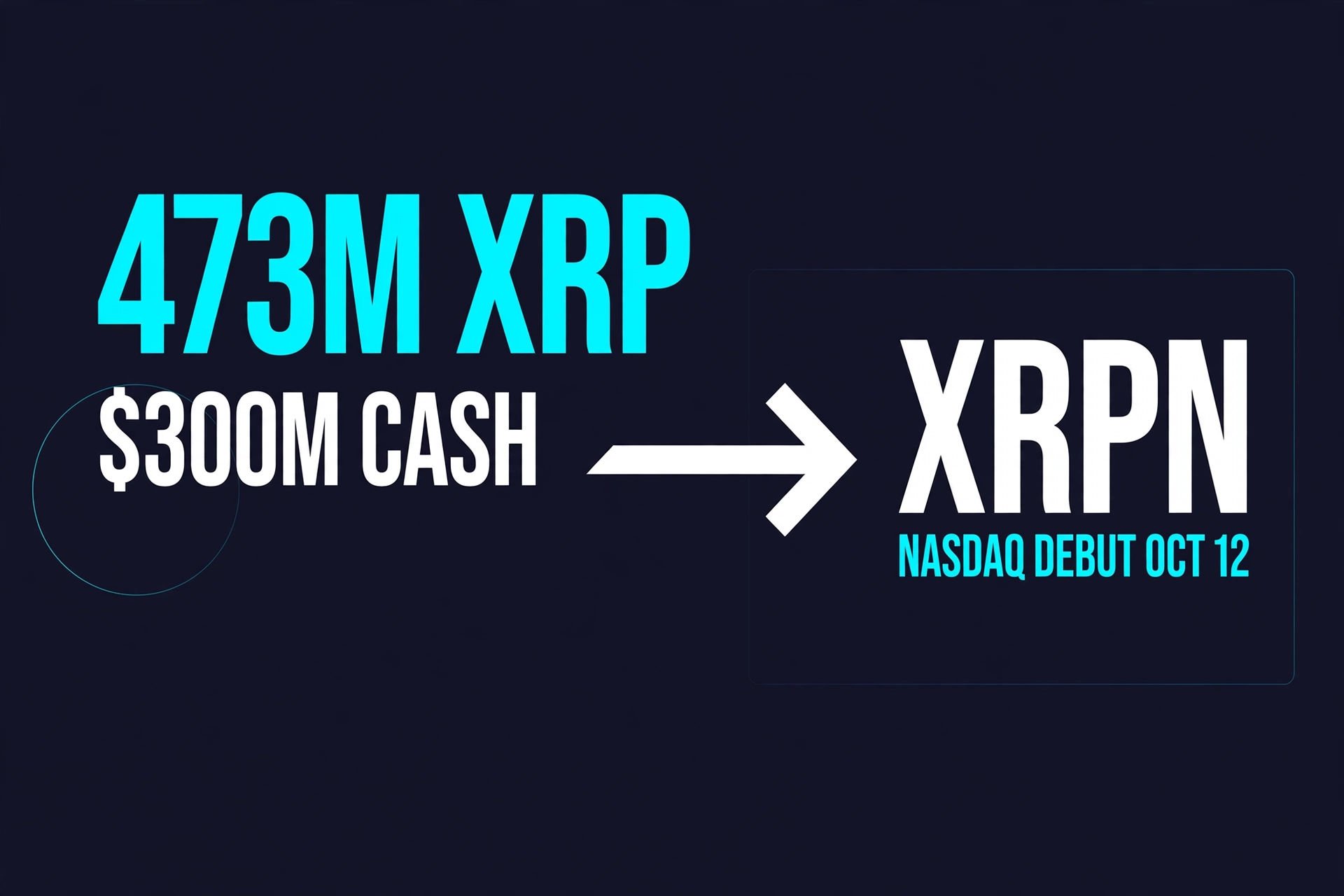
Evernorth debuts on Nasdaq Monday with 473M XRP and $300M cash. A deep-dive into the DAT playbook, the bull case, the bear case, and what actually moves XRP.
KZ
Dr. Kevin ZhangPrincipal AI & Quantitative Researcher·Oct 11, 2026 · 9 min read · Updated Oct 11
Tomorrow morning, XRP gets a Nasdaq ticker. Sort of.
When the opening bell rings at 9:30 AM ET on Monday, October 12, the ticker XRPN starts trading — and half of crypto Twitter will call it “XRP’s Nasdaq listing.” It isn’t. No new XRP token lists anywhere. What lists is the stock of Evernorth, a company that happens to sit on 473 million XRP and $300 million in cash.
That distinction — stock versus token — is the least interesting thing about this story once you understand it, and the most important thing to get right before you trade on it. Because Evernorth isn’t just a company holding crypto. It’s the most ambitious attempt yet to import Wall Street’s financial engineering to XRP — the same playbook that turned MicroStrategy from a forgotten software firm into the world’s largest corporate Bitcoin holder.
The real question isn’t whether XRPN pops on debut. It’s whether the machine works.
XRPN Deal — CoinXsight Analysis
What Evernorth Actually Is
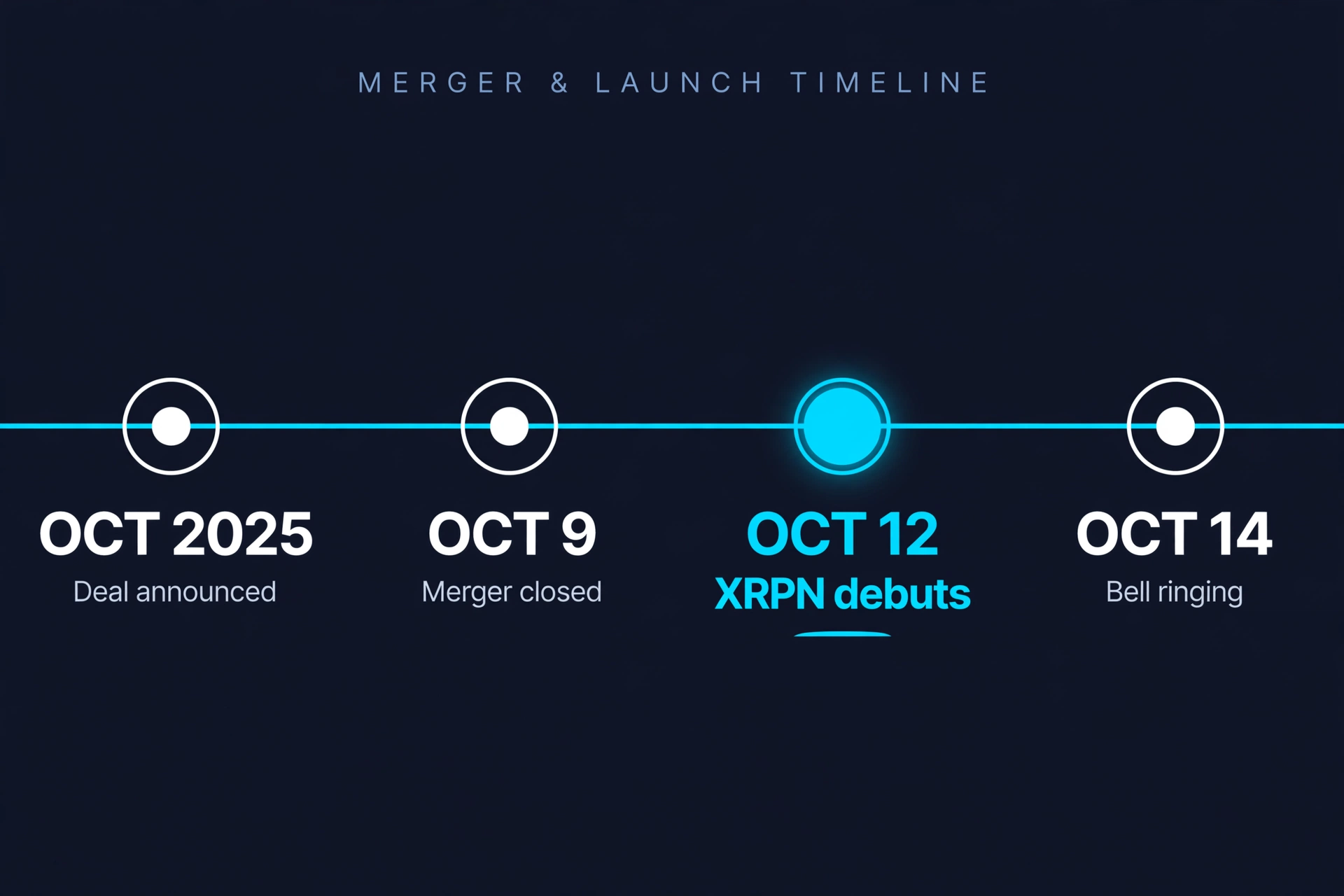
Evernorth completed its merger with Armada Acquisition Corp II — a SPAC sponsored by Arrington XRP Capital — on Friday, October 9. The deal was a year in the making, first announced in October 2025, approved by Armada shareholders on September 30. Common stock trades as XRPN; warrants as XRPNW.
The balance sheet at closing: approximately 473 million XRP, plus roughly $300 million in gross cash proceeds, backed by over $1 billion in total commitments. The investor roster reads like a crypto establishment roll call — Ripple itself, Pantera Capital, Kraken, SBI Group, Arrington Capital, GSR. CEO Asheesh Birla came from Ripple’s executive ranks.
Two nuances matter. First, the 473 million XRP didn’t come from market buying — it arrived through pre-merger transactions including large in-kind contributions. Nobody market-bought half a billion XRP last week; the position was assembled quietly, over months. Second, Evernorth insists it won’t just sit on the pile. The stated strategy spans institutional lending, liquidity provision, and blockchain infrastructure investment — an operating business built around the treasury, not a passive vault.
XRPN Timeline — CoinXsight Analysis
The DAT Playbook
To understand what Evernorth is attempting, you need the digital-asset-treasury playbook — and it starts with MicroStrategy.
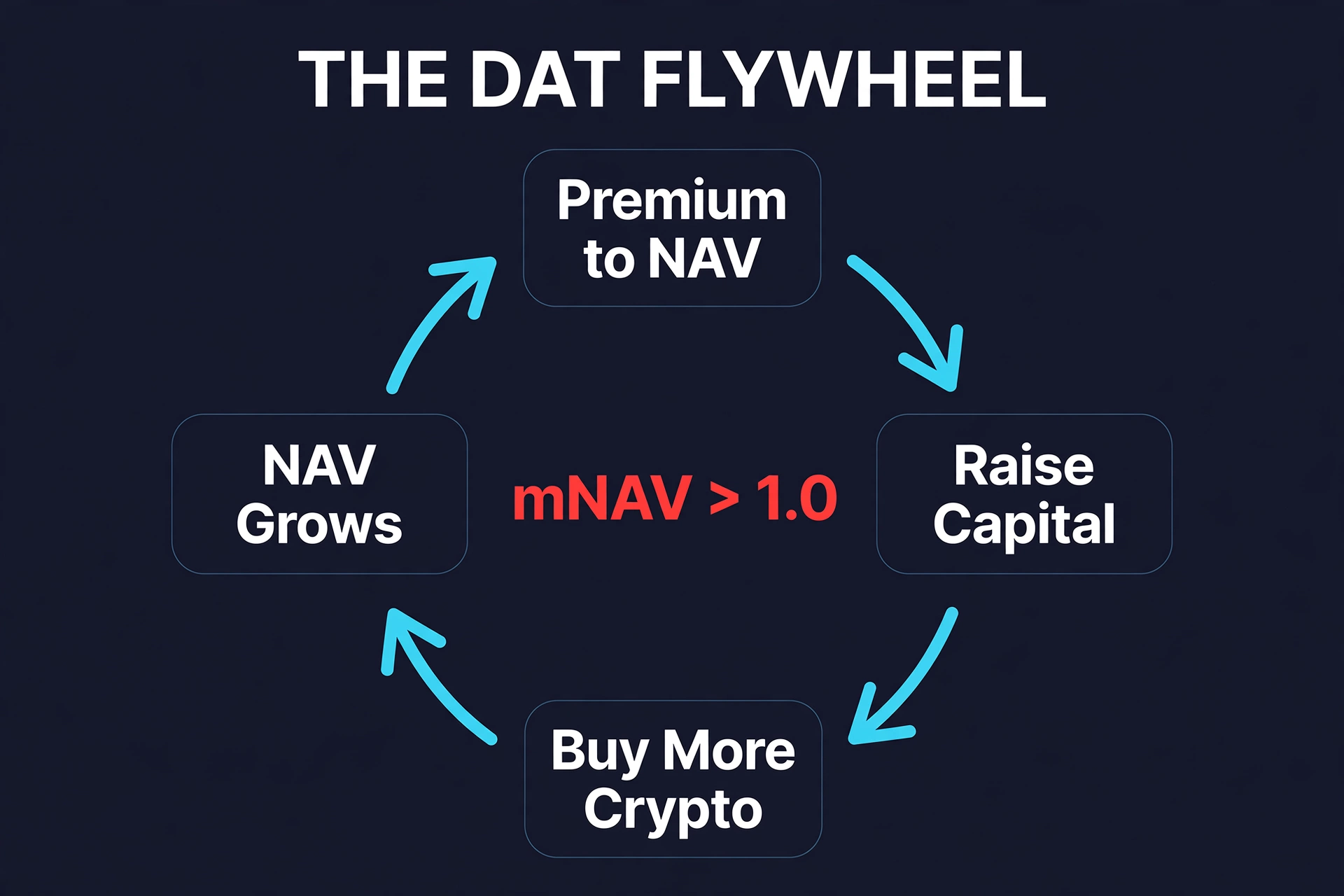
The core metric is mNAV: the multiple of net asset value. Take the company’s market capitalization, divide by the value of its crypto holdings. If the result is above 1.0, the market pays a premium for the wrapper; below 1.0, a discount. MicroStrategy — now Strategy — is the canonical case: its mNAV peaked near 3.9x in November 2024, meaning investors paid nearly four dollars for every dollar of Bitcoin on its balance sheet. By September 2026, it had collapsed to 0.81x — a 19% discount. In between, the company crossed below 1.0 for the first time in its history, sold nearly 7,000 BTC to fund preferred-stock dividends, and quietly ended its “never sell” pledge. The machine works until it doesn’t.
That premium is the engine. When a DAT trades above NAV, it can issue new shares or convertible notes at inflated prices and use the proceeds to buy more crypto — growing the per-share asset base, which justifies the premium, which enables the next raise. Practitioners call it the flywheel. Critics call it a confidence game. Both are describing the same machine.
The structure differs from a spot ETF in ways that cut both directions. An ETF has a creation-redemption mechanism — authorized participants arbitrage away any premium or discount within hours, keeping the share price pinned to NAV. A DAT has no such mechanism. Premiums and discounts can persist for months, and they can widen violently. That’s the trade: you accept NAV volatility in exchange for what the ETF can’t offer.
What the ETF can’t offer is agency. A DAT is an operating company. It can issue convertible debt at near-zero coupons (MicroStrategy’s signature move — billions raised at 0% interest from fixed-income investors who wanted the equity optionality), lend its holdings for yield, acquire operating businesses, and time its capital raises to market euphoria. Evernorth’s “actively managed” language and its lending ambitions are precisely this pitch: we’re not a vault, we’re a business, and the business is financial engineering around XRP.
This is also why DATs attract a different shareholder base than ETFs. ETF buyers want passive, low-fee exposure. DAT buyers are making a leveraged, actively-managed bet — they’re paying the premium because they believe management will compound crypto-per-share faster than the token appreciates on its own. When that belief holds, the premium is rational. When it breaks, there’s no arbitrageur to catch the fall.
The risk is the flywheel in reverse. If the stock slides to a discount, raising capital means diluting at fire-sale prices, which deepens the discount. This isn’t theoretical. Metaplanet — Japan’s Bitcoin DAT — saw a 237% premium collapse into a 10% discount; its stock is down 85% over twelve months. SharpLink, an Ethereum treasury, traded at a 31% discount to NAV with equity volatility eleven times the underlying asset. Twenty One fell from $47 to $5.50 in fourteen months. By early 2026, roughly 40% of the top 100 treasury companies traded below the value of their holdings. Once the market stops believing in the premium, the machine eats itself. Evernorth’s $1 billion in commitments is partly a defense against this — a deep enough capital base to survive the market’s mood swings.
XRPN Catalyst — CoinXsight Analysis
The Bull Case
Start with the obvious: regulated equity exposure to XRP without touching a wallet, a private key, or an offshore exchange. For the pension funds and RIAs who can’t hold tokens, XRPN is a ticker they can actually buy. That’s the same institutional on-ramp thesis behind the $1.4 billion in spot XRP ETF inflows — XRPN just adds an actively managed layer on top.
Then there’s the “grow XRP per share” mandate. If Evernorth executes — lending XRP to market makers at yield, providing liquidity, investing in XRPL infrastructure — each share represents a growing claim on XRP-denominated value. Birla’s phrasing, “strategies designed to grow XRP per share over time,” is the DAT promise in one line: your equity compounds in crypto terms, not just dollar terms.
The backers are the credibility signal. Ripple putting its own balance sheet behind this isn’t charity; it’s ecosystem strategy. Pantera, Kraken, SBI — these are firms that do deep diligence. Their presence doesn’t guarantee success, but it guarantees the homework was done.
And the news flow doesn’t stop Monday. Evernorth rings the Nasdaq closing bell on October 14 — four days after debut — keeping the story in front of mainstream financial media for a second cycle.
XRPN Flywheel — CoinXsight Analysis
The Bear Case
Now the other side, because the DAT graveyard is crowded.
First, the NAV math. Evernorth’s holdings at current prices — 473 million XRP at ~$1.40 is roughly $660 million, plus $300 million cash — put tangible NAV near $1 billion against total commitments above $1 billion. If XRPN debuts at a premium, fine. If skepticism wins and it opens at a discount, the flywheel never starts; it just sits there, a billion-dollar pile earning nothing, while management burns cash on “strategy.”
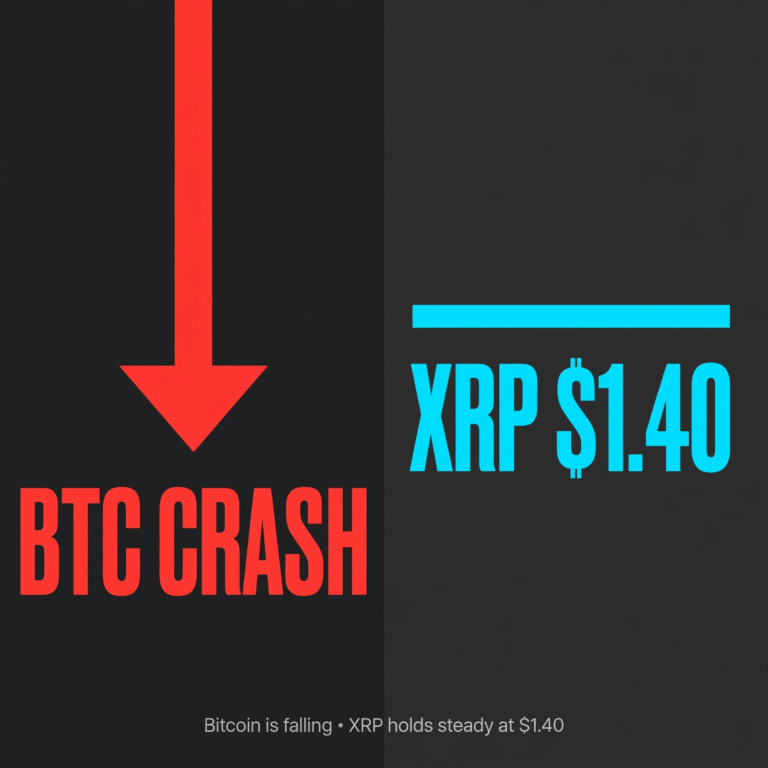
Second, leverage cuts both ways and XRP is the leverage. Every DAT is a levered bet on its underlying asset. If XRP drops 30%, the equity doesn’t drop 30% — the premium compresses simultaneously, and shareholders take the double hit. XRP at $1.40 is 61% below its all-time high. The treasury is being assembled in a drawdown, which is either brilliant contrarian timing or catching a falling knife with a billion dollars.
Third, execution risk is real and specific. Institutional lending and liquidity provision sound clean in a press release; in practice they mean counterparty risk, smart-contract risk, and the kind of blowups that have ended crypto lenders before. “Actively managed” is a promise, not a track record — Evernorth as a public operating company is days old.
Fourth, SPAC debut dynamics. Warrants (XRPNW) create overhang — every warrant exercised is a new share diluting the float, and warrant holders tend to sell into strength. First-day trading in high-profile listings is dominated by flippers, not believers. Add the SPAC sponsor’s promote shares unlocking, and the opening weeks can see mechanical selling pressure that has nothing to do with the treasury thesis. The opening print will tell you about supply and demand for the stock, not about the soundness of the model.
Fifth, and most underappreciated: concentration. Evernorth’s entire equity story is XRP — one asset, one ecosystem, one regulatory overhang that took Ripple half a decade to clear. MicroStrategy at least had a software business generating cash flow underneath the Bitcoin bet. Evernorth’s “business” is strategies it hasn’t executed yet, in markets it hasn’t operated in yet, with a team that’s days into the job as a public company. The $1 billion in commitments buys time. It doesn’t buy a track record.
One more number worth sitting with: Evernorth reportedly spent around $947 million assembling its XRP position late last year; by February, that stash was worth roughly $446 million — a greater-than-50% unrealized loss before the stock even listed. That figure comes from a single outlet’s reporting, so treat it as attributed rather than confirmed — but if accurate, XRPN debuts with the treasury already underwater, and the opening valuation has to absorb that starting position.
What Actually Moves XRP
Here’s the disciplined question: does any of this buy XRP?
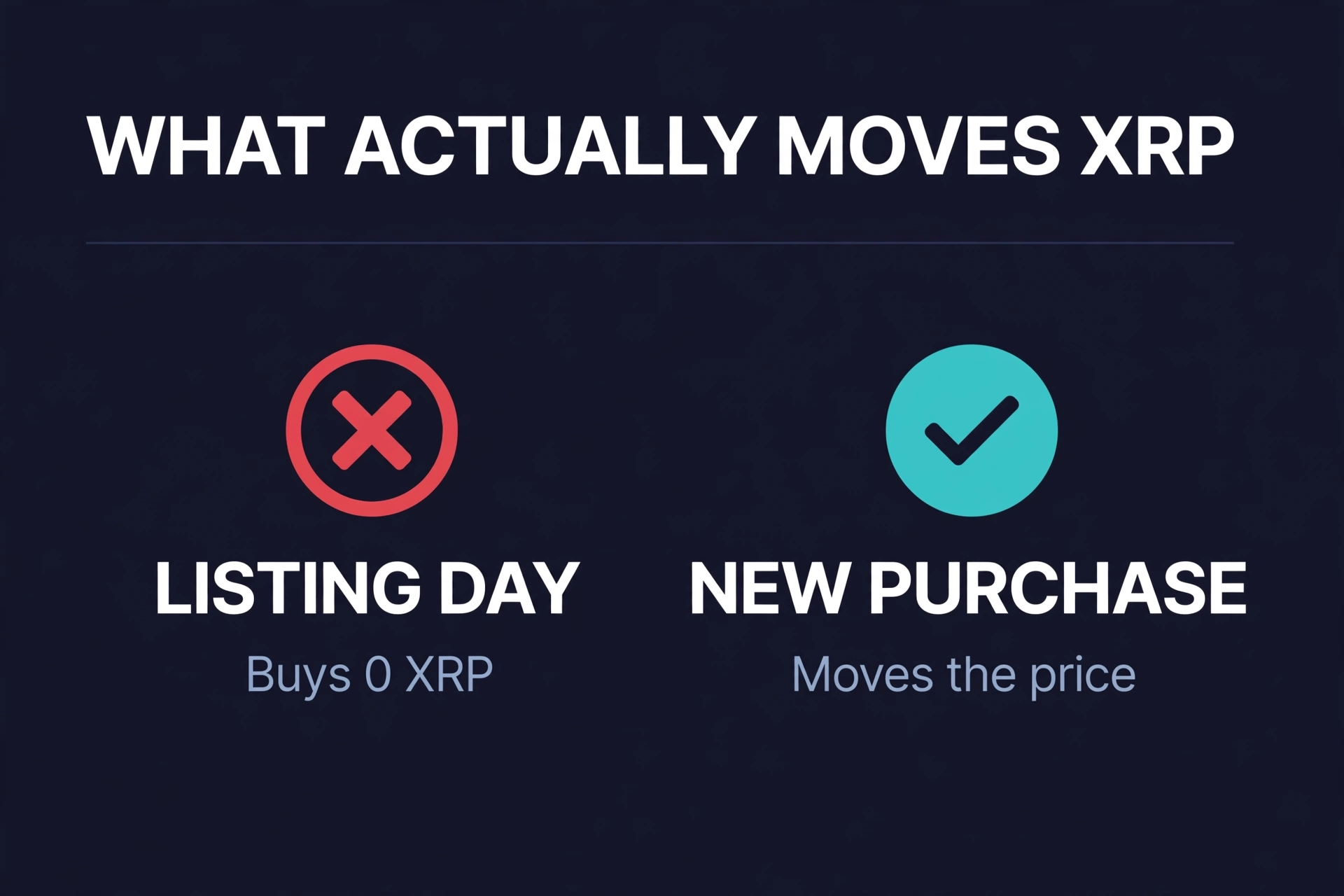
The listing itself: no. The 473 million XRP is already assembled; Monday’s bell doesn’t add a single coin of demand. Anyone expecting a spot-market pop from the debut is confusing the wrapper with the asset.
What would move XRP: Evernorth announcing additional treasury purchases — funded by that $300 million in cash or future raises. That’s the transmission mechanism, and it’s entirely at management’s discretion. Watch the 8-Ks, not the ticker.
Second-order effects are real but slower. If XRPN trades at a sustained premium, it validates the DAT model for XRP and invites copycats — more treasuries, more structural demand over quarters, not days. If it flops to a discount, the opposite signal goes out.
And the bell ringing on October 14 is sentiment, not substance — but sentiment moves crypto. Two media cycles in one week for an XRP-adjacent story, during a period when XRP is already holding $1.40 against a weak market, is the kind of attention that can shift positioning.
Close
Strip away the ticker and the ceremony, and Evernorth is a $1 billion bet on a simple thesis: Wall Street wants XRP exposure badly enough to pay a premium for a regulated wrapper — and a competent team can compound that wrapper faster than the token itself.
It’s the same bet MicroStrategy made on Bitcoin, now ported to XRP with institutional-grade backers and an active-management twist. The model has made fortunes and buried optimists. Monday’s opening print won’t tell us which one Evernorth is.
What it will tell us is the opening bid — how much premium the market assigns, on day one, to the idea that XRP belongs inside a Nasdaq-listed balance sheet. For XRP holders, that’s the number that matters. Not the stock price. The premium. Because the premium is the market’s vote on whether this machine works.
Principal AI & Quantitative Researcher·Deep Alpha Engine Labs
Ph.D. in Computational Statistics. Leads machine learning architecture, regime-switching detection, and automated execution systems at CoinXSight Labs.
QUANTITATIVE SUITE // DEEP ALPHA ENGINEACTIVE
BTC/USDT // LIVE SCANNER
CONFLUENCE 93
LIVE SPOT PRICE$83,908.89STRONG_BUY
TP2
$89,725.68
+6.94%
TP1
$86,233.44
+2.77%
ENTRY
$83,905.28
ZONE
SL
$82,741.19
-1.39%
Auto-detect Order Blocks, Fair Value Gaps and risk-adjusted DCA ladders in < 5s.