The most important crypto legislation in American history just died on a procedural vote. Not on substance — on process. And the market barely noticed.
That’s the strange thing about the CLARITY Act’s failure. Bitcoin held $82,000. The headlines moved on to PPI and FOMC countdowns. But for anyone thinking about crypto’s institutional future — where the next trillion dollars of market cap comes from — September 15 was the day that mattered most this year.
Here’s what actually happened, why it failed, and what fills the vacuum now.
What the CLARITY Act Was Supposed to Do
Strip away the legislative jargon and the bill had one job: end the turf war.
For a decade, crypto has lived under a regulatory split personality. The SEC claims most tokens are securities. The CFTC claims jurisdiction over derivatives and fraud. Exchanges operate in a gray zone where the rules change depending on which agency’s enforcement division wakes up first. Every major crypto company in America has a legal team whose full-time job is guessing which regulator will come knocking.
The CLARITY Act (H.R. 3633) would have settled this by statute. The CFTC gets spot markets for digital commodities — Bitcoin, and anything else classified as a commodity. The SEC keeps tokens sold as investment contracts. Exchanges, brokers, and dealers register with the CFTC. Customer protections get written into law. DeFi developers and software builders get carve-outs so writing code isn’t treated as operating an unlicensed exchange.
It also would have capped yield on idle stablecoin balances — a provision the banking lobby loved and the crypto industry hated.
The House passed it 294-134 in July 2025. Bipartisan. Comfortable margin. Everyone assumed the Senate would follow.
September 15: The Vote That Wasn’t About Crypto
On September 15, 2026, the Senate held a cloture vote on the motion to proceed. The result: 49-50. Sixty votes were needed.
Here’s what most coverage got wrong: this wasn’t a vote on whether the CLARITY Act becomes law. It was a vote on whether to start debating the bill. A procedural gate. And it failed by 11 votes.
The substance of the bill — the SEC-CFTC split, the registration framework, the customer protections — wasn’t what killed it. What killed it was ethics.
Democrats demanded provisions restricting federal officials’ crypto holdings, with language that explicitly covered the president and his family. The final text, in their view, fell short. Add in unresolved fights over stablecoin rewards and lingering concerns about illicit finance, and the coalition collapsed. Every Democrat and independent present voted no, joined by four Republicans.
Senator Thom Tillis entered a motion to reconsider, which technically keeps the bill alive on the calendar. But no new vote is scheduled. The Senate is in a state work period until November 6 — after the midterms. The lame-duck session is the earliest realistic window, and the congressional calendar is shrinking fast.
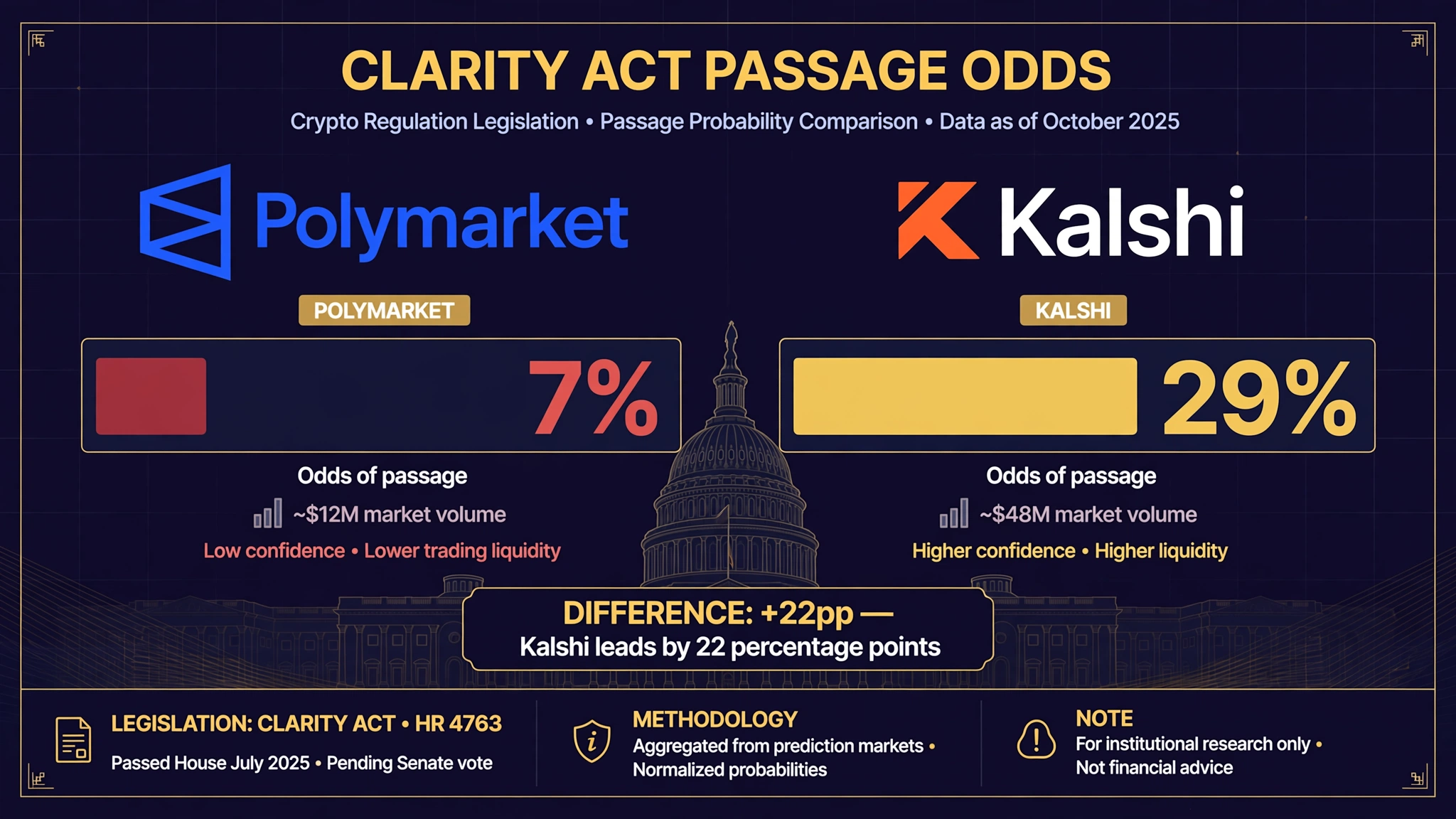
Prediction markets aren’t optimistic. Polymarket priced passage by end of 2026 at roughly 7% in late September. Kalshi traders put the odds of any market structure law before 2028 at about 29% as of October 15.
The CFTC’s Plan B: Regulate Without Congress
Here’s where it gets interesting. The CFTC isn’t waiting.
Chairman Michael Selig made the agency’s position clear on October 5: “I’m disappointed that Congress failed to deliver the Clarity Act to the President’s desk.” Then the pivot: the CFTC would build crypto market structure “using our existing statutory authorities.”
Two days after the Senate vote, the CFTC submitted rulemaking to the White House Office of Information and Regulatory Affairs. The proposals — Regulation Crypto Asset Transactions (Reg CTX) and Regulation Crypto Asset Markets (Reg CAM) — would use existing law to bring leveraged and margined retail crypto trading under CFTC oversight. Exchanges offering those products would need to register. Plain spot trading would generally stay under state money-transmission laws, though still subject to federal anti-fraud authority.
This isn’t happening in a vacuum. The SEC and CFTC issued a joint crypto-asset interpretation back in March that established five categories: digital commodities, digital collectibles, digital tools, stablecoins, and digital securities. The SEC is separately considering a proposed Regulation Crypto Assets with registration exemptions and a conditional safe harbor. The CFTC updated its guidance on tokenized investments and blockchain recordkeeping on September 24.
In other words: the agencies are building the regulatory framework piece by piece, without Congress.
The Table: Three Paths Forward
CLARITY Act vs. Agency Rulemaking vs. Status Quo
Dimension
CLARITY Act (stalled)
CFTC/SEC Rulemaking (active)
Status Quo (no action)
Legal durability
Statute — hard to reverse
Agency rules — vulnerable to court challenge or new administration
Enforcement-by-lawsuit — maximum uncertainty
CFTC spot authority
Yes, over digital commodities
Partial — leveraged/margined products only
No — fraud/manipulation only
Exchange registration
Mandatory federal framework
Required for leveraged products; spot stays state-level
Patchwork of state licenses
State preemption
Broad federal preemption
Limited — cannot override state law the way statute can
None — 50-state compliance burden
Timeline
Lame duck at earliest; likely 2027+ reintroduction
ANPR stage — final rules 12-18 months out
Indefinite
Odds (prediction markets)
~7% by end of 2026 (Polymarket)
High — already in motion
N/A
The critical row is legal durability. Agency rulemaking can accomplish maybe 60% of what the CLARITY Act would have done — but every rule is one lawsuit or one election away from being unwound. Statutes stick. Rules don’t.
That’s why institutional investors cared about this bill. Not because they love regulation, but because they need durable regulation. A pension fund allocating to crypto needs to know the rules won’t flip in 2028.
What This Means for Markets
Let’s be direct about the market implications.
Short term (now through year-end): neutral to mildly bearish for the regulatory narrative. The failure removes a potential catalyst. Anyone who was positioned for a “regulatory clarity rally” in Q4 just lost their thesis. But the market had largely priced this in — the September vote wasn’t a surprise to anyone watching the whip counts.
Medium term (2027): the real window. If the bill gets reintroduced in the next Congress (which begins January 2027), the politics reset. A new Congress, post-midterm dynamics, and potentially a different White House calculus could change the ethics fight that sank it this time. The 29% Kalshi odds for a law before 2028 aren’t great, but they’re not zero.
For exchanges: The CFTC’s Reg CAM proposal is the thing to watch. If you’re running a US exchange offering leveraged products, you’re about to need CFTC registration whether Congress acts or not. Compliance costs go up. Smaller platforms consolidate or exit. This is bullish for incumbents (Coinbase, Kraken) and bearish for offshore competitors trying to serve US customers.
For tokens: The five-category framework from the March joint interpretation is doing quiet work. How a token gets classified — digital commodity vs. digital security — determines everything about how it trades, who can list it, and what disclosures apply. Projects should be lawyering up around these categories now, not waiting for legislation.
For stablecoins: The GENIUS Act already passed, giving stablecoins their framework. The CLARITY Act’s stablecoin yield cap was the controversial piece — with the bill stalled, that fight moves to the rulemaking arena. Watch the CFTC’s treatment of yield-bearing stablecoin products closely.
For XRP specifically: Our XRP 2026-2030 prediction framework assumed gradual regulatory improvement. The CLARITY Act’s failure doesn’t break that thesis, but it pushes the timeline. The base case ($5.00) always depended more on ETF flows and institutional adoption than on any single bill. Those drivers are intact.
The Bigger Picture: Regulation Follows Price, Not the Other Way Around
Here’s the uncomfortable truth that macro people understand but crypto Twitter doesn’t: regulation has never driven a crypto bull market. It has sustained them.
The 2020-2021 run happened under maximum regulatory uncertainty. The 2024-2025 institutional wave — the ETFs, the corporate treasuries, the PPI-era resilience at $80K — happened while the CLARITY Act was still just a House bill. Price leads. Regulation follows. Then regulation locks in the gains by giving the next wave of institutional capital permission to enter.
That’s what died on September 15: not the current market, but the next leg of institutional adoption. The pension funds and endowments that were waiting for statutory clarity just got told to wait longer.
They’ll come anyway — eventually. The on-chain data shows long-term holders at all-time highs and exchange balances at multi-year lows. The supply squeeze doesn’t care about Senate procedure. But the pace of institutional inflows slows without the regulatory green light.
What to Watch Next
Three things, in order of importance:
1. The CFTC rulemaking timeline. Reg CTX and Reg CAM are in the advanced notice stage. The comment period and final rule process will take 12-18 months. Every draft, every public comment, every revision is a trading signal for anyone in the regulatory-arbitrage business.
2. The lame-duck session. After November 6, there’s a narrow window where a deal could theoretically happen. Watch for any movement on the ethics provisions — if Democrats and the White House find language they can both live with, Tillis’s motion to reconsider becomes live ammunition. Don’t hold your breath, but don’t ignore it either.
3. The 2027 reintroduction. This is the base case. New Congress, new bill number, possibly revised text that pre-negotiates the ethics fight. The crypto lobby isn’t going away, and neither is the industry’s need for clear rules. The question isn’t whether market structure legislation eventually passes — it’s whether it takes one more Congress or three.
The Bottom Line
The CLARITY Act’s failure is a setback, not a catastrophe. The market knows this — that’s why Bitcoin held $82K through the news cycle.
But don’t mistake market indifference for irrelevance. The bill’s death means crypto’s regulatory future will be built through agency rulemaking: slower, more fragile, more vulnerable to reversal. The CFTC is moving aggressively to fill the void, and credit to Selig for not waiting. But rules aren’t statutes, and everyone in Washington knows it.
For investors, the takeaway is straightforward: regulatory clarity is delayed, not denied. Position for the world as it is — agency-led, incremental, messy — while keeping an eye on 2027. The next Congress is where this gets decided.
The Senate voted on procedure. The market voted with its feet. Both said the same thing: not yet.
—
This article is for informational purposes only and does not constitute financial advice or legal advice. Cryptocurrency markets are volatile and carry substantial risk. Regulatory developments are subject to change. Always do your own research before making investment decisions. Data: U.S. Senate roll call records, CFTC public statements, Polymarket, Kalshi.
Figure 1: Prediction market probability divergence for CLARITY Act passage in 2026 (Polymarket vs. Kalshi).
Disclaimer: This analysis is provided for educational and informational purposes only and does not constitute financial, investment, or legal advice. Digital asset regulatory environments involve substantial uncertainty and capital risk. Always conduct your own independent research (DYOR) before making investment decisions.
CX
CoinXSight Alpha Desk
ALPHA // DESK
Quantitative Research Desk·Global Alpha Division
CoinXSight Institutional Research Desk produces quantitative crypto market intelligence, algorithmic models, and on-chain forensics.
QUANTITATIVE SUITE // DEEP ALPHA ENGINEACTIVE
BTC/USDT // LIVE SCANNER
CONFLUENCE 100
LIVE SPOT PRICE$82,606.01STRONG_BUY
TP2
$90,642.48
+9.94%
TP1
$85,726.41
+3.98%
ENTRY
$82,449.02
ZONE
SL
$80,810.33
-1.99%
Auto-detect Order Blocks, Fair Value Gaps and risk-adjusted DCA ladders in < 5s.