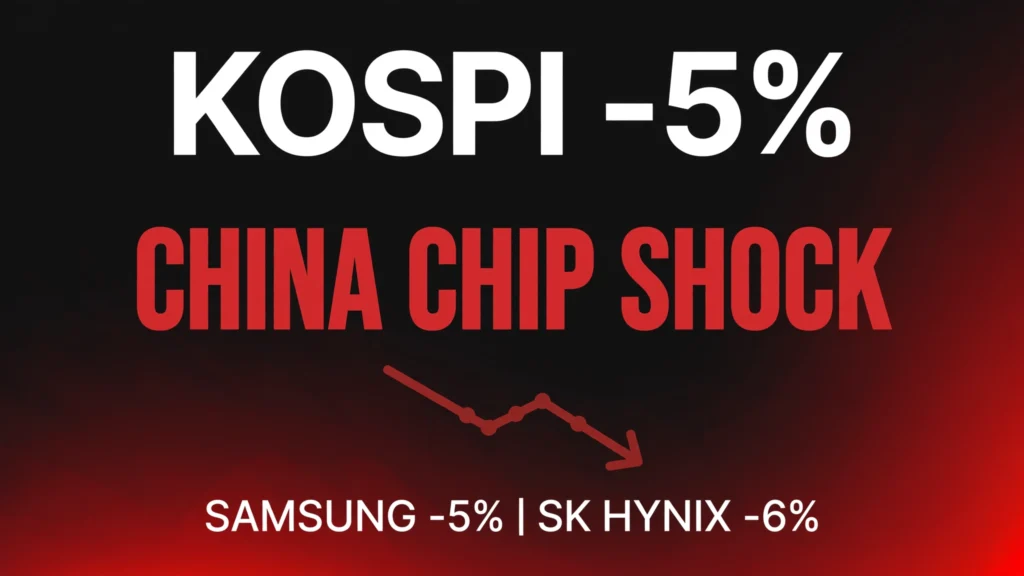
South Korea’s KOSPI shed nearly 5% on Tuesday, sliding to around 6,100 in its worst single-day drop in months. The trigger wasn’t a central bank surprise or a geopolitical shock — it was a product roadmap from a Chinese chipmaker most investors had never heard of.
ChangXin Memory Technologies (CXMT) announced over the weekend that it would ship next-generation server DRAM by the end of 2026, built on a denser 4F² chip architecture. Within hours of Seoul’s opening bell, Samsung Electronics had lost 5% of its market value. SK hynix fell 6%. Foreign investors dumped 2 trillion won of Korean equities. A circuit breaker halted program selling for the first time in two months.
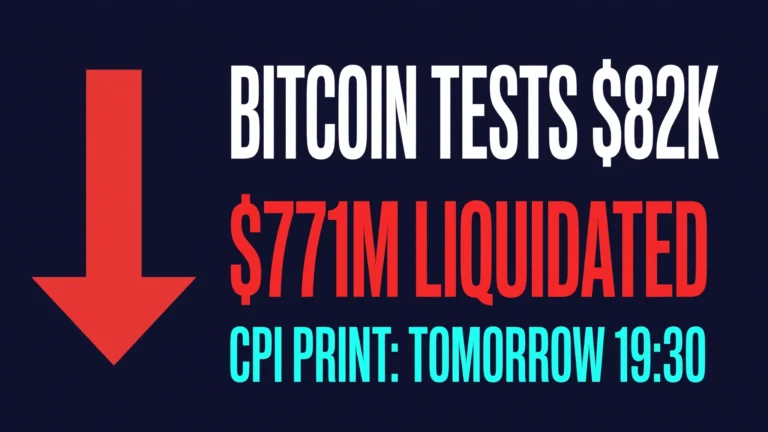
And by the time New York woke up, the contagion had crossed into crypto: $771 million in liquidations, Bitcoin below $82,000, Ethereum down 4.6%.
This is the story of how a single technology announcement in Hefei, China, cascaded through the world’s most concentrated stock market, across Asian equities, into US semiconductors, and finally into crypto leverage — and what the numbers say about each link in the chain.
CXMT’s Announcement: What Actually Happened
Let’s start with the facts, because the market reaction ran ahead of them.
CXMT, China’s largest DRAM manufacturer, disclosed that it had made significant progress on a next-generation 4F² memory cell architecture. According to TrendForce estimates cited across Korean financial media, the design could lift memory density by 30% to 50% compared to current designs. The company plans to ship server memory products built on this technology by the end of 2026.
Context matters. CXMT holds approximately 8% of global DRAM revenue — a meaningful player, but far behind Samsung (~40%) and SK hynix (~30%) combined. The company still faces significant yield challenges in high-bandwidth memory (HBM), the premium segment where AI accelerators source their memory. Its announcement targets conventional server DRAM, not the HBM that powers NVIDIA’s AI chips.
So why did the market react as if Samsung’s moat had been breached? Because server DRAM is where the margins are. It’s the high-value segment where Samsung and SK hynix generate disproportionate profits. Even a credible future competitor entering this space forces analysts to remodel long-term margin assumptions. Markets don’t wait for the silicon to ship — they price the competitive threat the moment it becomes credible.
The timeline is also critical: “by the end of 2026” is 14 months away. That’s an eternity in semiconductor cycles, but it’s within the forecasting horizon for institutional models. Fund managers running discounted cash flow models on Samsung had to decide Tuesday morning whether to haircut 2027–2028 memory margins. Enough of them decided yes.
Samsung and SK Hynix: Measuring the Damage
Market Telemetry: KOSPI sheds 5% to 6,100 amid tech sell-off and DRAM competition repricing.
The numbers from Tuesday’s session are stark.
Samsung Electronics (005930.KS) fell approximately 5% to 238,000 won, at one point touching 237,000 won intraday. For a company with a market capitalization in the hundreds of billions of dollars, a 5% single-day decline represents tens of billions in erased shareholder value. This extended Monday’s 4.4% decline, meaning Samsung has now lost roughly 9% in two sessions.
SK hynix (000660.KS) fared worse, dropping 5–6% to approximately 1.51 million won (intraday low: 1.507 million won). This was its fifth consecutive losing session, a remarkable streak for a company that reported record earnings just last week. The market is saying, in effect: your past quarter was excellent, but your future margins are now in question.
SK Square (402340.KS), the largest shareholder of SK hynix, fell approximately 8% to 907,500 won — amplifying the parent’s decline through the holding-company discount mechanism.
Samsung Electro-Mechanics dropped 6% to 1.398 million won, showing the selloff wasn’t limited to memory makers but extended across the semiconductor supply chain.
The concentration risk is the real story. Samsung Electronics and SK hynix together account for more than half of the KOSPI’s total market capitalization. When two stocks representing >50% of an index both fall 5–6% in a single session, the index has no choice but to follow. This isn’t a diversified market having a bad day — it’s a two-stock market repricing its core thesis.
The KOSPI Mechanics: Why 5% Matters
The KOSPI opened Tuesday down 3.10% at 6,186.08, already pricing in overnight weakness in US semiconductors. Losses widened through the morning: -4.03% to 6,126.65 by 9:15 AM, then -4.37% to 6,105.50, before stabilizing around 6,100 — a decline of roughly 5% from the previous close.
At 9:47:58 AM, the Korea Exchange triggered a sell-side sidecar — a five-minute suspension of program sell orders — after KOSPI 200 futures fell 5.08% to 955.02. A sidecar activates when futures drop 5% or more and stay there for at least one minute. This was the first sell-side sidecar in approximately two months (since August 19) and the first circuit breaker of any kind since August 20.
The sidecar is a speed bump, not a wall. It pauses algorithmic selling for five minutes to let human traders reassess. But its psychological impact exceeds its mechanical effect: when the exchange itself hits the brakes, it confirms to every trader watching that this is not a normal down day.
Zoom out and the picture darkens further. The KOSPI is now down approximately one-third from its June record high and trading below its 200-day moving average — the technical definition of a bear market trend. Monday’s session had already seen a 3.7% decline. The five-day drawdown now exceeds 10%. Yet the index remains up 44.89% for 2026, a reminder of how extraordinary the first-half rally was — and how much air is still in the trade.
The KOSDAQ, Korea’s tech-heavy secondary index, fell over 4% to 811.49, confirming the selloff wasn’t limited to large-cap memory makers.
Foreign Selling: Following the Money
If you want to know who’s driving a market move, follow the flows. On Tuesday, the answer was unambiguous: foreigners were selling, everyone else was catching the knife.
Foreign investors net sold approximately 2.07 trillion won (roughly $1.55 billion) on the main board. Domestic retail investors net bought 1.05 trillion won. Domestic institutions bought 598.7 billion won. Program trading showed net selling of 1.02 trillion won.
This is a classic foreign-led capitulation pattern. International fund managers, many running global technology mandates, looked at the CXMT news, looked at their Samsung overweight, and hit sell. Domestic retail, with a well-documented home bias and dip-buying tendency, absorbed the supply — a dynamic that has repeated through every Korean market stress episode.
The bigger number is the monthly trend: foreign investors have net sold more than $6 billion of KOSPI shares in October alone. That’s not a one-day reaction to CXMT — it’s a sustained exodus. The CXMT announcement was the catalyst for Tuesday’s flush, but the foreign selling pressure was already building on concerns about AI valuations, US rate policy, and geopolitical risk.
When $6 billion leaves a market in two weeks, single-day circuit breakers are a symptom, not the disease.
The Asian Contagion Map
Korea wasn’t alone. Tuesday’s risk-off wave washed across Asian equities with a clear pattern: the more tech-heavy the market, the deeper the decline.
Japan’s Nikkei 225 fell 2.6%, with semiconductor-adjacent names leading. SoftBank Group dropped 6.79% to 5,409 yen. Kioxia, the Japanese memory maker, tumbled 9.71% to 15,805 yen — a steeper decline than even SK hynix, reflecting Kioxia’s direct competitive overlap with CXMT in NAND and DRAM.
China’s ChiNext (the tech-heavy Shenzhen index) fell 3%. The CSI 300 lost 1.3%. The Shanghai Composite slipped 1.2%. The relatively modest Chinese declines are telling: the market where CXMT is listed treated the news as positive (a domestic champion gaining ground), while markets hosting CXMT’s competitors treated it as a threat.
This divergence is the cleanest natural experiment in Tuesday’s data. Same news, opposite reactions, perfectly predicted by competitive positioning. It confirms that the selloff was fundamentally about memory-chip competition dynamics, not a generic risk-off wave — at least at the epicenter.
But the ripples extended beyond semiconductors. Defense stocks, automakers, and battery makers all declined in Seoul (Hanwha Aerospace -3.7%, Hyundai Motor -5%), suggesting that once the initial chip-led selling started, broader de-risking took over.
The Semiconductor Supply Chain Under the Microscope
The overnight US session set the stage. The Philadelphia Semiconductor Index fell 2.6–2.7% to a three-week low. Micron Technology, the US memory maker most directly comparable to Samsung and SK hynix, dropped 3.9%. SanDisk fell 6%. NVIDIA and TSMC each lost 1.29%. Broadcom declined 1.88%.
This cross-Pacific weakness created a feedback loop: US chip stocks fell overnight on a combination of CXMT concerns (leaked early) and broader AI valuation anxiety. Asian markets opened lower on the US weakness, then fell further on the full CXMT announcement. US futures then weakened on the Asian selloff.
The memory subsector was the epicenter within semiconductors. Logic chip makers (NVIDIA, TSMC, Broadcom) declined 1–2% — a sympathy move. Memory makers (Micron -3.9%, Samsung -5%, SK hynix -6%, Kioxia -9.7%) declined 4–10% — a direct repricing. The market drew a sharp line between “AI compute” (still valued on growth) and “memory” (now valued on competitive risk).
This bifurcation matters for crypto investors watching the Nasdaq-crypto correlation. If the market continues to discriminate between AI-compute winners and memory losers, the tech-stock weakness may stay contained to semiconductors rather than spreading to the broader growth complex that crypto tends to follow.
From Chips to Coins: The Crypto Contagion Channel
Here’s where the story crosses into digital assets. The transmission mechanism from KOSPI to crypto isn’t direct — Bitcoin doesn’t care about DRAM pricing. It operates through three channels:
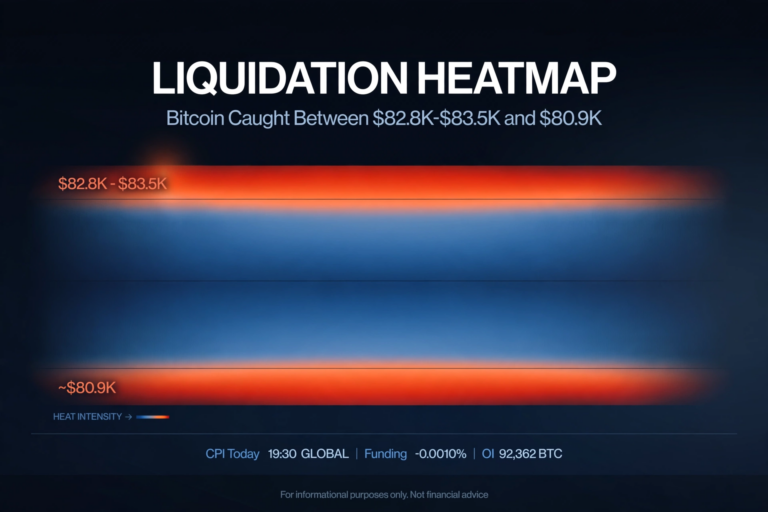
Channel 1: Risk sentiment. Crypto leverage is the most sentiment-sensitive positioning in global markets. When Asia’s most tech-heavy major market drops 5% in a day, leveraged crypto traders don’t wait to analyze the fundamentals — they de-risk. Tuesday’s $771 million in crypto liquidations (89% longs, 172,662 traders) included a significant Asian-hours component. The KOSPI selloff was the emotional trigger for traders already nervous about Wednesday’s CPI.
Channel 2: The dollar-yen-won complex. Risk-off episodes in Asian equities typically strengthen the dollar against regional currencies. A stronger dollar is mechanically bearish for Bitcoin, which trades as a dollar-denominated risk asset. The Korean won weakened against the dollar on Tuesday, part of a broader Asian FX softness that added marginal pressure to crypto.
Channel 3: ETF flow psychology. US spot Bitcoin ETFs recorded $681 million in net outflows last week — the worst since June. When traditional finance investors see semiconductor carnage in Asia, they’re less likely to allocate fresh capital to Bitcoin ETFs. The institutional bid that supported crypto through the summer is pausing, and equity market stress extends the pause.
The numbers confirm the contagion: Bitcoin fell 2.8% to $81,382. Ethereum dropped 4.6% to $2,425 (with $169.2M in liquidations, exceeding BTC’s $160.5M). Solana fell 7.5%. XRP slid 6.4%. The pattern — higher beta, deeper decline — is textbook risk-off behavior.
Tom Lee of Fundstrat noted Tuesday that the Korean stock market plunge may spill over to crypto, with ETH under particular short-term pressure. Given ETH’s higher liquidation total relative to BTC, the data supports his read: altcoin leverage was the real excess, and it’s still unwinding.
The AI Valuation Question
Beneath the CXMT-specific shock lies a deeper anxiety that Tuesday’s price action exposed: are AI valuations sustainable?
Broadcom CEO Hock Tan said this week that many AI investors “have no clue what they are investing in,” adding that financing may be a bigger constraint than chip shortages. Coming from the CEO of one of the AI infrastructure buildout’s largest beneficiaries, this is a remarkable admission. Tan is essentially saying: the market is pricing AI as if capital were infinite, but the actual bottleneck is who pays for the data centers.
The numbers support skepticism. The KOSPI’s 44.89% year-to-date gain (even after the correction) was built substantially on AI-memory optimism — the thesis that Samsung and SK hynix would capture outsized margins from HBM demand. CXMT’s announcement doesn’t threaten HBM directly, but it forces the market to question the durability of *any* memory margin premium.
If memory margins compress, the AI infrastructure investment thesis weakens at the margin. If the investment thesis weakens, the financing dries up. If financing dries up, Tan’s warning becomes self-fulfilling. This is the reflexive loop that has markets nervous — and it’s why a single DRAM announcement managed to erase tens of billions in market value.
For crypto, the parallel is uncomfortable. Digital assets have ridden the same “risk-on, growth-at-any-price” wave that lifted AI stocks. If that wave is cresting — if financing constraints start binding across the risk complex — crypto’s leverage-dependent rallies face the same reassessment.
What Comes Next
Three variables will determine whether Tuesday was a buying opportunity or the start of something worse:
1. CXMT’s follow-through. The market priced a credible threat. If CXMT’s year-end server DRAM shipments slip, or if yields disappoint, the competitive fear premium comes out of Samsung and SK hynix just as fast as it went in. Watch for supply-chain checks and CXMT’s next technical disclosure.
2. Wednesday’s US CPI (19:30 VN). Consensus is 3.7% year-over-year. A cool print below 3.6% would trigger a broad risk-on rally that lifts both KOSPI and crypto — the rising tide that covers multiple sins. A hot print above 3.8% would compound Tuesday’s damage across every risk asset. The CPI binary now overlays the CXMT shock, creating a two-factor risk model for Wednesday.
3. Foreign flow reversal. The $6 billion October exodus from KOSPI needs to stabilize. If foreign selling continues at Tuesday’s pace (~$1.5B/day), the technical damage compounds regardless of fundamentals. Watch daily foreign net-buy figures from the Korea Exchange — the first green print will mark the potential turning point.
For crypto specifically, the key insight from Tuesday is about leverage, not fundamentals. The blockchain didn’t break. Exchange inflows didn’t spike to panic levels. Whale wallets stayed stable. What broke was leveraged positioning built on the assumption that risk assets only go up into CPI.
That positioning has now been partially cleaned — $771 million worth. Whether the market rebuilds the same leverage before Wednesday’s print, or approaches it with appropriate caution, will determine whether we get a second cascade or a squeeze.
The chip that shook Seoul is a reminder: in interconnected markets, the catalyst doesn’t have to make sense for your asset class. It just has to scare enough leveraged traders at the same time.
⚡ Track Live Derivatives Telemetry on CoinXSight
Monitor real-time liquidation cascades, cumulative volume delta (CVD), and orderbook depth absorption directly on the CoinXSight Quant Terminal.
Disclaimer: This article is for educational and informational purposes only and does not constitute financial, investment, or trading advice. Digital asset markets involve significant volatility and capital risk. Always conduct independent research before making financial decisions.
Comprehensive institutional valuation model for XRP (2026–2030): RLUSD stablecoin utility, ETF adoption catalysts, and multi-tier price scenarios from .40 to…